As of 2026-11-12 18:34 UTC.
The travelling exhibition Living Hands: Heritage and Design in Dialogue opened at the Bethlehem Peace Center on November 10, bringing a collaboration between Palestinian craftspeople and designers to a city where declining tourism has hit olivewood carving and mother-of-pearl work. UNESCO announced the opening the following day.[1]
Organised by UNESCO with European Union funding, the exhibition follows an earlier stop in Al-Bireh. Its central proposition is practical: inherited techniques can find new uses in household objects, furniture and clothing, giving another generation reasons to learn them. The work ranges across glassblowing, pottery, olivewood carving, mother-of-pearl inlay, loom weaving and reed weaving.[2]
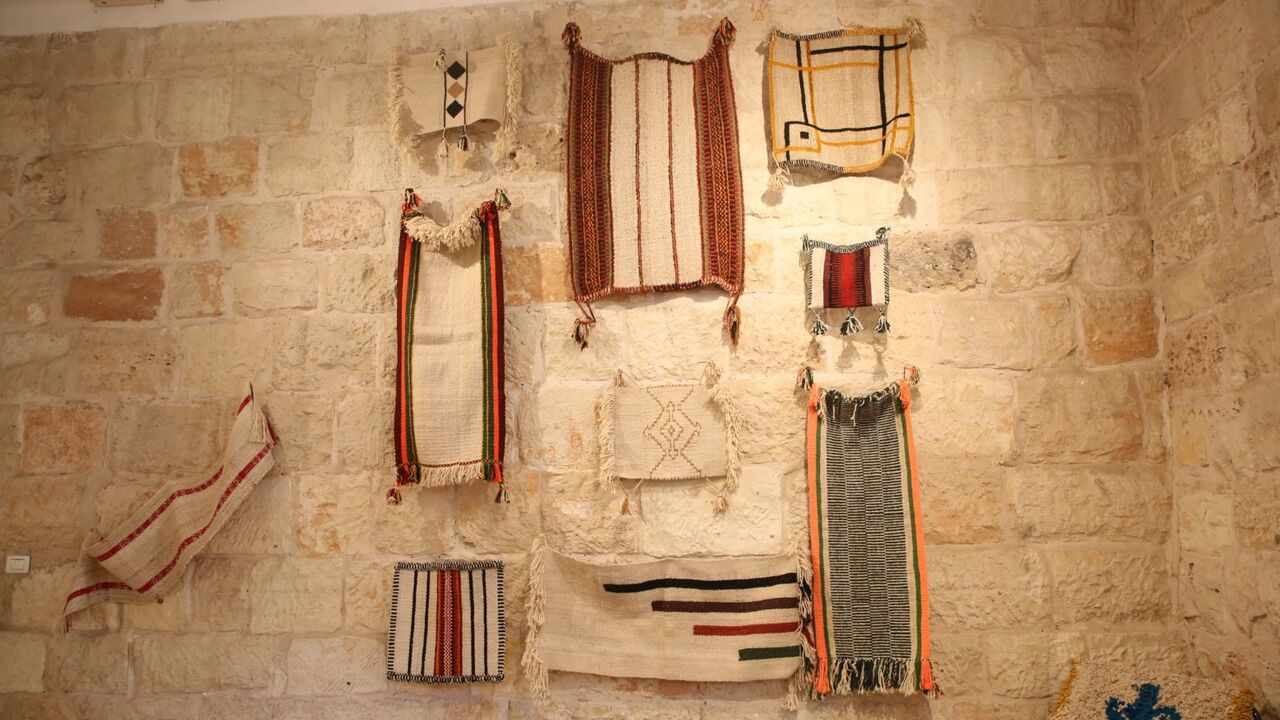
From a harvest basket to a lamp
Reporting from the September opening, the Palestinian newspaper Al-Quds described what this change of use could look like. Artisan Fathiya Jouda said her association combined olive shoots, traditionally woven into baskets for carrying agricultural produce, with olivewood to make lighting, tables and vases. The familiar material acquired a different place in the home.[3]
Designer Dana Idris described another collaboration with glass artisan and designer Nawal Amer: four garments incorporating blown glass, exploring the Palestinian bride and the fragility of her circumstances.[3]
The distinction gives the exhibition some of its interest. A lamp can suggest an everyday market; a garment incorporating glass can investigate an idea through materials. Both create occasions for a designer to work with a skilled maker, but they need not follow the same route into production. Treating every exhibit as a ready-to-sell product would obscure what the collaboration actually produced.
UNESCO's September account explicitly described objects, prototypes and design concepts. It also identified the educational connection: CREATE, implemented by Birzeit University's Faculty of Art, Music and Design, brought students and designers together with master artisans through workshops, talks and field training.[2]
The support behind the display
The exhibition sits at the end of a longer sequence of research, documentation and funded development. These are the principal documented milestones:
- April 8, 2026: UNESCO announced 20 grant recipients, comprising 15 collectives and five associations. Grants were capped at US$8,000 for collectives and US$10,000 for associations.[4]
- September 15, 2026: UNESCO's Al-Bireh opening account reported participation by 24 artisans, 43 designers and seven associations across 27 projects. These figures cover the wider programme.[2]
- November 10, 2026: the Bethlehem exhibition opened, according to UNESCO's subsequent report. Earlier publicity had listed November 5; the newer account establishes the actual opening date.[1][2]
The grant announcement also shows that collaboration sometimes crossed craft boundaries. Its named recipients included partnerships combining mother-of-pearl with olivewood, and bamboo with pottery. Funding was intended to help develop and produce the proposed work, alongside opportunities to reach audiences.[4]
A separate European Training Foundation review places the initiative among Palestine's education and employment programmes. Its description links improving young professionals' and students' employability with documenting traditional knowledge. The exhibition therefore belongs in a discussion about access to work as well as cultural preservation.[5]
The customer after the opening
Bethlehem already has organisations working on the connection between making and selling. Pro Terra Sancta says its Dar Al-Majus bazaar, active since 2022, works with around thirty suppliers, including local artisans and associations. Its range includes olivewood, ceramics, embroidered textiles and mother-of-pearl objects. It also describes helping suppliers improve products and manage their businesses.[6]
That is a separate initiative, not evidence of a sales partnership with Living Hands. It illustrates the continuing work that a temporary exhibition cannot perform by itself: keeping products available, maintaining relationships with makers and helping a small operation serve customers. Its account describes its own activities.[6]
The available exhibition reports document participation and completed work. They provide no published before-and-after income comparison or evidence of sustained employment. A plausible benefit is therefore still a proposition to test. Continued orders and continuing apprenticeships would tell readers more about durability than an opening's attendance alone.
What to follow while the exhibition is open
UNESCO lists the Bethlehem exhibition through November 25, Monday to Saturday, 9 a.m. to 3 p.m.[1] For buyers, educators and reporters, three conditional outcomes deserve attention:
- Base case: follow-up records confirm completed designs and training, but provide no evidence of repeat orders. The documented outcome remains a collaboration whose lasting economic value is unsettled.
- Upside: repeat orders and continuing paid training emerge after the show, supporting a stronger claim that the collaborations can sustain livelihoods.
- Downside: production or training stops when temporary support ends. That would undermine claims of durable revival even if the exhibition attracted interest.
A short follow-up checklist makes those distinctions usable:
- Within 24 hours: confirm current opening arrangements with the venue before planning a visit; a revised notice supersedes the published schedule.
- Within seven days: ask which displayed pieces are available to order, who makes them and whether production can be repeated.
- Within 30 days: seek evidence of fulfilled orders and continuing training after the scheduled closing. Without it, describe the exhibition as a documented collaboration, not an established employment success.
These are suggested reporting windows, not official project deadlines. The next chapter will be written in the workshops: whether a new object brings enough continuing work for another person to learn how it is made.
Sources
- UNESCO, “Living Hands arrives in Bethlehem: artisans and designers reimagine six endangered Palestinian crafts,” November 11, 2026; opening, tourism context, visitor schedule.
- UNESCO, “Living Hands: Heritage and Design in Dialogue opens in Al-Bireh Cultural Centre, Ramallah,” September 15, 2026, updated September 16; crafts, programme participation, CREATE and the earlier itinerary.
- Al-Quds, “Immortal hands… a dialogue between heritage and design,” September 16, 2026; Arabic reporting, participant interviews and photograph from the Al-Bireh opening; title translated into English.
- UNESCO, “Bridging Heritage and Creativity: UNESCO Supports 20 Palestinian Endangered Craft Initiatives,” April 8, 2026; grant recipients, funding ceilings and craft partnerships.
- European Training Foundation, Key Policy Developments in Education, Training and Employment: Palestine 2024, published 2025, p. 25; project objectives and implementing organisation, PDF.
- Pro Terra Sancta, “The Dar Al-Majus Bazaar”; the organisation's account of its separate Bethlehem retail and supplier-support initiative.