As of 2026-11-11 07:35 UTC.
A restored painting shows the visitor a finished surface. The file behind it can preserve something less visible: the studies made before treatment, photographs of the work and the reasoning behind an intervention. Venice is preparing to make much more of that record accessible from a distance.
UNESCO and Fondazione Giorgio Cini have announced a two-year project covering approximately 110,000 documents, 6,000 photographs and audiovisual material associated with safeguarding Venice. Publicised around the sixtieth anniversary of the flood of November 4, 1966, the initiative will release material gradually. Those large numbers describe the collection to be worked on, rather than a count of files already available to download.[1]
The change is easier to understand by looking back two years. In 2024, UNESCO put descriptions of restoration records online. The new project promises access to the material those descriptions help readers find.[2]
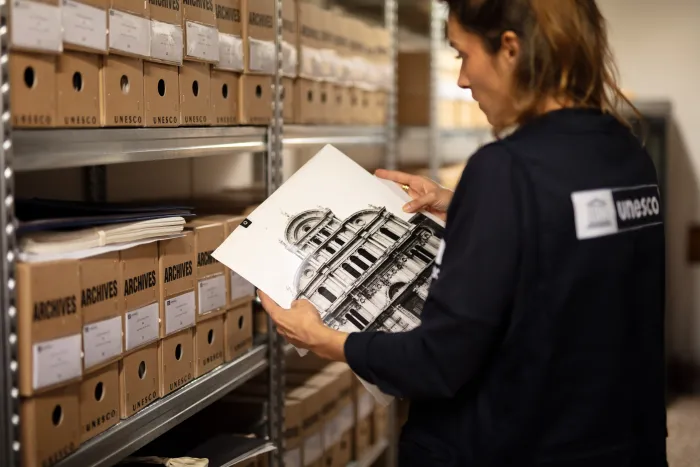
Finding a file and reading it are different steps
UNESCO’s October 2024 announcement described an inventory available through AtoM, its archival catalogue. The descriptions, in English and Italian, helped researchers identify relevant files before consulting the physical collection. Digitising the records themselves was presented as the next stage, for which partners and funding were still being sought.[2]
A catalogue entry can establish that a restoration file exists and help a researcher decide whether to request it. Reading the underlying study allows a different kind of inquiry: what was observed, what treatment was proposed and what evidence supported the choice. The distinction is much like finding a book in a library catalogue and opening it at the passage you need.
That makes the present announcement a change in the depth of access. It also explains why an older headline saying an archive is “online” need not contradict a new digitisation project. Descriptions and digital copies answer different questions.
The useful record comes before the finished picture
The 2024 inventory account lists surveys made before restoration, photographic campaigns, scientific investigations and records of interventions. These are the kinds of material that can connect an attractive final photograph to the physical problems a conservator faced.[2]
Consider a hypothetical researcher comparing two photographs of a painting. A change in appearance might prompt questions about treatment, lighting or the photograph itself. A dated technical report could help distinguish those possibilities. This is an example of how the material might be used, not a finding about a particular Venetian restoration.
The new project also encompasses correspondence and administrative records. UNESCO’s project description stresses the people, institutions and decisions behind conservation.[5] Read together, those records could help explain how a proposed intervention became an authorised and funded piece of work. That is a richer historical question than simply establishing that a painting was restored.
It remains an institutional record. A researcher interested in residents’ experiences would still need to ask whose accounts the files contain and whose perspectives require other sources. Easier access expands the evidence available; it does not make any single collection a complete history of the city.
From boxes to usable copies
ANSA reported on October 31 that the archival collection had been transferred from UNESCO’s Venice office to the Cini Foundation’s Digital Centre for the work.[3] Researchers arranging a visit should therefore seek current consultation instructions rather than rely on the location given in the 2024 announcement.
The centre’s technology catalogue helps explain why digitisation takes more than one kind of machine. It describes a V-shaped scanner that supports bound volumes without forcing them flat, a vacuum table for large or folded documents, and a rotary system that photographs both sides of loose material. These are documented laboratory capabilities; the sources reviewed do not establish which machines will handle each part of the UNESCO collection.[4]
The variety matters because a book opening, a large sheet and the reverse of a photograph can each hold evidence that an unsuitable capture process would miss. A digital image is useful only if it preserves what the reader needs to examine.
There is also a skills component. UNESCO’s 2026–2028 project plan provides for three annual scholarships through which students and young researchers will work with specialists. It combines digitisation with professional archival practice and long-term digital preservation.[5] The work is intended to leave trained people as well as files.
What readers can reasonably expect next
The publication plan has two routes: digitised documentation will progressively enter AtoM, while photographs and audiovisual material will become available through UNESCO’s Archives platform.[1] The announcement does not provide an item-by-item release calendar or a verified total of material already published.
The evidence has distinct dates and limits:
- October 28, 2024 — UNESCO: confirms publication of catalogue descriptions; it is evidence of the earlier inventory stage.[2]
- October 31, 2026 — ANSA: reports the transfer and project launch; it does not measure completed digitisation.[3]
- November 4, 2026 — UNESCO project plan: sets out the 2026–2028 programme; its stated outcomes are commitments, not a completion report.[5]
For researchers, teachers and heritage organisations, the base case is a growing collection that supports some questions before others. An upside trigger would be a release containing connected studies, correspondence and photographs from the same restoration, allowing readers to follow the work across different records. A downside trigger would be an essential file remaining unavailable when a research or exhibition deadline arrives. These are planning scenarios, not reported outcomes.
A practical checklist follows:
- Next 24 hours: identify the restoration or research question and distinguish a catalogue description from a viewable document.
- Next seven days: confirm access to the specific files needed before committing to travel or an exhibition schedule.
- Next 30 days: review new releases and record which evidence has become available and which gaps remain.
A missing digital copy invalidates a plan to complete that part of the research remotely. It does not establish that the physical record is missing. Keeping that distinction clear will help readers use the growing archive without asking it to answer questions it cannot yet support.
Sources
- UNESCO, “60 years since the ‘Aqua Granda’,” November 4, 2026, updated November 5 — collection scope, staged publication and photograph credit.
- UNESCO, “UNESCO Archives in Venice: a gateway to cultural heritage,” October 28, 2024 — the earlier inventory, bilingual descriptions and types of restoration documentation.
- ANSA, report on UNESCO and Fondazione Cini’s Venice archive project, displayed October 31, 2026 — transfer to the Digital Centre and gradual access; in Italian.
- ARCHiVe, “Technologies,” accessed November 11, 2026 — equipment for bound volumes, large documents and two-sided capture; general capabilities, not a project-specific equipment list.
- UNESCO, “Preserving Documentary Heritage, Sharing History,” November 4, 2026 — 2026–2028 project scope, archival records, preservation and scholarships.