As of 2026-04-25 05:04 UTC, the Potomac Interceptor story has shifted out of the emergency phase and into the liability phase. On April 20, the Justice Department, on EPA's behalf, filed a federal Clean Water Act complaint against DC Water and the District of Columbia over the January 19 collapse of the Potomac Interceptor in Montgomery County, Maryland.[1][2] Maryland filed its own complaint the same day, seeking state-law penalties and recovery of monitoring costs tied to the sewage release into the Potomac River.[3][5]
That legal turn matters because the core question is now narrower and more consequential than the January emergency itself. The first phase asked whether crews could stop the overflow, stabilize the bypass, and restore flow through the damaged line. The current phase asks what the maintenance record looked like before the break, whether the improvised mitigation was adequate after the break, and what courts may require DC Water to do next across a system that carries about 60 million gallons of wastewater per day toward the Blue Plains Advanced Wastewater Treatment Plant.[1][2]
DC Water does have a live response. It says the overflow to the Potomac was fully contained within 21 days, the damaged section was repaired in 55 days, flow was returned to the interceptor on March 14, and the utility is now accelerating rehabilitation of more than 2,700 linear feet of pipe in the same area.[5][6][8] So the question is no longer whether anything was done. It is whether what was done before and after the collapse will satisfy federal and Maryland judges examining a much longer maintenance chain.
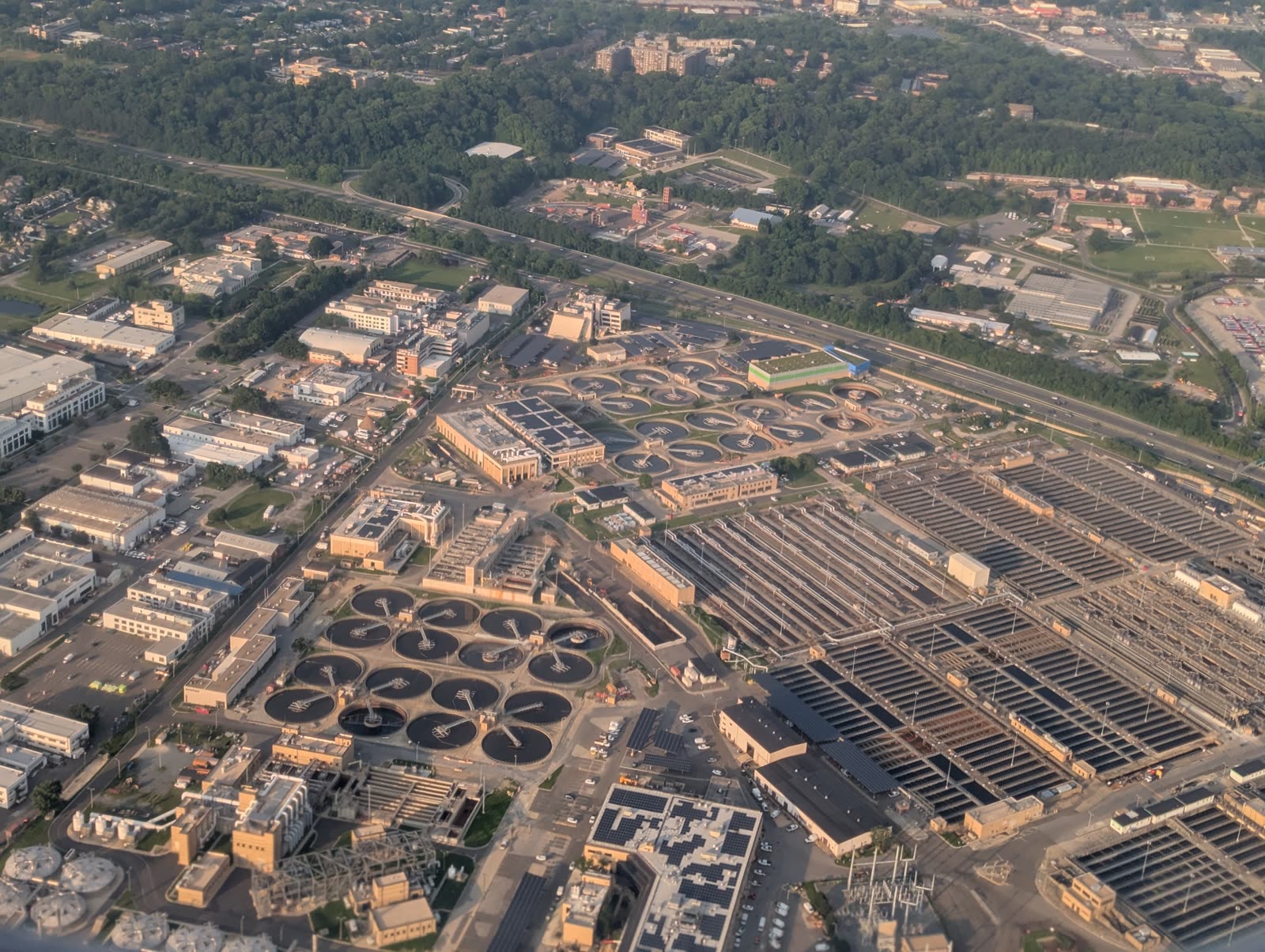
Image context: the cover uses a 2025 aerial photograph of Blue Plains because this file is fundamentally about physical wastewater infrastructure. The legal fight sits on top of a concrete regional system of pipes, pumping, and treatment capacity, not on a symbolic environmental backdrop.[7]
Facts on the file
| Item | What is known | Confidence note |
|---|---|---|
| Federal case | DOJ and EPA filed a federal complaint on April 20-21, 2026 seeking civil penalties, rehabilitation projects, pollutant mitigation work, and an enhanced operations and maintenance plan.[1][2] | High; described in federal press releases. |
| State case | Maryland separately sued DC Water in Montgomery County, alleging unauthorized discharges and seeking penalties and reimbursement of state monitoring costs.[3][5] | High; described in the Maryland complaint and AP's report. |
| Spill scale | Federal releases say the collapse caused more than 200 million gallons of untreated sewage to reach the Potomac; DC Water's February findings estimated about 243 million gallons; AP reported 244 million gallons from the litigation file.[1][4][5] | High that the event exceeded 200 million gallons; exact totals vary slightly by source rounding and methodology. |
| System role | The Potomac Interceptor carries roughly 60 million gallons per day from parts of Virginia, Maryland, and D.C. toward Blue Plains.[1][2] | High; federal releases state this directly. |
| Repair status | DC Water says emergency repairs were completed and flow was restored on March 14, 2026 after a 55-day response effort.[6] | High for the utility's stated repair milestone. |
| Environmental status | Maryland's complaint says contaminated soil remained near the river as of April 14 and that state sampling found elevated E. coli during the earlier response period; DC Water's April 21 update says recent daily testing shows E. coli within the typical recreational range, with normal fluctuations.[3][8] | High that both statements were made; the key distinction is timing. |
Why the legal turn matters more than the emergency chronology
The practical emergency is easier to summarize. A large sewer line collapsed, wastewater was routed around the break through the C&O Canal, pumps clogged at points during that bypass, federal emergency assistance arrived in February, and flow was eventually returned to the interceptor in mid-March.[1][2][6] Those are the operational facts.
The lawsuits do something different: they convert those facts into a maintenance-and-remedy record. The federal complaint seeks not only money penalties, but sewer assessment and rehabilitation projects plus an Enhanced Operations and Maintenance Plan for all sewer lines.[1] Maryland's case adds another layer by focusing on unauthorized discharges into state waters and reimbursement for environmental health monitoring and testing costs.[3] In other words, this is no longer only a cleanup story. It is becoming a precedent-setting question about how much neglected wastewater infrastructure can cost once failure leaves a long paper trail.
That is the strongest reason not to read the April filings as routine post-incident paperwork. If either court pushes broad operational remedies rather than only penalties, utilities around the region will have a fresh example of what happens when corrosion warnings, emergency bypass measures, and downstream contamination all end up in the same record.[1][3][5]
What the competing records actually say
The most severe allegation comes through the litigation language itself. AP reported that the federal filing says DC Water had known for at least eight years about "severe corrosion requiring immediate repair" before the damaged section catastrophically failed.[5] The federal releases also say the bypass through the canal was inadequate, and note an additional 500,000-gallon sewage discharge on February 8 when multiple pumps had to be shut down after clogging with rags and wipes.[1]
Maryland's complaint sharpens the environmental side of the file. It says contaminated soil remained in the vicinity of the Potomac as of April 14, and that state monitoring showed E. coli levels above EPA's recreational benchmark through at least February 17, prompting public-health advisories and a shellfish advisory earlier in the response.[3] Those details matter because they frame the event not just as a momentary overflow, but as a prolonged contamination and remediation problem with consequences for public access and monitoring costs.
DC Water's counter-record is not that the collapse was trivial. It is that the utility moved quickly after the break and is already deep into the repair and rehabilitation sequence. AP says DC Water acknowledged the pipe was deteriorating and said rehabilitation work on a section about a quarter-mile from the break had begun in September and was recently completed.[5] Its March 14 release says all discharges to the Potomac were stopped within 21 days, that emergency repairs were completed in 55 days, and that the next phase is an accelerated rehabilitation of more than 2,700 linear feet of interceptor pipe.[6] Its April 21 update adds that crews had already excavated sections for long-term work, begun tree removal needed for a bypass chamber, and pushed C&O Canal soil removal to 55% complete while continuing daily water testing.[8]
The clean reading is therefore a limited one. The federal and Maryland cases make serious allegations. DC Water has tangible repair progress to point to. Neither of those facts cancels the other out. The courts will be sorting a maintenance-history dispute while the utility is still physically rebuilding the line.
What to watch now
The first watch item is the remedy question. If the federal case begins moving toward a system-wide operations and maintenance plan rather than a narrow spill settlement, the consequence will extend well beyond the failed segment near Lock 12.[1]
The second is whether current rehabilitation progress keeps pace with the legal narrative. DC Water's April 21 update is meant to show forward motion: excavation, canal cleanup, tree removal, and preparation for slip-lining work.[8] If that progress slows, the lawsuits look stronger. If it continues steadily, DC Water gets a better argument that the utility is already fixing the underlying exposure.
The third is public-health visibility. Maryland's complaint preserves the record of elevated E. coli and lingering contaminated soils during the response window.[3] DC Water's current updates emphasize that more recent water-quality readings are within typical recreational ranges.[8] Readers should treat those statements as different slices of time, not as direct contradictions.
The narrow conclusion is the useful one. The Potomac Interceptor rupture is no longer only a January infrastructure failure. It is now a live legal file about notice, maintenance, mitigation, and remedy. The emergency phase proved the line could be put back into service. The next phase will decide what the system owes because it failed in the first place.[1][3][5][8]
Sources
- U.S. Department of Justice, "Justice Department Files Clean Water Act Complaint Against DC Water for Potomac Interceptor Failure" (April 20, 2026).
- U.S. Environmental Protection Agency, "United States Files Complaint Against DC Water in Response to Potomac Interceptor Collapse" (April 21, 2026).
- State of Maryland, Complaint, Maryland Department of the Environment et al. v. District of Columbia Water and Sewer Authority (filed April 20, 2026).
- DC Water, "DC Water Releases Key Findings on Extent of Sewer Overflow and Potomac River Impact" (February 6, 2026).
- Gary Fields, "Justice Department files complaint against Washington and its sewage authority for massive spill." AP News, April 20, 2026.
- DC Water, "Emergency Repairs Completed: Flow Restored to Potomac Interceptor" (March 14, 2026).
- Wikimedia Commons, "File:Blue Plains Advanced Wastewater Treatment Plant aerial view, 2025.jpg" (cover image source).
- DC Water, "Long-Term Rehabilitation Work on Potomac Interceptor Continues in Preparation for Construction" (April 21, 2026).