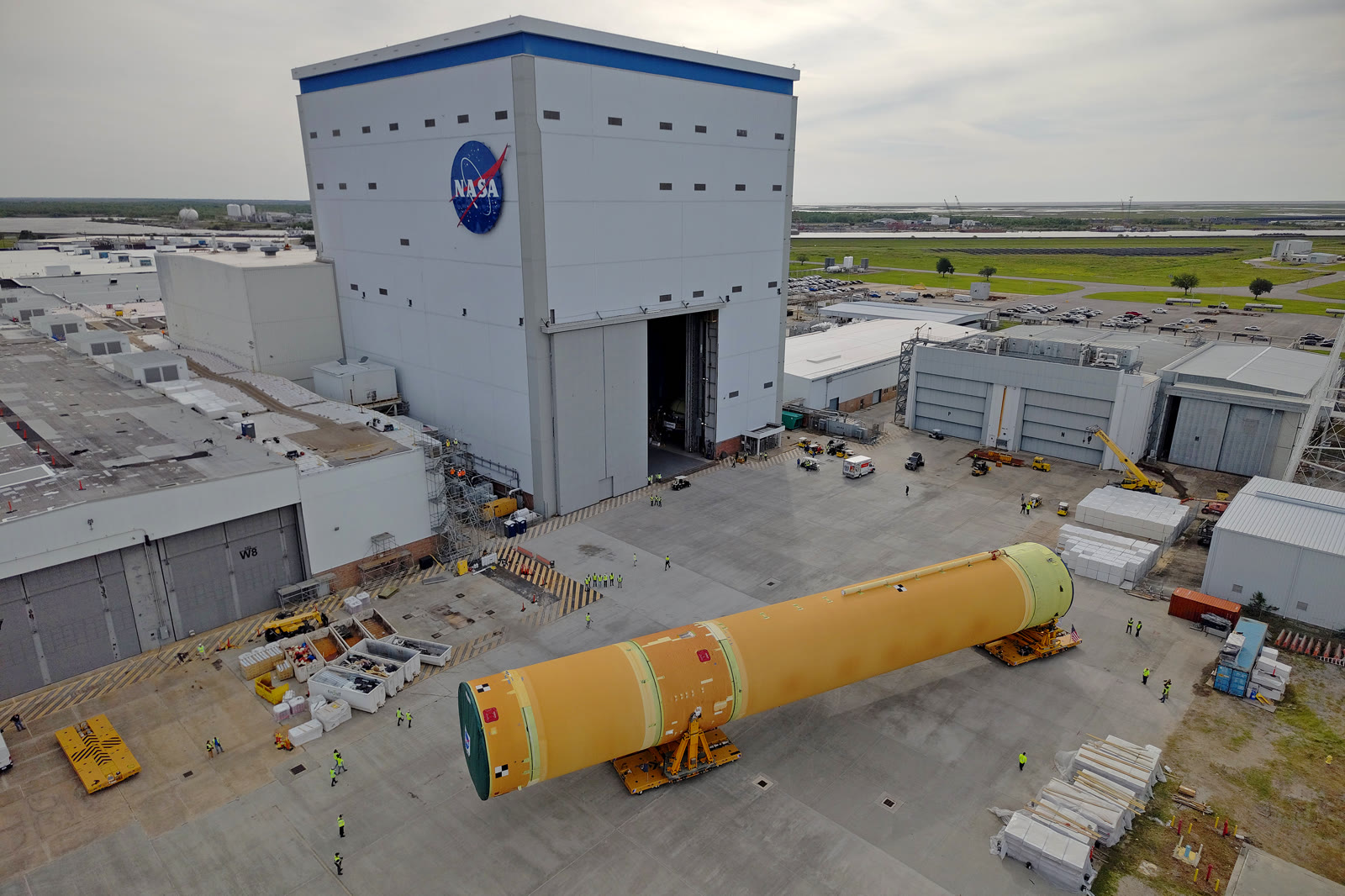
As of 2026-04-25 04:33 UTC, the visible news is straightforward. NASA rolled the top four-fifths of the Artemis III Space Launch System core stage out of Michoud Assembly Facility in New Orleans on April 20, loaded it onto the Pegasus barge, and sent it toward Kennedy Space Center for final outfitting and vertical integration.[1]
The more useful reading sits one layer deeper. This shipment is the first real public test of whether NASA can turn Artemis from a sequence of individually stressed launch campaigns into something closer to a staggered production system. By the time the top four-fifths left Louisiana, the Artemis III engine section and boat-tail had already been sitting inside Kennedy's Vehicle Assembly Building since mid-2025, waiting for the rest of the stage to arrive.[2][4] That means the hardware story is no longer "build it all in one place, then move it." The agency is now trying to make New Orleans and Florida work in parallel.
That shift matters because NASA's February architecture reset raised the program's ambition at the same time it raised the execution bar. The agency said it would standardize the SLS configuration, add a new mission in 2027, and push toward annual lunar missions thereafter.[5] Hardware has to absorb that promise. If Artemis remains a one-off, custom-timed assembly effort, the cadence language stays rhetorical. If parallel production works, the rollout becomes the first proof that NASA is finally building to a rhythm rather than only to a date.
Image context: the cover uses NASA's rollout photograph because the critical signal in this story is physical movement inside the production chain. A barge-loaded core stage is the most concrete evidence available that Kennedy-based parallel integration has moved from planning language into real operations.[1]
Fast facts
- What moved: NASA shipped the top four-fifths of the Artemis III core stage from Michoud to Kennedy on April 20.[1]
- What was already in Florida: the Artemis III engine section and boat-tail moved into Kennedy's Vehicle Assembly Building in late July 2025 for processing and integration.[2][4]
- What still has to arrive: the four RS-25 engines are scheduled to ship from Stennis to Kennedy no later than July 2026.[2]
- Why the process changed: beginning with Artemis III, NASA moved engine-section outfitting and integration work to Kennedy to streamline manufacturing and allow simultaneous work on multiple core stages.[4]
- What NASA says about cadence: NASA's March architecture update says the agency added a mid-2027 low-Earth-orbit demonstration mission, is targeting the first lunar landing in 2028, and wants about one lunar mission per year thereafter.[5]
- What remains in motion: NASA's April 20 rollout release still describes Artemis III as a 2027 crewed lunar landing mission, even though the same release also describes a rendezvous-and-docking test profile that March materials assign to the new 2027 demonstration mission and link to an Artemis IV landing in 2028.[1][5]
Why this rollout matters more than the photo
NASA's August 2025 Kennedy update quietly explained the deeper industrial change. For Artemis I and Artemis II, the SLS core stage was manufactured entirely at Michoud and then transferred to Kennedy for later integration. Starting with Artemis III, NASA shifted engine-section internal outfitting and its integration with the rest of the stage to Kennedy in order to speed production and allow overlapping work on more than one core stage at a time.[4]
The April 20 rollout is the point where that restructuring becomes testable. The top four-fifths are no longer just a piece of large rocket hardware on a barge. They are the missing section in a two-site workflow: tanks and forward structures from Louisiana, engine section and later stacking activity in Florida.[1][4] If that workflow stays clean, NASA gets a real shot at reducing idle time between missions. If it does not, the program keeps absorbing delay in exactly the part of the chain the redesign was meant to fix.
This is also why the move matters more than ceremonial language about "progress toward the Moon." NASA has used that kind of phrasing for years. The stronger signal is operational: a split-production plan has now reached the stage where logistics, integration handoffs, and schedule discipline can be observed directly.[1][4][5]
The real signal is whether NASA can compress the gap after Artemis II
The Artemis II flight itself gave NASA some grounds for confidence. In its initial post-flight assessment, the agency said the SLS rocket met mission objectives, placed Orion where it needed to be, and left the pad and mobile launcher with only limited damage after launch.[3] That is the encouraging side of the ledger.
The other side is that post-flight work is still live. NASA says teams are investigating the urine vent line issue seen during Artemis II and will identify corrective action for Artemis III.[3] That problem is tied to Orion rather than the core-stage rollout, but schedule risk does not care which subsystem creates it. A program that wants tighter mission spacing needs hardware improvements and post-flight fixes to move together, not serially.
That is where the rollout becomes a cadence test. NASA's architecture update openly says the agency wants to avoid long gaps and is reorganizing the transportation stack to do it.[5] AP summarized the same strategic point in February: the old pattern of multi-year pauses between flights had become unacceptable to the new leadership, which wanted a more methodical sequence of demonstrations before the next landing attempt.[6] The barge move from Michoud to Kennedy is therefore not a side story. It is one of the places where NASA has to prove that shorter gaps can be engineered, not merely announced.
NASA's public mission language is still catching up with the hardware
The most interesting tension in the April 20 release is not the photo. It is the wording. NASA calls the shipment key progress toward the agency's "first crewed lunar landing mission" in 2027, then later says next year's Artemis III mission will launch astronauts to Earth orbit to test rendezvous and docking capabilities needed for Artemis IV astronauts to land on the Moon in 2028.[1]
March's longer architecture explainer is cleaner. It says Artemis III is the new mid-2027 low-Earth-orbit demonstration mission, Artemis IV is the first lunar landing targeted for early 2028, and Artemis V is another surface mission later in 2028 using the standardized SLS configuration.[5] That sequence is coherent. The April rollout release is not fully aligned with it.
My inference from the two documents is that the hardware plan is advancing faster than NASA's public-facing mission nomenclature has stabilized. That does not mean the rollout is less real. It means outsiders should read current Artemis communications carefully: the production chain may be ahead of the messaging cleanup, and a mission name on one page does not automatically settle the exact manifest slot in another.[1][5]
What to watch next
The first watch item is arrival and mating work at Kennedy. The engine section is already there; once the shipped hardware joins it, the parallel-production thesis becomes much easier to judge in practical schedule terms.[1][2][4]
The second is the RS-25 delivery window. NASA's April 13 advisory says those engines are due in Florida no later than July 2026.[2] If that date moves, the cadence story weakens quickly because the engine handoff is part of the very bottleneck the redesign was supposed to relieve.
The third is whether NASA cleans up the manifest language. A program trying to sell annualized lunar cadence cannot afford fuzzy public descriptions of which numbered mission is the docking rehearsal and which one is the first landing under the revised plan.[1][5]
The narrow conclusion is the right one. As of April 25, 2026, Artemis III's core-stage rollout is real progress, but its value lies less in the spectacle than in the production logic beneath it. The shipment shows NASA's two-site assembly strategy has moved into execution. The next question is whether that strategy can actually hold the schedule tightly enough to make the agency's post-February cadence claims believable.[1][3][5]
Sources
- NASA, "NASA Rolls Out Artemis III Moon Rocket Core Stage" (April 20, 2026).
- NASA, "NASA Invites Media to Rollout Event for Artemis III Moon Rocket Stage" (April 13, 2026).
- NASA, "NASA on Track for Future Missions with Initial Artemis II Assessments" (April 20, 2026).
- NASA, "NASA Begins Processing Artemis III Moon Rocket at Kennedy" (August 18, 2025).
- NASA, "NASA Strengthens Artemis: Adds Mission, Refines Overall Architecture" (March 3, 2026).
- Associated Press, "NASA revamps its Artemis moon landing program" (February 27, 2026).