As of 2026-09-17 17:34 UTC, the European Union and Canada are preparing a September 23 pledging event in New York to broaden support for the Global Ocean Observing System, or GOOS. The gathering will launch the OceanEye International Alliance and seek cash and in-kind commitments to sustain observations, protect vulnerable infrastructure and extend coverage.[1]
The practical stakes are out at sea. Ocean records depend on instruments being deployed, replaced and connected to systems that make their measurements useful. Next week's announcements will be worth reading for the work they keep going: a funding total alone cannot show which observations will survive.
What is on the table
| Record checked | Established position | What remains open |
|---|---|---|
| EU diplomatic service event notice, checked September 17 | The September 23 meeting is scheduled for 10:00–11:30 EDT at UN headquarters, with EU and Canadian leaders hosting.[1] | The notice supplies an agenda, not a completed pledge ledger. |
| Commission's OceanEye programme page | Existing EU programmes are to allocate more than €92 million across monitoring, data systems and startups.[2] | These allocations are not a tally of next week's contributions. |
| GOOS account of the initiative, June 15 | OceanEye launched on June 3; the alliance is intended to support sustained international observation.[3] | Delivery will depend on commitments being implemented. |
Organisers describe a system spanning 64 countries and 17 global observing networks, with roughly 8,000 platforms supplying 120,000 observations daily. They warn that dependence on a small group of major contributors leaves it exposed to financial and geopolitical disruption. The gathering seeks a broader base of support, including national plans and coordination capacity.[1]
A float's working life makes the funding problem visible
Argo provides one concrete example of what sustained observation involves. In its standard mission, a robotic float spends much of a ten-day cycle drifting at depth. It then descends to about 2,000 metres and measures the water as it rises. At the surface it transmits data through a satellite before beginning again. Argo's technical account gives a typical working life of four to five years.[4]
That cycle turns deployment into an ongoing obligation. A successful launch begins a stream of observations with a finite instrument lifetime. Keeping that stream useful requires planning beyond the next launch photograph. The relevant question for a donor is how its contribution supports continuity over time.
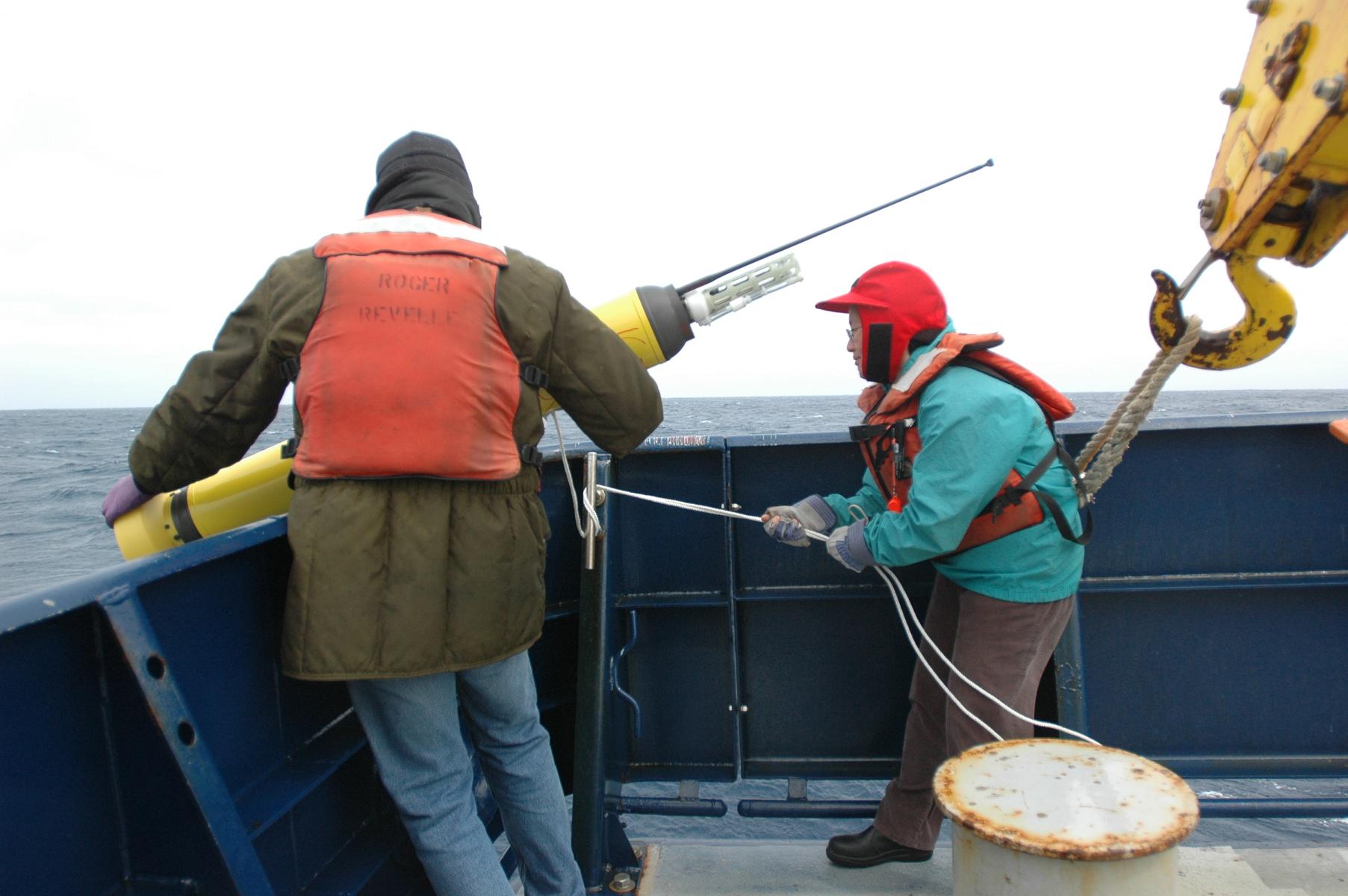
The archival photograph accompanying this report brings that work back to human scale. In early March 2007, scientist Annie Wong and technician Gene Pillard deployed an Argo float from the stern of the research vessel Roger Revelle. The ship's two cruises deployed 28 University of Washington floats and also collected measurements for studies of ocean heat, carbon and freshwater, along with sensor calibration.[6] A robotic instrument still begins its journey with people, equipment and access to a ship.
The June money and the September ask
The Commission's published allocation breaks down into €50 million for global monitoring, €12 million for data systems and €30 million for startups. Its wider OceanEye programme also links ocean observations with digital modelling, business development and public engagement.[2]
Readers should therefore resist treating every euro under the OceanEye name as money for the same task. Supporting a technology company, improving a data service and sustaining measurements can reinforce one another, but the budget lines describe different purposes. A useful account of the September event would identify the recipient, duration and purpose of each pledge and distinguish additional support from earlier announcements.
GOOS identifies gaps in the Southern Hemisphere, Arctic, deep ocean and coastal waters. Its June account also describes an agreement with Mercator Ocean International to evaluate the observing system and guide investment. The connection matters: digital ocean models rely on measurements, while modelling can help identify where additional observations would be most useful.[3]
The need for durability was also raised at the EU Arctic Forum this month. EuroGOOS's September 4 report says participants discussed moving beyond fragmented projects toward sustained observing systems. They stressed connections between satellite and in-water measurements, accessible data, and cooperation with Indigenous Peoples and local Arctic communities.[5]
That discussion offers another test for the pledges: whether they support a continuing regional capability, with people able to use the results. A newly purchased instrument is only one part of that capability.
What would count as progress next week
For observing programmes and public agencies, the immediate task is to check the event arrangements and identify the needs their contributions would meet. Within seven days, the scheduled meeting should provide an opportunity to compare commitments. Over the following month, the useful follow-up would be an implementation record naming recipients, delivery dates and supported activities. Those are reporting priorities, not deadlines announced by the organisers.
The base case is a launch followed by implementation work; its trigger would be published pledges with delivery details still pending. An upside case would become visible through additional, multi-year support tied to named gaps or threatened observations. A downside case would emerge if the eventual record mainly restates existing allocations while leaving those needs unresolved. These are ways to assess the outcome, not forecasts of the amount raised.
When the announcements arrive:
- Compare each contribution with the June baseline before counting it as additional funding.
- Separate financial pledges from in-kind support and identify what each will deliver.
- Look for the duration of support and the observations or data services it sustains.
Update conditions: revise this report if the event is rescheduled, the organisers publish a pledge ledger, or participating programmes disclose implementation agreements. Evidence of funded continuity would strengthen the case for the alliance; statements of support without delivery details would leave that case unproven.
Sources
- European External Action Service, “OceanEye International Alliance: Stronger Together for Ocean Observation” — event notice and objectives, checked September 17, 2026.
- European Commission, “OceanEye: EU ocean observation initiative” — programme scope and funding breakdown; page last reviewed June 3, 2026.
- GOOS, “EU and IOC of UNESCO unite in International Alliance to strengthen global ocean observations” (June 15, 2026) — coverage gaps, launch chronology and scientific cooperation.
- Argo Program, “How do floats work” — standard mission cycle, depth and typical instrument lifetime.
- EuroGOOS, “EuroGOOS at the EU Arctic Forum 2026: The Future of Arctic Observations” (September 4, 2026) — regional priorities and sustained observing capacity.
- Argo Program, “Argo floats deployed from I8S and I9N cruises near Antarctica” — 2007 cruise account and deployment photographs by Pien Huang.