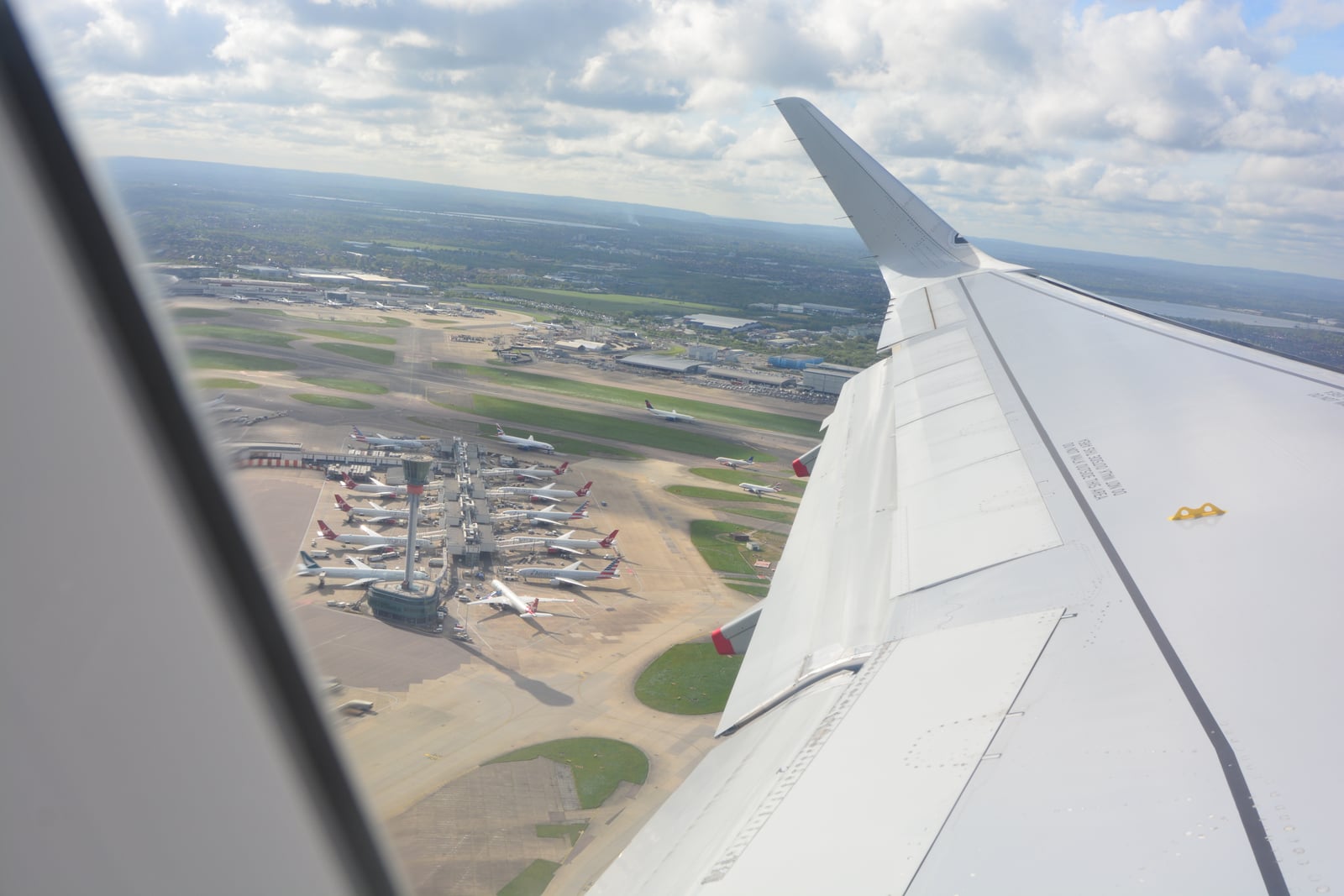
As of 2026-09-18 02:36 UTC, Britain's climate advisers have put a condition at the centre of Heathrow's expansion debate: before ministers grant development consent, they should legislate for aviation to address all its emissions by 2050 through direct reductions and engineered carbon removals. The Climate Change Committee's September 16 report is a recommendation; it does not itself approve or reject the runway.[1]
The question reaches beyond airport construction. An extra runway creates room for flights, but the climate case depends on the fuel those aircraft burn, the emissions that remain and who pays to deal with them. The sharpest disagreement is over whether expansion can proceed while that policy framework is still being built.[2][5]
What has actually changed?
Three dated records establish the position:
- November 25, 2025 — government request: the Department for Transport formally sought the committee's advice on the airport policy review and aviation's contribution to national carbon budgets. This establishes the advisory process, not an expansion permit.[6]
- July 17, 2026 — removals policy: the government said options for creating demand for greenhouse gas removals needed further work, with more detail due in 2027. That document records policy development, not a completed aviation removals obligation.[4]
- September 16, 2026 — new assessment: the committee found no credible route to climate-compatible Heathrow expansion under current policies, as Reuters also reported. This is a firm assessment of the existing framework, not a prediction that every possible future framework must fail.[1][2]
Why cleaner fuel does not settle the question
The UK already has a Sustainable Aviation Fuel mandate. Its main obligation began at 2% in 2025 and rises to 10% in 2030 and 22% in 2040. Fuel suppliers earn certificates according to the greenhouse gas savings delivered; they can use or trade certificates, or meet obligations through a buy-out mechanism.[3]
The word sustainable describes a lifecycle comparison. These fuels can reduce emissions associated with producing and using fuel, but the label does not mean a flight has no climate cost. Eligibility under the mandate requires at least a 40% lifecycle greenhouse gas saving against the fossil comparator. Different production routes deliver different savings.[3]
That distinction matters when reading an expansion promise. A growing share of lower-emission fuel is evidence of progress, but cannot by itself demonstrate that every remaining tonne has been addressed. Reuters reports that SAF still accounts for less than 1% of global aviation fuel use and costs several times as much as conventional fuel. That global figure is a scale check, not a measurement of UK mandate compliance.[2]
What does buying a removal accomplish?
Engineered removals take carbon dioxide out of the atmosphere and store it. Direct air capture with storage is one example. The committee distinguishes these durable removals from tree planting, which it considers insufficiently permanent to compensate for residual fossil aviation emissions.[1]
The government's July response describes the industrial work behind the credits: supporting removal projects with revenue certainty, investing in carbon transport and storage networks, and developing reliable demand and standards. It also says removals must complement emissions cuts. A credit therefore needs an actual removal behind it; a future purchasing intention alone does not demonstrate delivery.[4]
There is a revealing unresolved detail. The July response considered a proposal to adapt the SAF mandate to support both fuel and permanent removals, but called for further examination rather than adopting it. The fuel obligation already operating and the future removals framework are at different stages.[4]
The practical inference is that any expansion assessment needs to examine delivery together with accounting. A plan can balance emissions on paper while depending on projects, buyers and rules that have yet to come together.
The dispute is also about the order of decisions
Sustainable Aviation, the industry coalition, accepts that current policies will not fully decarbonise the sector. Its September 16 response supports industry bearing appropriate transition costs and acknowledges that those costs affect demand. It nevertheless rejects making expansion wait for the complete policy framework, arguing that growth and decarbonisation policy can develop together.[5]
The coalition also warns that substantially tougher UK rules could divert passengers through overseas hubs. That is an industry concern about competitiveness and emissions shifting across borders, not proof that any particular UK measure would increase global emissions.[5]
The committee's position places more weight on commitments made before consent. Its pathway assumes that decarbonisation costs reach ticket prices, helping restrain demand growth as well as fund cleaner flying. It also calls for contingencies if fuel or removals technologies fail to scale on time.[1][2]
For readers, the useful distinction is between agreement on a destination and agreement on the conditions for approving new capacity. The former leaves plenty of room for disagreement about the latter.
What would change the outlook?
For the next day, this is a change in the evidence available to ministers, not a new passenger charge. Over the coming week, the useful development would be a substantive response addressing the consent condition. Over the next month, look for proposed instruments, responsible departments and implementation dates; these are monitoring horizons, not announced deadlines.
The base case for reading further announcements is continued policy development with the gap still open. An upside case would require binding obligations, credible supply arrangements and an explicit fallback for delayed delivery. A downside case would become clearer if an expansion decision relied on future technologies without specifying who must procure them or what happens if they fall short. These are conditional interpretations of the documents, not forecasts of a planning outcome.
When the next announcement arrives:
- Identify its status: advice, consultation, legislation or development consent.
- Check who bears the emissions obligation and when it becomes enforceable.
- Look for evidence of delivery and the response to a shortfall.
Update conditions: this account needs revision if ministers enact the recommended framework, change the expansion proposal or publish a new assessment that closes the identified gap. A statement of ambition alone would not establish that those conditions had been met.
Sources
- Climate Change Committee, Advice to the UK Government on proposed Heathrow Airport expansion, September 16, 2026 — executive summary and chapters 2–4, including the recommended condition before development consent.
- Reuters, “Heathrow expansion incompatible with UK climate goals unless airlines do more, advisers say,” September 16, 2026, via London South East — independent reporting, technology scale and contingency planning.
- Department for Transport, The SAF Mandate: an essential guide, December 19, 2024 — fuel obligations, lifecycle savings, certificates and buy-out provisions.
- Department for Energy Security and Net Zero, Independent review on greenhouse gas removals: government response, July 17, 2026 — supply support, demand policy and the proposed relationship with the SAF mandate.
- Sustainable Aviation, response to the CCC report on airport expansion, September 16, 2026 — the industry coalition's stated position on costs, competitiveness and the sequencing of expansion.
- Department for Transport, Letter to the Climate Change Committee: engagement during Airports National Policy Statement review, November 25, 2025 — the government's formal request for advice.
- Joe Mabel, Aerial photo of Virgin Atlantic planes at London Heathrow Airport, photographed April 17, 2024, Wikimedia Commons — archival photograph and attribution record, CC BY-SA 4.0.