As of 2026-04-07 20:01 UTC, the U.S. automatic-emergency-braking story has moved beyond a simple adoption headline. In one sense, AEB already won the equipment battle years ago: the 2016 NHTSA-IIHS voluntary commitment covered more than 99% of the market, and IIHS later reported that all participating automakers met the light-duty target to equip at least 95% of production with AEB by the end of the 2023 reporting cycle.[4][5] If a buyer walks into a dealership today, basic forward crash-prevention hardware is usually there.
The live policy shift sits somewhere else. NHTSA's 2024 FMVSS No. 127 rule turned AEB from a common feature into a federal performance floor for nearly all light vehicles by September 2029.[1] That change matters because the rule is not satisfied by a dashboard icon or a low-speed city-braking system alone. It sets minimum test behavior at higher speeds, extends the requirement to pedestrian scenarios, and requires operation in darkness.[1][3] The 2026 signal is that consumers are beginning to see that federal standard echoed earlier through NCAP, even though mandatory compliance still sits several model years away.[3]
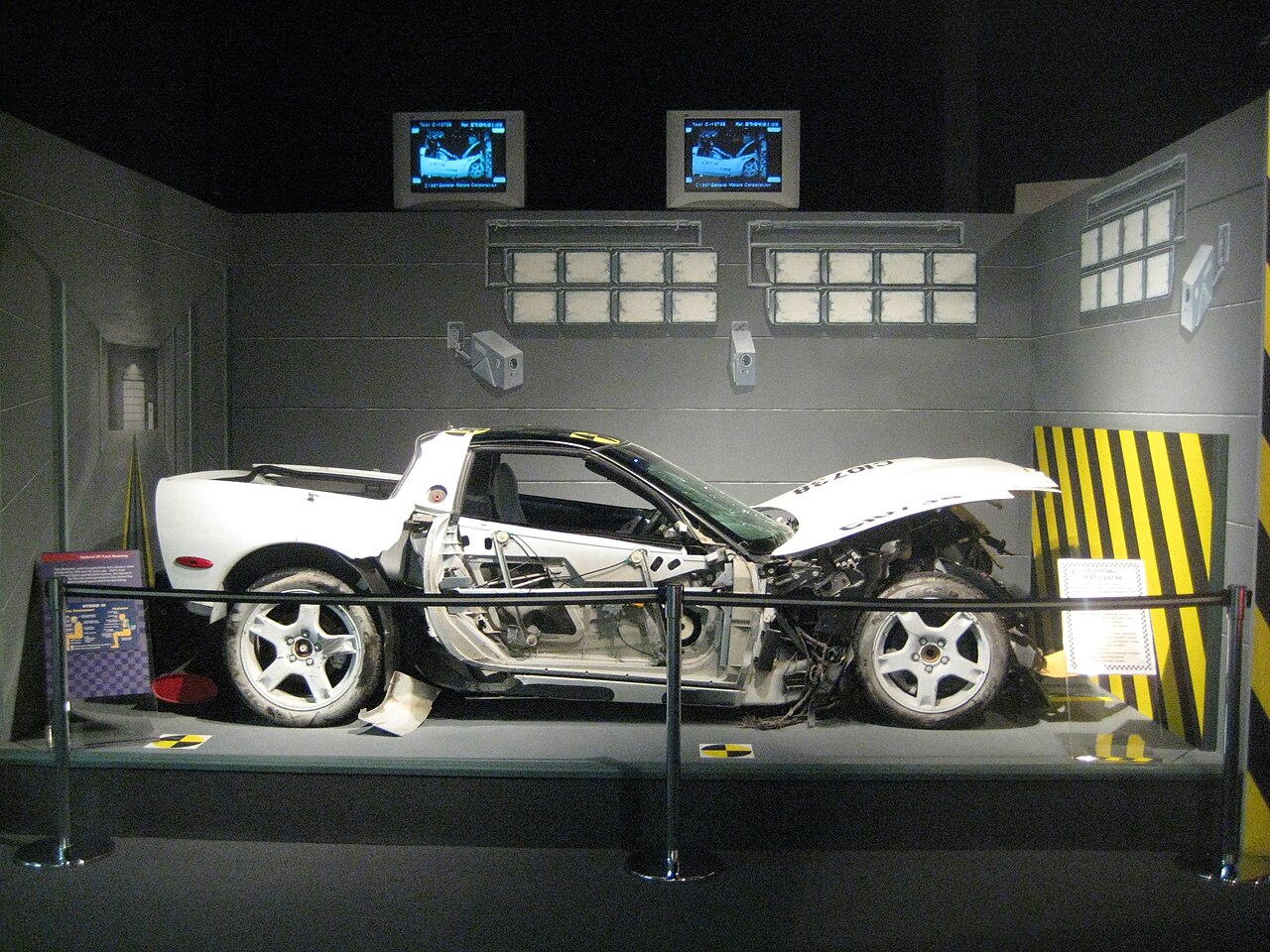
Image context: the cover image shows a crash-tested Corvette on display. It works here because this file is about measurable crash avoidance standards, not about abstract software promises or an infotainment screenshot.[8]
Most new cars already have AEB. That is not the same as having the rule.
The older voluntary era solved a narrower problem: getting AEB into the market faster than a full federal rulemaking could have done on its own.[4] NHTSA and IIHS announced that pact in March 2016, with automakers promising to make AEB standard on virtually all new light-duty cars and trucks on an agreed timeline.[4] By the end of the 2023 reporting cycle, IIHS said the light-duty side of that commitment had been fulfilled and told buyers that almost any new vehicle they purchased would come with a city-speed AEB system, typically with pedestrian detection.[5]
That is real progress, but it is not the same thing as FMVSS No. 127. The federal rule goes further by defining what the system has to do under government test conditions. NHTSA says vehicles must be able to stop and avoid contact with a lead vehicle at speeds up to 62 mph, must automatically apply the brakes at speeds up to 90 mph when a collision with a lead vehicle is imminent, and must detect pedestrians in both daylight and darkness, with pedestrian braking performance required up to 45 mph.[1] AP described the same move as Washington's first attempt to regulate this layer of automated driving functionality with hard performance standards instead of relying on availability or marketing claims alone.[2]
That is why the current file reads as a news report rather than a generic safety explainer. The public can easily hear "AEB is already standard in most cars" and conclude that the federal rule changed little. The source record shows a more consequential shift: availability became widespread through a voluntary deal, but minimum capability is now being defined in public law.[1][4][5]
The 2024-2025 process clarified the rulebook instead of erasing it
The next important fact is procedural. After the May 2024 final rule, NHTSA received petitions for reconsideration from manufacturers and other parties. The agency then issued a November 2024 final rule that partially granted some petitions and made clarifying changes, and the Department of Transportation later delayed the effective date of that November rule until March 20, 2025.[6]
That sequence matters because it shows what kind of fight this really became. Washington did not retreat to a vague endorsement of AEB. It kept the standard alive, refined the text, and moved the amended rule through a short effective-date delay rather than walking away from the file.[6] The industry position, however, remained sharply negative. The Alliance for Automotive Innovation said NHTSA had effectively denied its petition and argued that the agency's approach was wrong on the science and unworkable with currently available technology.[7]
The disagreement therefore sits on a narrower and more technical plane than many buyers might assume. The core question is no longer whether automakers think AEB is useful. They already helped make it mainstream.[4][5] The question is whether they accept a federal test regime that forces stronger lead-vehicle performance, pedestrian performance at night, and a clearer forward-collision-warning baseline across the market.[1][7]
Why 2026 matters before the 2029 deadline
The cleanest 2026 development is NHTSA's NCAP update. In its November 2024 final decision on advanced driver-assistance technologies, the agency said vehicles would begin receiving website check marks for AEB and pedestrian AEB performance starting with model year 2026 vehicles.[3] NHTSA also said it tried to keep the NCAP procedures compatible with FMVSS No. 127, so manufacturers would be able to design toward one coherent public standard rather than two unrelated ones.[3]
That consumer-information layer is important because it moves the federal signal forward in time. The mandate still does not bite until September 2029 for most manufacturers, and even supportive safety groups criticized that runway as too long.[1][5] But the NCAP change means the government is no longer waiting until 2029 to tell buyers what kind of crash-avoidance performance it wants to reward. It is beginning to surface that preference in the shopping window now.[3]
This also helps explain why the AEB file should be read as a performance-floor story rather than a feature-penetration story. Penetration is already high.[4][5] The unresolved part is whether consumers, regulators, safety groups, and manufacturers converge around the same definition of a sufficiently robust system. NCAP starts to operationalize that definition before the compliance deadline arrives.[3]
Bottom line
The most useful way to read the U.S. AEB file in 2026 is this: the market phase and the regulatory phase are no longer the same story. The market phase already put AEB into most new vehicles through the 2016 voluntary commitment and the 2023 fulfillment milestone.[4][5] The regulatory phase, opened by FMVSS No. 127 and reinforced by the NCAP update, is about how demanding the national baseline should be once AEB is assumed to exist.[1][3]
That is the real change. The federal government is no longer only asking whether the feature is present. It is asking how well the system brakes, how fast it still works, and whether it remains reliable when the pedestrian is standing in the dark.[1][2][3]
Sources
- National Highway Traffic Safety Administration, "NHTSA Finalizes Key Safety Rule to Reduce Crashes and Save Lives" (April 29, 2024).
- Tom Krisher, "US to require automatic emergency braking on new vehicles in 5 years and set performance standards." Associated Press, April 29, 2024.
- National Highway Traffic Safety Administration, New Car Assessment Program Final Decision: Advanced Driver Assistance Systems Roadmap (November 2024 PDF).
- National Highway Traffic Safety Administration, "U.S. DOT and IIHS announce historic commitment of 20 automakers to make automatic emergency braking standard on new vehicles" (March 17, 2016).
- Insurance Institute for Highway Safety, "Automakers fulfill autobrake pledge for light-duty vehicles" (December 7, 2023).
- National Highway Traffic Safety Administration, Federal Motor Vehicle Safety Standards; Automatic Emergency Braking Systems for Light Vehicles (delay of effective date notice PDF, January 2025).
- Alliance for Automotive Innovation, "Statement on NHTSA's Rejection of Automatic Emergency Braking Petition" (November 25, 2024).
- Wikimedia Commons, "File:Corvette Crash Tester (3695903512).jpg" (image source).