As of 2026-04-08 21:04 UTC, next week's Accreditation, Innovation, and Modernization (AIM) sessions are not a same-semester remake of college accreditation. They are the opening bargaining window in a narrower but still consequential 2026 fight: who gets to accredit, how easily colleges can switch or add accreditors, and how far the Department of Education can push accreditors toward program-level outcomes and new federal civil-rights and governance tests when Title IV eligibility is on the line.[1][2][3][4][5][6]
The reason this matters now is that the Department has already published more than a press-release agenda. It has posted a session schedule, a summary memo, and 151 pages of draft redlines against current regulations. Those materials show an administration trying to move on two clocks at once: a faster procedural clock for accreditor entry, switching, and recognition review; and a slower ideological and legal clock around student-outcomes benchmarks, "intellectual diversity," and the outer boundary of federal control over accreditors.[1][2][5][6][7]
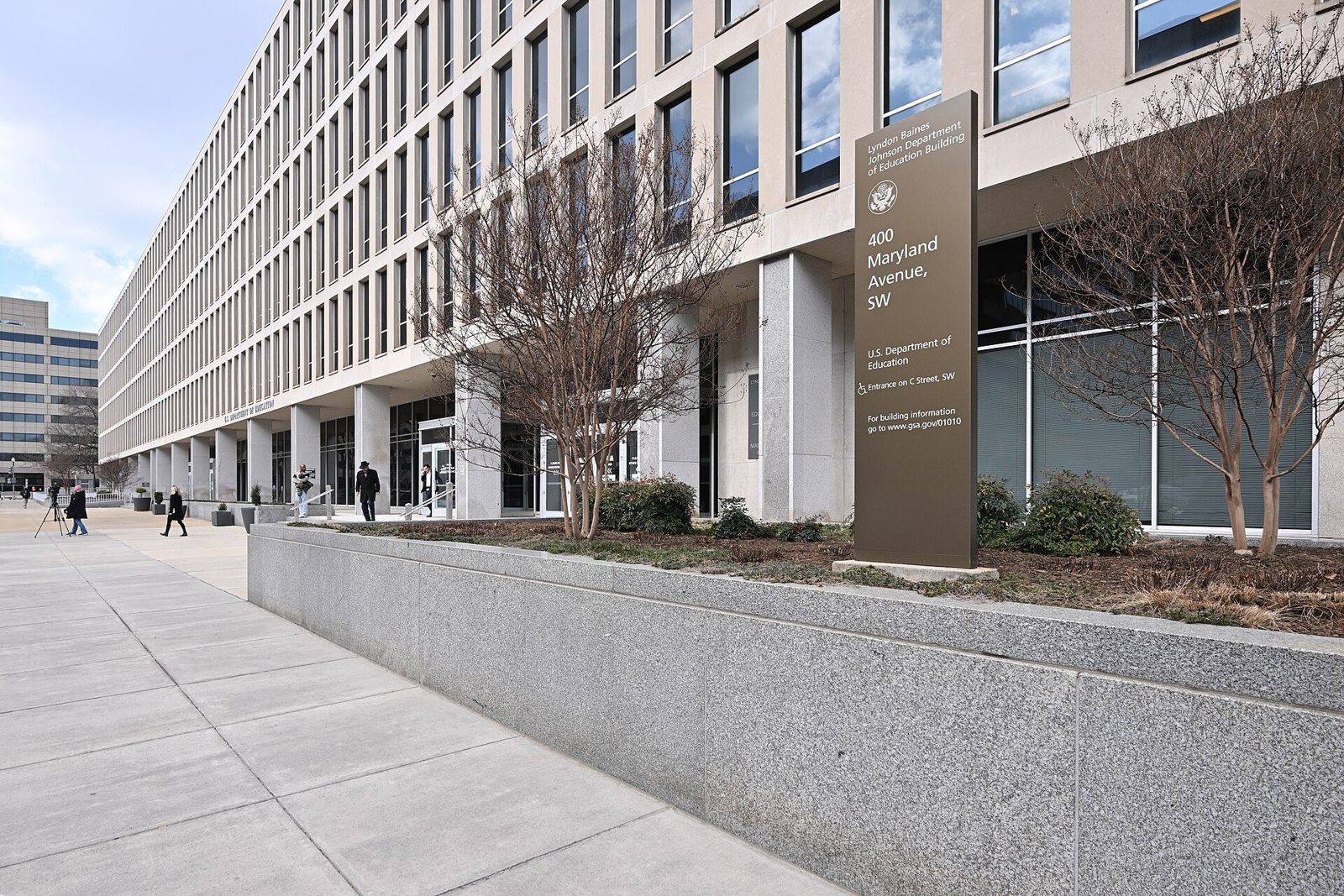
Image context: the cover image shows the Department of Education's Washington headquarters. It works here because the live story is not an abstract campus culture argument; it is a concrete federal rulemaking process, with negotiators arriving at this building next week to argue over the accreditation rules that gate access to federal student aid.[8]
Fact file
- January 26, 2026: the Department announced its intent to launch the AIM negotiated rulemaking committee and outlined four topic buckets: deregulation, student outcomes, merit, and integrity.[2]
- January 27, 2026: the Federal Register notice formally opened the committee process and said the Department intended to amend recognition and related institutional-eligibility rules for Title IV programs.[3]
- April 6, 2026: the Department's AIM page was updated with presession materials, including the committee list, protocols, draft regulations, and summary memo.[1]
- April 13-17, 2026: session 1 runs at Department headquarters in Washington, with livestreaming available.[1]
- May 18-22, 2026: session 2 is already scheduled, which signals that the Department expects unresolved issues after the first week.[1]
- Important uncertainty: the Department said it has "not prejudged the outcome" of the rulemaking, so the April session is a negotiating stage, not a final-rule publication date.[2]
What is actually on the table next week
The live agenda is broader than a simple anti-DEI story. The Department's January 26 framing and April draft materials show at least four linked lanes.[2][5][6]
The first lane is competition and switching. The Department wants to ease restrictions on institutions changing accreditors, relax some rules around having multiple accreditors, and reduce entry barriers for agencies seeking initial recognition. In the summary memo, that includes eliminating what the Department calls the arbitrary "two-year rule," speeding reviews, dropping some letters-of-support and multiple-site-visit requirements, and making the recognition process more risk-based.[5][6]
The second lane is program-level outcomes. The draft and summary push accreditors to use objective, program-level measures of student success and to identify minimum expectations tied to completion, placement, licensure, and economic value. That is not just a rhetorical shift. It would move the center of accreditation further toward measurable return and away from process-heavy review alone.[2][4][5][6]
The third lane is civil-rights and standards policing. The Department says it wants accreditor standards to comply with federal civil-rights law, remove policies that discriminate on the basis of immutable characteristics, and stop using unlawful DEI-based standards as a proxy for quality assurance. The press release also ties this to issues such as race-based scholarships and institutional policies that the administration views as discriminatory.[2][4][5]
The fourth lane is governance and academic-freedom language. The summary memo goes beyond accreditors entering the market. It proposes standards around academic freedom and "intellectual diversity," limits on accreditor interference in decisions that belong to boards or state governments, and tighter separation between accreditors and related trade associations.[2][5][6] That is where the policy fight becomes less procedural and more constitutional, political, and litigation-prone.[7]
What can move on the fast clock
The fastest-moving parts of the file are the mechanics of recognition and switching. The redlines show the Department trying to loosen several chokepoints that have made accreditation sticky: rules governing changes in accreditor, rules for multiple accreditation, requirements around renewal timing, and parts of the review process that agencies and institutions have long described as duplicative.[5][6]
If those provisions survive in recognizable form, the practical 2026 effect would be less about immediate campus transformation and more about bargaining leverage. Colleges dissatisfied with their current accreditor could gain more room to threaten a switch. New or aspiring accreditors could see a clearer federal pathway. Existing accreditors could face stronger pressure to justify documentation burdens and explain how their standards improve quality rather than merely entrench incumbents.[2][5][6][7]
That is why this story is not just about language in a draft. Accreditation is the gatekeeper for federal student-aid eligibility. A rule that changes how quickly institutions can move between accreditors, or how demanding the Department is when recognizing new ones, can change market structure even before the most ideological provisions are settled.[2][3][5]
What remains on the slower clock
The slower clock is legality, consensus, and implementation. Negotiated rulemaking is only one stage in a longer federal process. The Department still has to move from committee discussion to a proposed rule and then to a final rule, with the usual comment, revision, and challenge risks in between.[2][3]
That matters because some of the draft's most controversial ideas run directly into arguments about statutory limits. Inside Higher Ed's January reporting captured the core concern: even some observers who support more competition say parts of the waiting-period structure and some student-outcomes boundaries may be harder to move by regulation alone than the Department's summary implies.[7] The Department can propose an aggressive reading. It cannot guarantee that every aggressive reading will survive legal review or later judicial scrutiny.
The same is true of the ideological provisions. "Intellectual diversity" sounds straightforward at slogan level, but it becomes much harder once negotiators ask what an accreditor would actually measure, what counts as institutional autonomy, and where federal oversight becomes viewpoint policing. Program-level outcomes raise a parallel problem. Many higher-education reformers support stronger outcomes accountability in principle, yet the details become messy as soon as institutions, missions, licensure pipelines, and student populations differ.[5][6][7]
So the useful reading for April is narrow. The Department has moved the file from general intent to concrete draft text. It has not yet proven that the full package can clear the legal, administrative, and political hurdles needed to become a durable rulebook.[1][2][3][5][6][7]
Decision impact by horizon
In the next 24 hours, colleges, accreditors, and state systems should read the presession materials as an actual negotiating document, not as campaign rhetoric. The operational question is which provisions affect switching, recognition timing, multiple accreditation, and program-level metrics soonest.[1][5][6]
Over the next 7 days, the main signal will be whether the Department separates procedural deregulation from the more ideological fights. If negotiators show room for agreement on review speed, documentation burden, or switching mechanics, parts of the package may advance even if the debates over DEI, merit, and intellectual diversity remain polarizing.[2][5][7]
Over the next 30 days, the question becomes rulemaking durability. Watch whether the Department narrows the most litigation-sensitive proposals, whether stakeholders frame certain items as statutory overreach, and whether the May session agenda suggests convergence or trench warfare.[1][3][7]
Scenarios
Base case: the April session clarifies that the Department can probably move a mixed package of procedural easing and outcomes language, but not a clean ideological sweep.
Trigger: negotiators split between support for faster switching and resistance to the broadest merit and intellectual-diversity provisions.[5][6][7]
Upside for the Department: a narrower consensus forms around recognition-process reform, lighter documentation burdens, and clearer expectations for outcome reporting.
Trigger: the Department is willing to decouple the procedural items from the most politically charged provisions and keep the early package focused on accreditation mechanics.[2][5]
Downside: the negotiation turns into a proxy war over DEI, faculty viewpoint, and federal control, making consensus unlikely and increasing litigation risk around any later proposed rule.
Trigger: committee debate centers more on ideological language and statutory authority than on switching and review design.[4][5][6][7]
Action checklist
- Institutions: map current accreditor dependencies, transfer-credit pain points, and any reasons a switch or second accreditor might matter if the rules loosen.[5][6]
- Accreditors: identify which standards and review practices are most exposed to complaints about cost, duplication, civil-rights conflict, or trade-association entanglement.[2][5][6]
- State systems and governing boards: watch the draft language on institutional governance and state authority, because that is where a procedural rewrite can turn into a federalism fight.[5][6]
- Policy watchers: separate proposals that change review mechanics from proposals that would likely face immediate statutory or constitutional challenge.[3][4][7]
The high-signal takeaway is narrower than the headline. The AIM meetings open a real rewrite attempt, but the nearest-term 2026 consequences sit in accreditation switching, recognition process design, and outcomes reporting. The larger battle over ideology, governance, and legal authority runs on a slower clock and still has to survive negotiated rulemaking, later notice-and-comment, and probable court scrutiny.[1][2][3][5][6][7]
Sources
- U.S. Department of Education, "Negotiated Rulemaking for Higher Education 2026" (page updated April 6, 2026).
- U.S. Department of Education, "U.S. Department of Education Announces Negotiated Rulemaking to Reform and Strengthen America's Higher Education Accreditation System" (January 26, 2026).
- Federal Register, "Intent To Establish Negotiated Rulemaking Committee" (January 27, 2026).
- The White House, "Reforming Accreditation to Strengthen Higher Education" (Executive Order 14279, April 23, 2025).
- U.S. Department of Education, Accreditation, Innovation, and Modernization (AIM) Negotiated Rulemaking: Summary and Discussion of Initial Draft Regulations (PDF, 2026).
- U.S. Department of Education, Accreditation, Innovation, and Modernization (AIM) Negotiated Rulemaking: Initial Draft Regulations for Discussion (PDF, 2026).
- Jessica Blake, "ED Eyes Rewrite of Accreditation Rules," Inside Higher Ed (January 27, 2026).
- Wikimedia Commons, "File:Department of Education Lyndon Baines Johnson building sign Washington DC 2025-02-04 12-13-26.jpg" (cover image source).