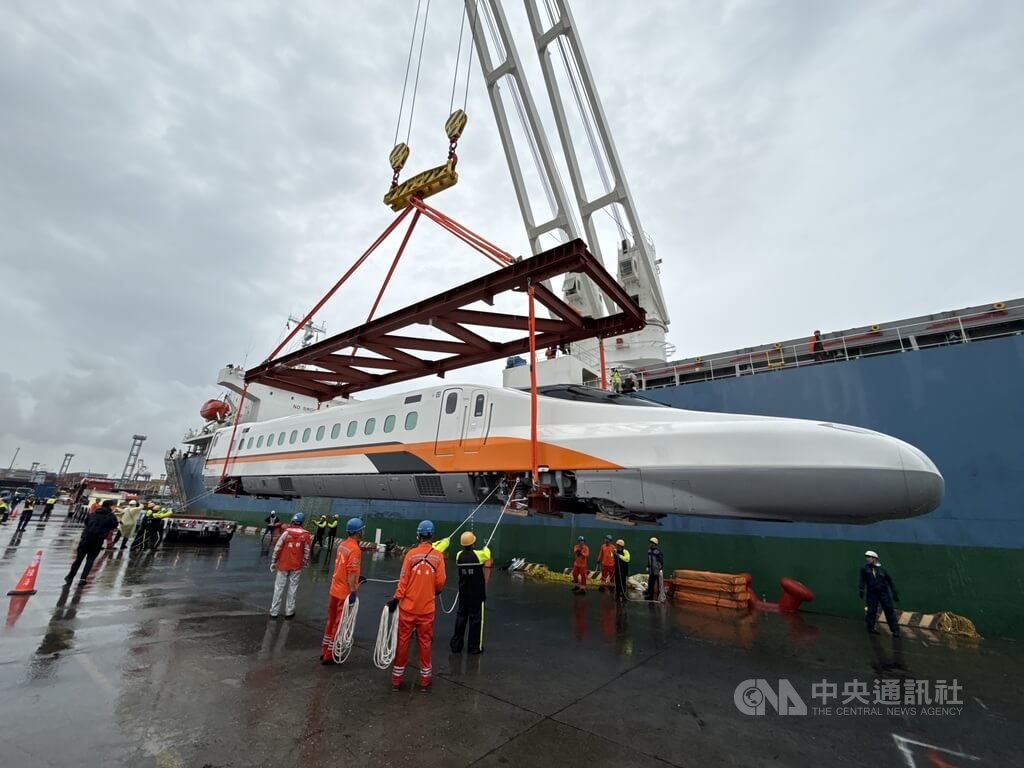
As of 2026-08-16 20:36 UTC—4:36 a.m. Monday in Taiwan—the first 12-car N700ST trainset had reached Kaohsiung Port’s Berth 74, and its road transfer toward Taiwan High Speed Rail’s Yanchao main workshop had begun.[1][2]
The arrival photographs show the new train in an unusual state: a white nose car hanging from a lifting frame, rain on the quay, dockworkers guiding ropes below. It is complete enough to be recognizable and still far from being a passenger train. Each car must be unloaded, moved inland, reassembled and admitted into a local test program before the set can operate under its own authority.
Status at the cutoff: arrival is verified; unloading and inland transfer are in progress; Taiwan assembly, static testing, dynamic testing, regulatory review and revenue service remain future milestones. The operator’s current passenger target is July 2027, not August 2026.[1][2][3]
The arrival record
- August 6 was the planned departure. A typhoon delayed the train at Japan’s Kasado Works.[1]
- August 11 became the actual sailing date. All 12 cars left on one cargo vessel. Poor conditions in the Taiwan Strait later forced the ship to slow.[1]
- August 15 brought the first set to Berth 74. Central News Agency reported an 8 a.m. arrival and an afternoon ceremony after the weather delay. The unloading plan covered two days.[1]
- August 16 began the visible inland handoff. CNA reported a police-supported road movement into Yanchao, where the cars are to be assembled and tested. The full transfer was planned across three late-night periods.[1][2]
This chronology establishes custody and movement, but not acceptance. A photograph of one car entering Yanchao cannot show that all 12 cars have arrived, passed their post-shipment inspection or been coupled into a complete set. Those require separate evidence.
The commissioning passport
The most useful way to follow the N700ST now is as a sequence of stamps. A later milestone cannot be inferred from an earlier one.
| Phase | Status at the cutoff | Evidence needed for the next stamp | Evidence source |
|---|---|---|---|
| Factory completion and shipment | Verified for the first 12-car set. The manufacturer says it is the first of 12 sets, or 144 cars, ordered for Taiwan.[4] | Delivery records and a complete post-shipment inventory in Taiwan. | Hitachi–Toshiba consortium; THSR reporting. |
| Port unloading and road transfer | In progress. Arrival and the first movement toward Yanchao are documented; the published plan allowed two days for unloading and three nights for road transport.[1][2] | Operator confirmation that all 12 cars are inside the workshop and released from delivery handling. | CNA arrival and convoy reports. |
| Assembly and static testing | Announced, not completed. The current target is the end of November 2026.[1][3] | A dated completion statement identifying the assembled set and static checks cleared. | THSR and Railway Bureau updates. |
| Dynamic testing | Announced, not yet evidenced. The program contains 69 items and is due to finish by April 30, 2027.[1][3] | Results showing the required items completed, including any retests or modifications. | THSR test record; Railway Bureau oversight. |
| Ground-interface and pre-operation review | Planned. The Railway Bureau says the Railway Technology Research and Certification Center will assist with ground-interface work, including noise and vibration, before the operator submits files for pre-operation approval.[3] | A regulator decision based on the completed test package. | Railway Bureau. |
| Passenger service | Targeted for July 2027. The current plan puts the first three sets into service then.[1] | Operating approval, an effective timetable and an operator service notice. | Railway Bureau and THSR. |
| Full 12-set program | Targeted for 2028. Current Taiwan reporting uses September 2028; the manufacturer gives the broader boundary of commercial operation by year-end.[1][3][4] | Delivery and acceptance records for all 12 sets. | THSR, Railway Bureau and manufacturer. |
The dates are planning boundaries. Confidence is high on the first set’s arrival and initial transfer because both are documented current events.[1][2] Confidence is moderate on November, April, July and the final 2028 window because each depends on work that had not been completed at the cutoff.
One detail is explicitly unresolved. On August 1, Railway Bureau Director-General Yang Cheng-chun described the 69 dynamic items as a four-stage program.[3] CNA’s August 15 arrival report described three stages.[1] The count of test items and April completion target agree; the stage count does not. The sources may group the same work differently, or the plan may have changed. Without a published stage map, neither explanation should be assumed.
Analysis: where the N700ST meets Taiwan
Hitachi and Toshiba describe the N700ST as an N700S-based train designed for Taiwan High Speed Rail’s operating environment and requirements.[4] Taiwan High Speed Rail identifies changes to the exterior and cabin, including displays, power-equipped seats, luggage storage and accessibility provisions, and says the local program includes static and dynamic testing.[5]
Those facts define the acceptance problem. Factory completion establishes that the train was built to the contracted design. Taiwan testing must establish that the delivered configuration works repeatedly as part of this railway.
The published dynamic families include traction, braking and service equipment.[1] The Railway Bureau adds a ground-interface layer, citing noise and vibration testing and a final file review before pre-operation approval.[3] Together, these cover two different kinds of evidence:
- Vehicle evidence: the train accelerates, brakes and operates its onboard systems within required limits.
- Interface evidence: the train’s behavior remains acceptable when it meets local infrastructure, operating practices and the surrounding environment.
The second category is why experience with Japan’s N700S platform cannot simply be copied into a Taiwan result. Proven design ancestry reduces uncertainty; it does not replace measurements on the delivered N700ST. Likewise, a successful low-speed depot movement would demonstrate only that movement—not completion of high-speed braking, reliability or regulatory review.
The public record is still thin at the level that will matter most after testing starts. It gives the number 69, broad families and deadline dates, but not a public matrix of acceptance limits, completed items or retests.[1][3] A useful operator update would therefore name the set, the phase, the tests cleared and any work still open. “Testing continues” would be accurate and insufficient for judging the July target.
The depot is part of the fleet change
Taiwan High Speed Rail has operated its established 700T generation for nearly two decades. Adding N700ST creates a two-generation maintenance problem before it creates extra timetable capacity. Chairman Shih Che said the railway’s routine maintenance is compressed into a nightly period of less than five hours and identified mixed-fleet support as one of the project’s principal challenges.[1]
The supporting contracts make that challenge tangible. Taiwan High Speed Rail said in May that it was arranging 21 subcontracts covering dynamic testing, training, maintenance materials and related work. It put the wider facilities-and-equipment program at more than NT$30 billion, separate from the train purchase, including a NT$2.6 billion order for ground equipment used in bogie inspections and general overhauls at Yanchao.[6]
Mitsubishi Heavy Industries says that equipment is due in April 2028.[7] Taiwan High Speed Rail’s plan places the first N700ST bogie-inspection cycle in 2028 and first general overhaul in 2029, and says upgraded lines at Yanchao should support both N700ST and 700T work.[6] That common capability matters: a new fleet with isolated tools, scarce technicians or an incomplete spares chain could add trains on paper while reducing flexibility in the depot.
The maintenance program is therefore part of commissioning, even though the first passenger launch comes earlier. The test set must prove that it can run; the depot must prove that the railway can keep it running.
Capacity arrives through a timetable
The first set’s arrival does not alter a ticket, departure or seat count. The capacity case belongs to the complete program.
Railway Bureau reporting says the fleet is planned to grow from 34 to 46 trainsets once all 12 N700ST sets arrive, while the maximum peak departure rate could move from seven to ten trains per hour.[3] Taiwan High Speed Rail separately estimates an approximately 25% increase in peak dispatch capacity after the new fleet enters operation.[5]
Those figures describe different denominators and should not be collapsed into one percentage. Fleet size, maximum trains per hour and passenger-carrying capacity are related, but schedules, stopping patterns and the number of accepted sets available on a given day determine how much of the hardware becomes useful service.
Demand explains the urgency. At the arrival ceremony, Shih said average daily ridership had grown from about 46,000 when service began in 2007 to an expected level above 230,000 in 2026.[1] The evidence riders eventually need is consequently specific: which departures are added, which corridors receive them, when the timetable takes effect, and whether reliability holds while both generations share the operation.
The evidence watchboard
| Window | Evidence to watch | Decision it changes |
|---|---|---|
| Next 24 hours | Confirmation that every car has completed unloading and the road transfer, plus disclosure of any shipping or handling damage. | Whether the physical handoff to Yanchao is complete. |
| Next 7 days | An operator record naming the full first set inside the workshop and stating that assembly has begun. | Whether the project has moved from logistics into local commissioning. |
| Next 30 days | A dated assembly/static-test update and a reconciled three-versus-four-stage test plan, ideally with the Railway Bureau approval sequence. | Whether the November and April targets remain credible enough to support planning for July 2027. |
For passengers, none of these windows requires a booking change. Existing trains and the current timetable remain the operative service. A test-train sighting is not a reason to expect an N700ST on a scheduled departure.
Three commissioning outcomes
| Outcome | Observable trigger | Service implication |
|---|---|---|
| Published sequence holds | Assembly and static work close by November; all 69 dynamic items close by April 30; the regulator approves operation. | July 2027 remains a usable target for the first three sets. |
| Schedule reserve grows | Milestones close early without narrowing the test scope, and approval arrives with time for crew and timetable rehearsals. | More margin before July; no permission to carry passengers early without authorization. |
| Integration delay | A test requires modification or repetition, the Railway Bureau imposes conditions, or an official milestone moves. | Confidence in July falls and the service introduction may slip. |
No probabilities are assigned to these outcomes. No cited source at the cutoff reports a failed Taiwan acceptance test, and no source can guarantee that all 69 items will clear on the first attempt.
Before passengers board
- Verify the trainset and phase in every update. One photographed car, one depot movement and one completed test item are not interchangeable.
- Treat the operator’s November, April and July dates as announced targets until completion evidence is published.[1][3]
- Use a Railway Bureau approval and an effective THSR timetable—not promotional material or a test sighting—as the passenger-service signal.
- Test the 25% capacity claim against actual peak departures and fleet availability after approved sets enter service.[3][5]
Revise this report if the operator discloses shipping damage, reconciles the stage-count discrepancy, changes the 69-item scope or moves the November, April, July or 2028 dates. Its central status boundary expires when an N700ST receives operating approval and appears in scheduled passenger service; at that point, the first set will have advanced from delivered test asset to revenue train.
Sources
- Central News Agency, “First high-speed-rail trainset arrives in Taiwan; passenger service planned for July 2027” (August 15, 2026) — arrival, weather delays, unloading and transfer plan, static and dynamic test schedule, 69 test items, mixed-fleet challenge and provenance for the cover photograph.
- Central News Agency, “New high-speed train enters Yanchao main workshop as crowds photograph the convoy” (August 16, 2026) — current confirmation of the first road movement, police support and depot destination.
- Central News Agency, “THSR plans major 2027 timetable revision as N700ST work begins” (August 1, 2026) — Railway Bureau statements on 69 tests in four stages, ground-interface work, pre-operation approval, fleet growth and peak service planning.
- Hitachi and Toshiba, “Hitachi and Toshiba to Deliver the Future of High-Speed Rolling Stock to Taiwan” (July 30, 2026) — manufacturer confirmation of the N700S-based design, first shipment and 12-train/144-car delivery program.
- Taiwan High Speed Rail, “A new generation starts for you: N700ST name and livery announced” (August 20, 2025) — localization, cabin and accessibility changes, test plan, 2027 service window and estimated 25% increase in peak dispatch capacity.
- Taiwan High Speed Rail, “N700ST rollout countdown: maintenance-equipment contract and system preparations” (May 20, 2026) — 21 subcontracts, more than NT$30 billion in supporting investment, NT$2.6 billion ground-equipment order and dual-fleet maintenance plan.
- Mitsubishi Heavy Industries, “MHI Receives Order from Taiwan High Speed Rail Corporation for Maintenance Tools and Equipment for Yanchao Main Workshop” (July 2, 2026) — equipment scope, delivery deadline and maintenance-readiness context.