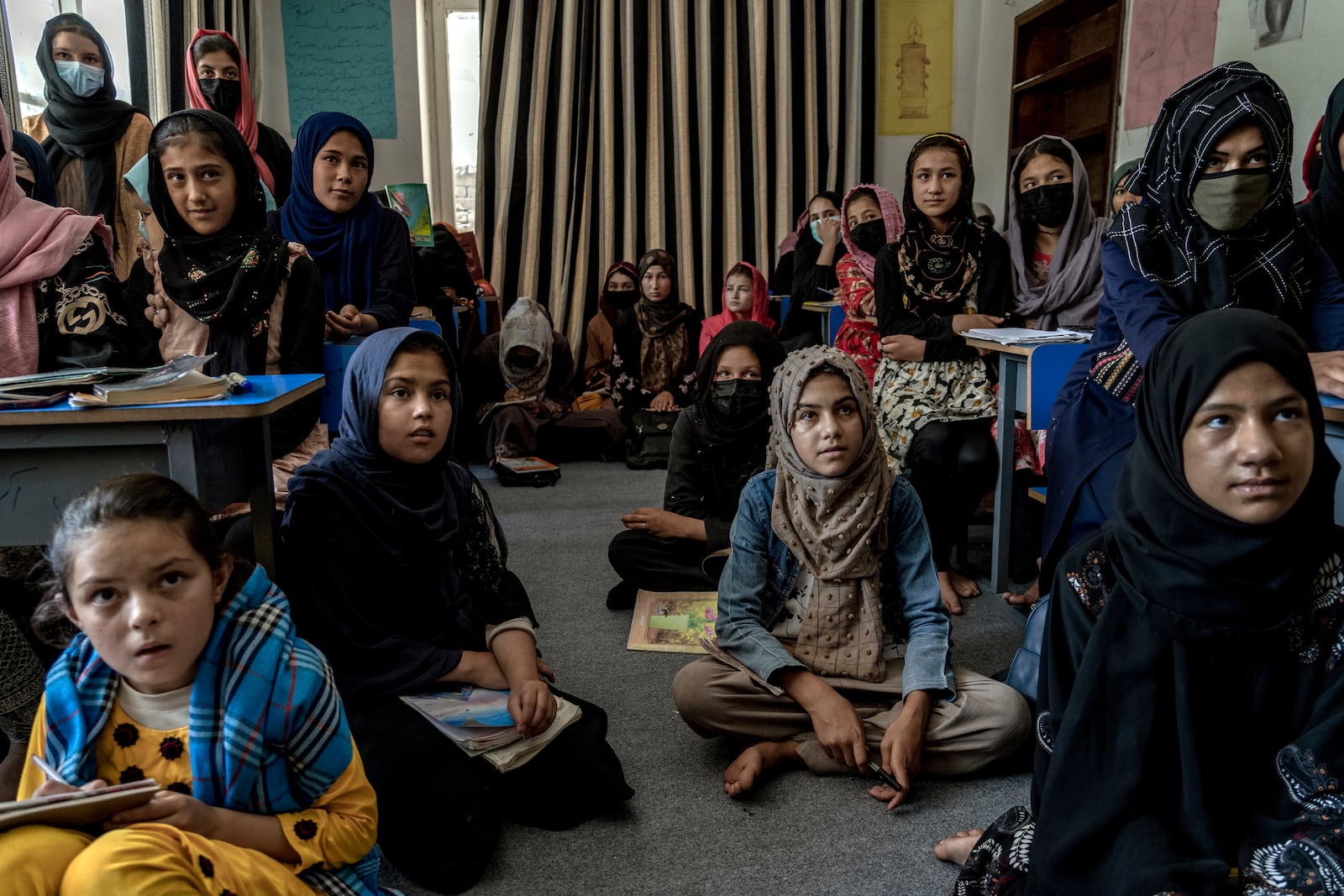
As of 2026-08-17 02:39 UTC, Afghanistan's prohibition on girls studying beyond grade six remains in force. At the five-year mark of the Taliban's return to power, UNESCO's current estimate is 2.4 million girls excluded from secondary education, 200,000 more than a year earlier. Taliban officials continue to say they are working on conditions for female education; in the cited current reporting, those conditions are not clarified and no reopening timetable is given.[1]
Five years changes the meaning of the story. This is no longer only a school-closure count. Each blocked class is also a missing intake of future teachers, nurses, doctors and midwives. UNICEF projects that, if the restrictions continue, Afghanistan could lose as many as 20,000 women teachers and 5,400 women health workers by 2030.[3] That is a forecast, not an observed 2030 outcome—but the replacement problem behind it has already begun.
This reported and synthesized Q&A draws on current reporting and institutional data; it is not a live interview. Its central question is practical: who replaces essential women professionals when the education system is prevented from training their successors?
The evidence at a glance
| Measure | What the source actually counts | Confidence boundary |
|---|---|---|
| 2.4 million, August 2026 | Girls currently excluded from secondary education, according to UNESCO's anniversary estimate.[1][2] | High for the cited estimate. It is a current stock, not the number newly excluded since 2021. |
| 2.2 million, January 2026 | Adolescent girls banned from secondary school in a joint UNESCO–UNICEF statement.[5] | High for that date. It predates the August estimate; the two figures should not be averaged. |
| 3.8 million, June 2026 | Girls ages 7–18 out of school, including more than 2.6 million adolescents, in a U.N. Security Council briefing.[4] | High for the cited briefing. It covers more ages and more causes of exclusion than the secondary-school ban alone. |
| 73,000 to 66,000, 2022–2024 | Decline in women teachers in basic education, from nearly 73,000 to about 66,000.[3] | Observed estimate, not a causal experiment. Restrictions operate alongside poverty, displacement and wider system stress. |
| Up to 25,400 by 2030 | Projected loss of 20,000 women teachers and 5,400 women health workers if restrictions persist.[3][4] | Conditional projection. Policy reversal, retention, migration and funding could change the result. |
1. Why is the fifth year different from the fourth?
Because elapsed time has become a structural input, not just an anniversary.
A girl who was due to enter grade seven when secondary schools closed in 2021 has now missed almost an entire secondary cycle. Meanwhile, girls who complete primary school continue to arrive at the same barrier. UNESCO's August count rose by 200,000 in one year; before the takeover, nearly one million girls were enrolled in secondary education.[1][2]
The policy boundary is still clear. Girls may attend formal school only through grade six; women remain excluded from higher education. The uncertainty lies in what would end those restrictions. The current AP reporting identifies no public criteria or dated reopening plan behind official references to suitable conditions.[1] Until access changes can be verified, a statement of intent is not evidence that students have returned.
2. Are the 2.2 million, 2.4 million and 3.8 million figures contradictory?
No. They answer different questions at different dates.
The 2.2 million figure was the number of adolescent girls described by UNESCO and UNICEF as banned from secondary school in January 2026.[5] The 2.4 million figure is UNESCO's later, August estimate of current secondary-school exclusion.[1][2] The 3.8 million figure was presented to the U.N. Security Council in June for all out-of-school girls ages 7–18; it includes primary-aged children and girls excluded for reasons beyond the secondary ban.[4]
Those labels matter. Adding the figures would double-count children. Treating them as a trend line would mix years, age bands and definitions. The most defensible current headline measure is 2.4 million girls excluded from secondary education; the 3.8 million baseline explains why reopening secondary schools, while essential, would not by itself repair Afghanistan's wider learning crisis.
That wider crisis begins early. In January, UNESCO and UNICEF reported that 93% of children at the end of primary school were still working toward basic reading proficiency.[5] The pipeline is therefore squeezed at both ends: many children do not reach strong foundational learning, and girls who do complete primary school cannot progress through the formal system.
3. How does a school ban become a staffing shortage?
Think of a profession as overlapping cohorts. Experienced staff leave through retirement, migration, illness or career change. A functioning education system replaces some of them with graduates moving from secondary school into university or professional training and then into supervised work.
Afghanistan has interrupted that sequence for women:
grade six → secondary school → university or professional institute → qualification → school or clinic
The first gate has been closed since 2021, higher education for women was subsequently suspended, and medical training routes have also been restricted.[7] At the same time, the estimated number of women teachers in basic education fell by more than 9%, from nearly 73,000 in 2022 to around 66,000 in 2024.[3]
The causal claim needs care. That decline alone does not prove that every departure resulted from the education ban. Afghanistan also faces poverty, displacement, weak infrastructure and aid constraints. The stronger inference comes from the sequence: whatever causes an experienced professional to leave, the restrictions sharply reduce the pool of women able to train for the vacancy. UNICEF's 2030 projection models that accumulating replacement gap.[3][4]
4. Why can men not simply fill the vacancies?
Because a worker is not interchangeable when access itself is gender-constrained.
UNICEF notes that in Afghanistan's social and policy context, women are often unable to receive medical services from men. Fewer women health workers can therefore mean less maternal, newborn and child care—not merely a different clinician delivering the same service.[3] Education has a similar dependency: women teachers support girls' access and are associated with stronger learning outcomes, while social norms around who may teach whom narrow staffing options.[5][7]
This does not mean every vacancy produces an immediate closure, nor that all provinces and facilities operate identically. It means that replacing a woman with a man may preserve a payroll position without preserving practical access for women and girls. Headcount, sex, qualification, location and actual service volume all have to be measured together.
5. Can underground, community or online learning hold the pipeline open?
They can preserve learning; they cannot substitute for a national right to progress through formal education.
UNESCO says it has reached more than 76,000 vulnerable learners through education and skills initiatives since 2021. A new two-year programme backed by Sweden is intended to expand accredited alternatives and connect learning to employment and entrepreneurship.[6] Separately, UNICEF reported that 442,000 children, 66% of them girls, used community-based learning initiatives in 2025.[3]
These are meaningful programmes, but the numbers are not a coverage ratio. UNESCO's 76,000 is cumulative and includes education and skills participants; UNICEF's 442,000 is a one-year child-programme count; UNESCO's 2.4 million is a current secondary-exclusion estimate. None establishes how many excluded adolescent girls can obtain a recognized secondary credential and then enter higher education or licensed clinical training.
That is the decisive test. A class can protect literacy, routine, confidence and connection. To repair the workforce pipeline, learners also need recognized progression, bridge courses for missed years, examinations, admission to higher education and a lawful route into employment. Alternative learning is a bridge worth funding. It should not become the language used to normalize a closed gate.[2][6]
6. What decisions matter in the next 24 hours, seven days and 30 days?
In the next 24 hours, agencies and newsrooms should publish the denominator beside every number: age range, education level, reference year, whether the figure is a stock or a flow, and whether it is observed or projected. Donors should identify which current community classes and women-led services face interruption, with a cash date rather than a general pledge.
In the next seven days, the de facto authorities could turn “working on conditions” into something testable by publishing the conditions, responsible ministry, reopening date and grades covered. Education and health partners should publish a common retention dashboard for women teachers and health workers, disaggregated by province and qualification. In the absence of either record, claims of progress remain unverified.
In the next 30 days, planners should prepare for both continuity and reopening: fund safe learning now; map missing cohorts; design placement assessments and accelerated bridge courses; preserve teacher and health-worker training capacity; and specify how alternative qualifications would transfer into formal institutions. Reopening after five lost years would be a recovery operation, not the simple unlocking of school doors.
7. Which path is the evidence pointing toward?
These are conditional paths, not assigned probabilities.
| Path | What it would look like | Observable trigger |
|---|---|---|
| Base case: restriction plus partial workarounds | The formal ban persists, community programmes reach a fraction of excluded learners, and the replacement gap widens as trained women leave. | No published reopening decree; the secondary-exclusion count and women-staff vacancy measures continue to rise. |
| Upside: verified reopening and recovery | Girls return by grade and province, women re-enter higher and medical education, and bridge programmes convert interrupted learning into recognized progression. | A dated national order followed by independently observable enrolment, attendance, examinations and women entering training. |
| Downside: pipeline loss accelerates | Further restrictions or aid cuts reduce both alternative learning and the remaining women-led services, weakening primary education and health access before 2030. | Programme suspensions, falling women-staff counts, fewer functioning classes or clinics, and widening provincial access gaps. |
8. What evidence would change this assessment?
A press statement alone would not. The article's core assessment would be weakened by four things appearing together: a durable national reopening order; verified attendance beyond grade six; restored access to university and professional institutes; and women moving from training into staffed classrooms and clinics.
The workforce projection could also prove too pessimistic if retention rises, qualified women return, alternative credentials become genuinely portable, and measured service capacity stabilizes. It could prove too cautious if women-staff losses, clinic access or primary-school participation deteriorate faster than UNICEF's model anticipates.
For anyone tracking the story, the evidence checklist is short:
- Separate current exclusion from the broader out-of-school population.
- Label observed counts and conditional projections.
- Track women teachers and health workers by qualification, province and service volume—not headcount alone.
- Demand a public timetable and school-level verification for any reopening claim.
- Measure whether alternative learners gain recognized progression, not only whether they attend a class.
- Update the assessment when the next comparable education and workforce datasets arrive.
The fifth anniversary is therefore not just a measure of time lost by 2.4 million girls. It marks a narrowing window in which Afghanistan can still retain experienced women professionals while rebuilding the cohorts meant to follow them. A school ban empties a classroom today; left in place, it also leaves tomorrow's classroom and clinic without the person qualified to open the door.
Sources
- Associated Press, “Afghanistan marks 5 years under the Taliban with safer streets but pleas for jobs and education” (August 14, 2026) — current status of the restrictions, the Taliban's stated position, the 2.4 million estimate and its year-over-year increase.
- Associated Press, “2.4 million Afghan girls shut out of secondary school 5 years after Taliban takeover, UN says” (August 11, 2026) — UNESCO's anniversary estimate, pre-2021 secondary enrolment and current community-learning context; the WCAX syndication of the same dispatch supplies the original caption and provenance for Ebrahim Noroozi's July 28, 2022 archival photograph.
- UNICEF, “Restrictions on girls' education and women's employment in Afghanistan could lead to a loss of over 25,000 female teachers and health workers by 2030” (April 27, 2026) — primary release for workforce projections, women-teacher counts and UNICEF's 2025 community-learning reach.
- Adla Massoud, The National, “Taliban school ban leaves nearly 3.8 million Afghan girls out of education, UN warns” (June 8, 2026) — reporting on the U.N. Security Council briefing for the broader ages 7–18 measure and projected skilled-worker losses.
- UNESCO and UNICEF, “UNESCO and UNICEF urge action to protect the right to education in Afghanistan” (January 24, 2026) — joint statement on secondary exclusion, foundational reading and women teachers' role in learning.
- UNESCO, “UNESCO and Sida strengthen alternative learning opportunities and empowerment pathways for Afghan learners” (June 14, 2026) — scope, funding and cumulative reach of one alternative-learning portfolio.
- Associated Press, “Under Taliban, barring Afghan girls from school takes an emotional toll—and a community one, too” (July 31, 2026) — reported evidence on restricted medical training, the women-teacher pipeline and limits on replacing women professionals.