As of 2026-06-24 02:31 UTC, NOAA's Space Weather Prediction Center is watching a large sunspot group that Solar Orbiter saw growing on the far side of the Sun and that is expected to rotate into Earth view on June 24.[1] The public takeaway is specific: this is a monitoring handoff, not a declared geomagnetic storm.
The current NOAA 3-day forecast, issued 2026-06-24 00:30 UTC, keeps geomagnetic activity below G-scale storm levels and solar radiation storm odds at 1% for June 24-26. The live risk pocket is radio blackouts: NOAA lists R1-R2 chances at 25% on June 24 and 30% on June 25-26, with R3 or greater at 5% each day.[2]
Fact File
| Item | What is known now | Confidence note |
|---|---|---|
| Trigger | NOAA says Solar Orbiter observed a large sunspot group emerging and growing on the far side of the Sun; the region is expected to rotate into Earth view on June 24.[1] | High for NOAA's notice; the region's Earth-facing magnetic complexity remains to be assessed. |
| Current geomagnetic outlook | NOAA's 3-day forecast expects a greatest 3-hour Kp of 4.00 for June 24-26, below NOAA G-scale storm levels.[2] | High for the 00:30 UTC product; it can change as the region becomes better observed. |
| Radiation-storm outlook | NOAA lists S1 or greater at 1% for each of June 24, 25, and 26.[2] | High for current forecast probabilities; low risk is not zero risk. |
| Radio-blackout outlook | NOAA lists R1-R2 probabilities at 25%, 30%, and 30% for June 24-26, and R3 or greater at 5% on all three days.[2] | High for posted probabilities; flare timing is inherently uncertain. |
| Main uncertainty | NOAA says forecasters can fully analyze the region only once it rotates into Earth view.[1] | High. This is the boundary between farside warning and Earth-facing forecast refinement. |
What Changed
The change is not that Earth has already been hit. It is that a region previously seen from an off-Earth vantage point is moving into the observing geometry that NOAA uses for operational forecasting. Solar Orbiter matters because it can observe the Sun from a position different from Earth's line of sight, giving forecasters an early look at farside activity before standard Earth-facing monitoring has the full picture.[1][5]
That early look is useful but incomplete. NOAA's own notice says the sunspot group has an impressive size and a strong magnetic footprint, while also saying it is still unclear whether the region is magnetically complex.[1] That caveat is the difference between a large spot group that mostly rotates across the disk and one that produces significant flares.
For readers, the mechanism is radio first. NOAA explains that solar flares are bursts of electromagnetic radiation that can affect the sunlit side of Earth's upper atmosphere almost as soon as they are observed. Strong enough flares increase ionization in the ionosphere's lower D-layer, where high-frequency radio signals can be weakened or absorbed.[3] That is why the current forecast can show elevated R-scale probabilities even while G-scale storm expectations remain below threshold.
Who Should Care
HF radio users, aviation and maritime planners, emergency-communications teams, satellite operators, and GNSS-dependent workflows have the clearest reason to watch NOAA updates. An R1-R2 event is not a civilization-scale disruption; NOAA's scale framework treats it as minor to moderate radio-blackout territory. But it can still matter in the wrong place at the wrong time, especially for sunlit-side HF paths and low-frequency navigation performance.[3]
Aurora watchers should read this differently from a geomagnetic storm watch. The current 3-day product says no G1 or greater geomagnetic storms are expected and notes no significant transient or recurrent solar-wind features in the forecast rationale.[2] A flare can create a radio problem quickly; an aurora-relevant geomagnetic storm usually depends on solar-wind structure and magnetic coupling at Earth. This report is therefore not an aurora promise.
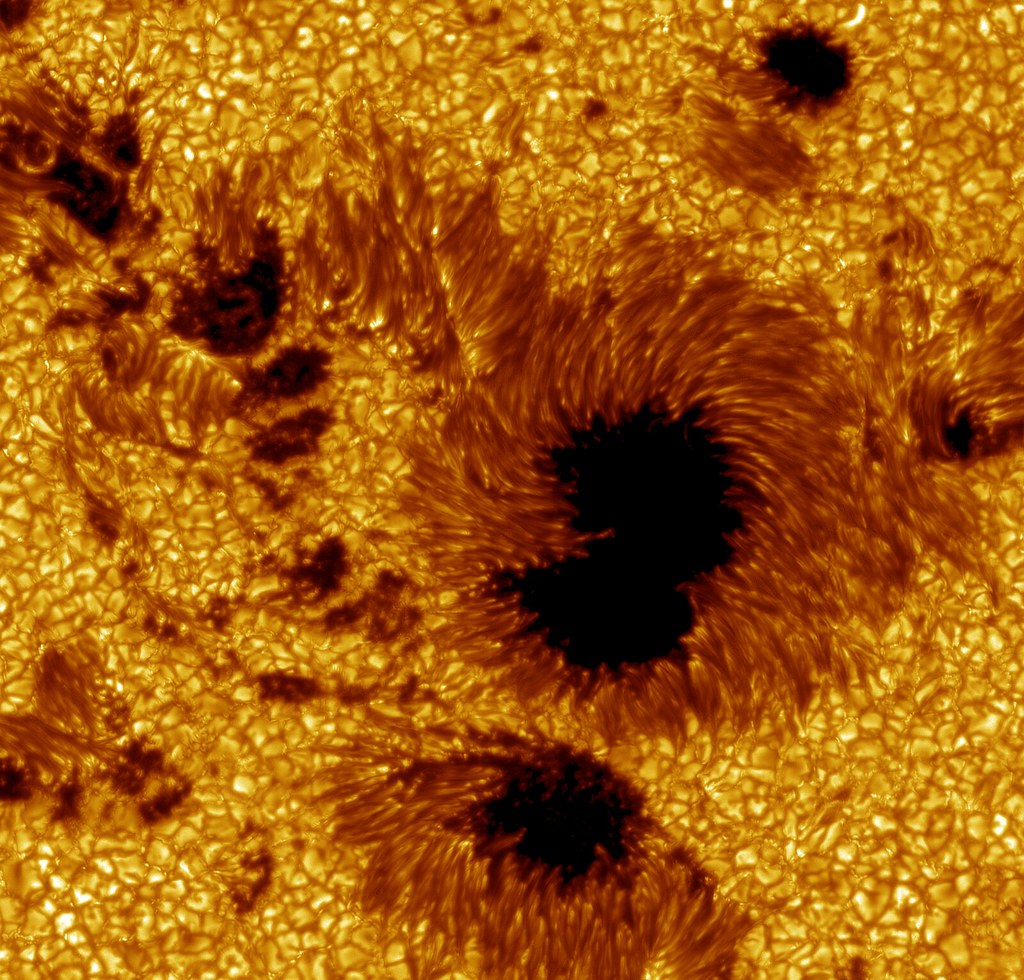
The image also has to be read carefully. Sunspots can look dramatic because they are concentrations of magnetic flux rising through the solar surface. NOAA says active regions associated with sunspot groups are among the most likely sources of flares, CMEs, radiation storms, and radio bursts, and the largest groups can span large parts of the visible solar surface.[4] But visible size is only one input. Magnetic arrangement, evolution, and flare history are what turn a large region into an operational forecast.
What To Watch
The next useful update is not a social-media screenshot of the Sun; it is NOAA's revised probability table after the region is fully visible from Earth. If R1-R2 odds rise materially, the story becomes a near-term communications watch. If R3-or-greater odds move above the current 5% line, the forecast begins to signal stronger flare concern.[2][3]
Watch whether NOAA starts issuing alerts, watches, or warnings tied to specific observed flares or storm categories. The current posture is forecast probability. A confirmed alert would mean the event threshold has been reached, not merely that a region looks capable.[2][3]
Also watch the separation between three clocks. The first is solar rotation: the active region moving into view. The second is flare timing: an electromagnetic event that can affect the sunlit ionosphere quickly. The third is CME timing: if a flare is associated with an eruption, any Earth-directed solar-wind disturbance would have its own later arrival window. Mixing those clocks is how a narrow radio-blackout forecast turns into exaggerated storm language.
Falsifier: the restrained framing here would be wrong if NOAA's next products upgrade from low geomagnetic and radiation-storm odds to an active G- or S-scale watch, or if observed flares push R-scale alerts well above the current forecast. Until then, the defensible reading is watchful but bounded: a large farside region is rotating into the forecast window, and the live risk NOAA is quantifying is radio blackouts.
Sources
- NOAA Space Weather Prediction Center, "Large Sunspot Group to Rotate into Earth View 24 June" (published June 23, 2026).
- NOAA Space Weather Prediction Center, "3-Day Forecast" text product (issued June 24, 2026 00:30 UTC).
- NOAA Space Weather Prediction Center, "Solar Flares (Radio Blackouts)" (background on R-scale mechanisms and HF impacts).
- NOAA Space Weather Prediction Center, "Sunspots/Solar Cycle" (background on active regions and sunspot magnetic structure).
- European Space Agency, "Solar Orbiter" (mission overview and observational context).
- NASA Goddard Space Flight Center, "Sunspot group" on Flickr (Royal Swedish Academy of Sciences image; archival sunspot photograph used in this post).