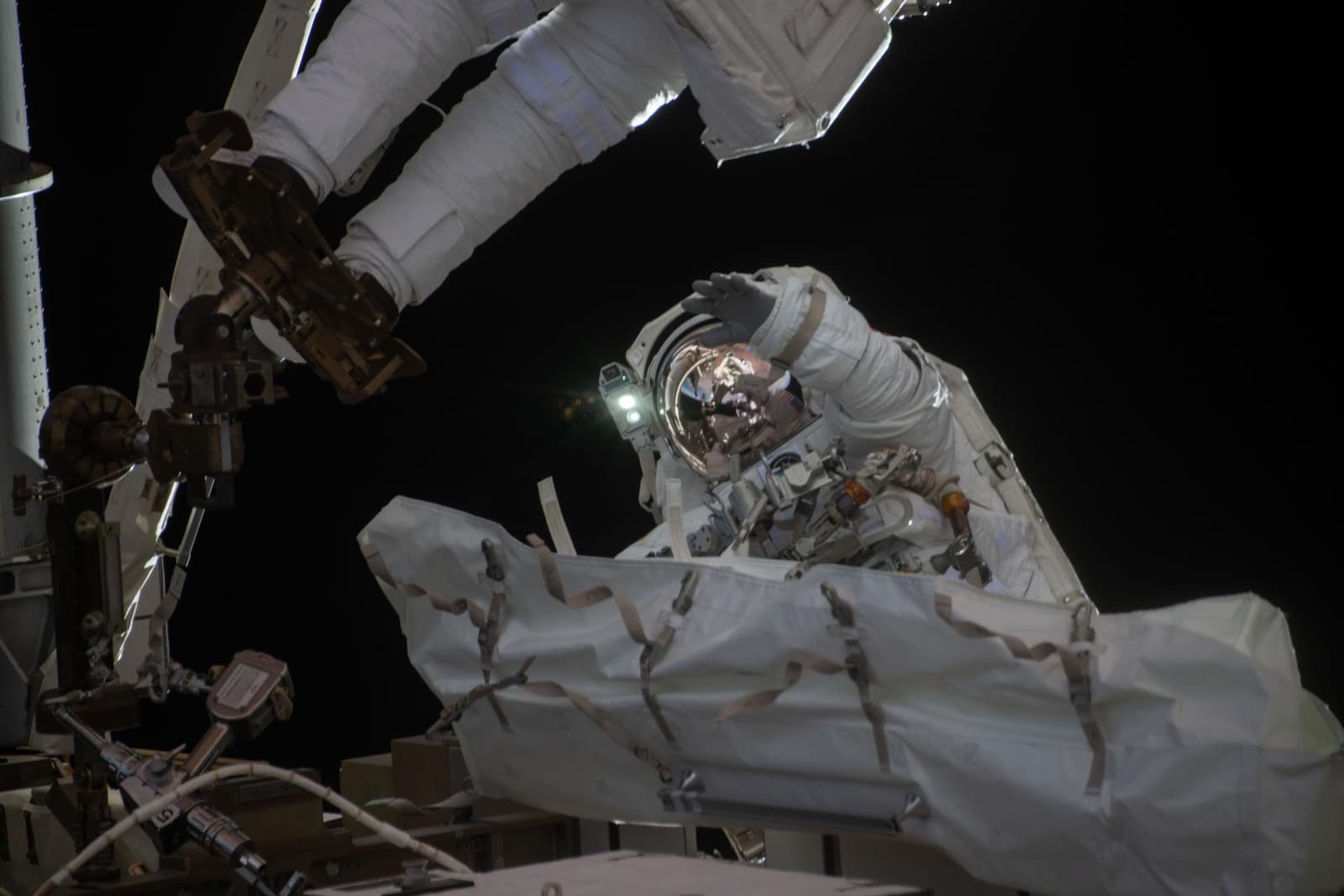
As of 2026-06-23 23:36 UTC, NASA's next U.S. spacewalk is no longer a generic station-maintenance item. It is a targeted repair of Canadarm2, the Canadian-built robotic arm that handles station hardware, supports exterior work, and has spent more than 25 years as one of the International Space Station's core operating tools.[1][4]
NASA says astronauts Chris Williams and Jessica Meir are scheduled to leave the Quest airlock on Tuesday, June 30, at about 8:35 a.m. EDT to replace a wrist joint on the arm. Live coverage is scheduled to begin at 7 a.m. EDT, and NASA and the Canadian Space Agency plan a preview briefing on Thursday, June 25, at 2 p.m. EDT.[1][5] The repair plan is straightforward in outline: a joint misbehaved, the arm is in a safe configuration, routine arm work has been paused, and a spare part already aboard the station gives the crew a defined replacement job rather than an improvised rescue.[2][3]
Fact File
| Item | What is known now | Confidence note |
|---|---|---|
| Trigger | During routine Canadarm2 operations on May 27, NASA says a wrist joint drew elevated motor current and arm motion did not occur as expected.[1][3] | Strong; NASA repeated the fault description in both the station blog and media advisory. |
| Immediate status | Standard or non-time-sensitive robotic-arm operations have been paused while the arm remains in a safe configuration.[2][3] | Strong for current status; operational priorities can change as the repair date approaches. |
| Repair plan | NASA and CSA determined a spacewalk is required, using a spare joint already on the station.[1][2][3] | Strong; both agencies describe the same path. |
| Crew and timing | Williams and Meir are assigned to exit Quest on June 30 at about 8:35 a.m. EDT; NASA expects roughly 6.5 hours outside.[1][5] | Strong for advisory timing; spacewalk start times can move with station operations. |
| System context | Canadarm2 was built to be serviced in orbit, with replaceable components and prior joint or end-effector repairs in its history.[2][4] | Strong; CSA's technical profile frames repairability as a design feature. |
What Changed
The new fact is not that an aging space-station component needs service. That is normal. The sharper change is that a maintenance design decision made decades ago is now being tested in public view: Canadarm2 can be repaired because its joints and end systems were built as replaceable space hardware rather than as sealed parts waiting for retirement.[2][4]
That matters because Canadarm2 is not decorative infrastructure. CSA describes the arm as capable of handling loads up to 116,000 kilograms, moving end-over-end along station grapple fixtures, and being controlled either from inside the station or from ground teams at CSA or NASA.[4] Space.com notes that the arm's work has included cargo-vehicle handling and exterior maintenance, and that ground controllers in Canada support more than 100 days of operations a year across the Canadian robotics suite.[6] When the arm pauses routine work, station managers lose scheduling flexibility even if the station itself remains safe.
The most important boundary is that NASA and CSA are not describing a station emergency. The arm is safe, a spare exists, and the repair is scheduled rather than urgent.[1][2][3] The risk is operational drag: delayed robotic tasks, tighter choreography around cargo and maintenance, and less margin if another station job unexpectedly needs the arm before or after the spacewalk.
Why the Wrist Joint Matters
Canadarm2's value comes from reach plus precision. It can relocate itself around the station, move large equipment, support astronauts, and work with Dextre, the smaller Canadian robotic handyman used for finer exterior tasks.[4] A wrist joint is not just one more hinge. It is part of the geometry that lets the arm approach hardware at useful angles, keep loads controlled, and turn a massive external structure into something station crews can actually position.
The repair story also shows why "25 years old" is not the same as "obsolete." CSA says Canadarm2 launched to the station in 2001, has continued roughly 10 years beyond its original design life, and was expected to need component swaps as normal wear accumulated.[2][4] Its history already includes a June 2002 wrist-roll-joint replacement and new Latching End Effectors in 2017 and 2018.[4] The current spacewalk is part of that maintenance lineage, not a surprising collapse of the system.
Decision Impact
Next 24 hours: the useful watch item is the June 25 briefing. NASA has named the crew and high-level task, but the briefing should clarify tool choreography, arm constraints during the replacement, and whether any other station work has been resequenced around the pause.[1]
Next 7 days: the June 30 spacewalk becomes the execution gate. A clean replacement would move Canadarm2 back toward normal operations and show that the spare-parts plan worked as intended. A delay would not necessarily imply danger, but it would extend the period in which station planners have less robotic flexibility.[2][3]
Next 30 days: the follow-through is whether the arm returns to ordinary station work without recurring current anomalies. The article's base assumption should be invalidated if NASA or CSA reports additional joint faults, a failed replacement attempt, or a broader suspension of robotic operations after the spacewalk.
Scenarios
Base case: Williams and Meir complete the replacement on June 30, the joint checks out, and Canadarm2 returns to regular station support after post-spacewalk verification.[1][2] The story then becomes a useful maintenance proof point for modular, repairable orbital hardware.
Upside case: the repair proceeds efficiently enough to preserve schedule margin for other station tasks. That would reinforce the value of having spares already aboard and trained EVA procedures ready for a system designed to be refurbished in orbit.[2][4]
Downside case: the joint replacement takes longer than expected, reveals a connected issue, or requires a second activity. In that case, the station is still not automatically in crisis, but cargo handling, exterior maintenance, and robotics scheduling would face a tighter planning problem.[3][6]
Action Checklist
- Treat the June 25 briefing as the source for final procedure details, not only the June 22 advisory headline.[1]
- Separate safety from schedule: NASA and CSA say the arm is safe, while routine work is constrained until the joint is replaced.[2][3]
- Watch post-repair checkouts more closely than the spacewalk start time; the real success measure is restored robotic-arm function, not simply EVA completion.[1][4]
- Keep the system history in frame: prior wrist and end-effector replacements make this a planned-maintenance architecture story, not a one-off anomaly.[4]
Sources
- NASA, "NASA to Cover US Spacewalk 95, Host Preview News Conference" (June 22, 2026).
- Canadian Space Agency, "Joint issue on Canadarm2" (June 10, 2026).
- NASA Space Station Blog, "Expedition 74 Works Scientific Installs, Suit Prep Ahead of Canadarm2 Repair Spacewalk" (June 10, 2026).
- Canadian Space Agency, "About Canadarm2."
- NASA+, "U.S. Spacewalk 95" scheduled-video page.
- Space.com, "The critical robot arm on the ISS isn't working properly, but NASA has a plan to fix it" (June 12, 2026).