As of 2026-06-24 22:32 UTC, the new global energy-access story is not that progress has stopped. It is that the easy reading of progress is no longer good enough. A joint release from the SDG7 custodian agencies says 655 million people still lack electricity, while two billion people still rely on polluting fuels and technologies for cooking.[1] Those numbers sit beside real gains: since 2010, hundreds of millions of people have gained electricity access, and clean-cooking access has expanded too.[1][2]
The tension is the news. The global electricity access rate has reached about 92%, but the remaining gap is increasingly concentrated in places where low income, rural distance, weak public budgets, high debt costs, and fragile distribution economics make each new connection harder than the last.[1][4] The report's practical warning is therefore narrower than "build more power." It is: make the connection affordable, make the service reliable, and make finance reach the communities where ordinary grid expansion has not closed the gap.
That is why the 2026 SDG7 update reads less like a victory lap than a delivery audit. The world has technologies that work. What is missing is pace, targeting, and financing structure.
Facts Now
| Item | What changed or matters | Confidence note |
|---|---|---|
| Electricity access gap | The June 24 release says 655 million people globally still lack access to electricity.[1] | High; joint release from the report's custodian agencies. |
| Regional concentration | The same release says Sub-Saharan Africa accounts for over 560 million people without electricity.[1] | High for reported estimate; country-level quality can vary. |
| Clean-cooking gap | About two billion people still use polluting cooking fuels and technologies, and Sub-Saharan Africa has 970 million people without clean cooking access.[1] | High; aligns with WHO/IEA clean-cooking framing. |
| Access pace | The report says global electricity access stagnated at 92% in 2024 and that the pace must triple to reach universal access by 2030.[1] | High for headline indicator; future pace requirement is model-based. |
| Finance mix | International public financial flows for clean energy in developing countries rose only slightly to US$24.6 billion in 2024, and about 80% of those flows were debt-based.[1] | High; important because debt-heavy finance can be a weak fit for the poorest systems. |
| Renewables split | Renewables supplied over 30% of global electricity, but low-income countries had only 33.6 watts of renewable generating capacity per person versus 1,224 watts in high-income countries.[1] | High; shows that renewable growth and equitable access are related but not identical. |
The Headline Number Hides Two Different Problems
The electricity-access gap and the clean-cooking gap are often grouped together under SDG7, but they behave differently. Electricity access can be a grid-extension problem, a mini-grid problem, a solar-home-system problem, or a reliability problem after a nominal connection has been made. Clean cooking is more intimate and stubborn: it runs through kitchens, fuel markets, stove design, household cash flow, health risk, gendered labor, and daily habit.[1][5]
That difference matters because a country can improve one without solving the other. A household may get a light bulb, phone charging, or a small appliance before it can afford a cleaner way to cook. The 2026 release says urban clean-cooking access is far higher than rural access, and it warns that 1.8 billion people could still rely on polluting fuels by 2030 without stronger action.[1] That is a health story as much as an energy story: WHO frames air pollution, including household exposure, as a major risk to human health.[1][5]
Electricity access has its own trap. A power line near a village is not the same thing as usable energy. The release explicitly names connection fees, wiring costs, and basic service affordability as obstacles even where infrastructure exists.[1] That detail is important because it changes the policy test. Counting poles and megawatts is not enough. A successful program has to answer whether households can connect, whether they can keep paying, and whether the service quality is good enough to change work, study, refrigeration, irrigation, communication, or safety.
Why Sub-Saharan Africa Is the Center of the Story
The report's most severe geography is Sub-Saharan Africa. The release says the region holds over 560 million of the people without electricity and 970 million without clean cooking access.[1] It also says the rural electricity deficit in the region grew from 376 million in 2010 to 447 million in 2024.[1] That does not mean no projects worked. It means population growth, rural dispersion, weak affordability, and implementation speed are outrunning the access machine.
This is where the mini-grid and off-grid discussion becomes practical rather than fashionable. Distributed renewable systems can serve places where the central grid is slow, expensive, or unreliable, and the release says off-grid solar and mini-grids are already serving hundreds of millions of people.[1] But distributed does not automatically mean equitable. If tariffs are too high, batteries fail, local maintenance is thin, productive-use demand is underestimated, or subsidies arrive late, a mini-grid can become a small stranded system rather than a development platform.
The strongest read is that universal energy access now depends on matching the tool to the place. Dense peri-urban areas may need grid reinforcement and cheaper connections. Remote settlements may need mini-grids or solar home systems. Health clinics, schools, mills, cold rooms, and irrigation pumps may need reliability standards higher than household lighting alone. Clean cooking may require LPG, electric cooking, bioethanol, biogas, improved biomass supply chains, or combinations that fit local fuel markets and incomes.[1][3][5]
Finance Is the Bottleneck Behind the Bottleneck
The new release's finance details are the part to watch. International public financial flows supporting clean energy in developing countries edged up from US$24.4 billion in 2023 to US$24.6 billion in 2024, while flows to least developed countries fell to US$3.7 billion, down 11% from 2023.[1] That is a bad match for the access map, because the hardest remaining gaps are precisely where cheap, patient capital matters most.
The mix also matters. If about 80% of international public clean-energy finance is debt-based, governments and utilities already under fiscal strain may hesitate to borrow for projects whose social payoff is high but whose near-term cash recovery is weak.[1] Grants, guarantees, concessional debt, results-based financing, and local-currency structures are not interchangeable details. They decide whether access projects can absorb low household ability to pay while still maintaining equipment, paying operators, and attracting private participation where it is useful.
This is the central contradiction in the 2026 update: energy access has become more urgent just as public balance sheets are tighter. The World Bank's energy materials put the issue in development terms: electricity enables jobs, services, refrigeration, irrigation, and health-care delivery, but millions still lack access or live with unreliable power.[3][4] The report's policy implication is that access finance has to be designed around the users who cannot make a conventional project-finance spreadsheet look easy.
Decision Impact
Next 24 hours: the release gives governments, development banks, donors, and energy-access companies a fresh public benchmark. The immediate risk is that the headline becomes another broad "off track" statement. The useful move is to separate electricity access, clean cooking, affordability, and finance mix instead of treating them as one generic energy-poverty number.[1][2]
Next 7 days: watch whether institutions use the July 8 launch event and the High-Level Political Forum review to name country-level delivery lanes rather than only global averages.[1][4] The strongest signals would be new grant or guarantee windows, affordability-targeted connection programs, and commitments tied to rural Sub-Saharan Africa rather than broad renewable-capacity pledges.
Next 30 days: the practical test is whether the SDG7 dashboard changes project selection. If finance continues to flow mainly as debt, and if access programs do not cover connection costs, service reliability, clean-cooking adoption, and maintenance, the world can add capacity while still missing the households most exposed to energy poverty.[1][3][4]
Scenarios
Base case: energy access continues improving, but not fast enough for the 2030 target. Electrification gains come from a mix of grid extension, mini-grids, and solar home systems, while clean cooking lags because household economics and behavior change are harder than hardware deployment.[1][5]
Upside case: the report pushes funders toward more concessional and targeted finance. If grants, guarantees, local-currency support, and results-based subsidies are used to reduce connection costs and protect maintenance, distributed renewables and grid upgrades can reach poorer rural communities faster.[1][3]
Downside case: the world celebrates renewable growth while access remains underfunded. In that branch, global renewables keep rising above the 30% electricity-share mark, but low-income countries remain far below high-income countries in capacity per person, and clean-cooking exposure keeps producing avoidable health damage.[1][5]
Action Checklist
- Treat electricity access, clean cooking, affordability, and reliability as separate metrics in program design.
- Prioritize countries and rural districts where the access deficit is growing despite global progress.
- Use grants and guarantees where household cash flow cannot support debt-heavy infrastructure economics.
- Pair mini-grid and solar-home deployment with maintenance plans, productive-use demand, and consumer protection.
- For clean cooking, fund adoption support and fuel-market reliability, not only stove distribution.
- Track whether July 2026 SDG7 follow-up produces country-specific commitments rather than broad global language.
The 2026 SDG7 release is a progress report with a harder message inside it. Universal energy access is no longer mainly a question of whether the world knows what technologies can work. It is a question of whether finance, affordability, and service design can reach the households for whom the last mile is not a metaphor but the actual distance to light, refrigeration, safe cooking, and a usable power bill.[1][2][3]
Sources
- World Health Organization, "655 million people still living without electricity underscore urgent need to deliver on universal energy access target" (June 24, 2026) - joint SDG7 release with headline access, clean-cooking, finance, renewables, and efficiency figures.
- United Nations Department of Economic and Social Affairs, "Goal 7" - SDG7 target context and 2030 access framework.
- World Bank Group, "Energy" - development framing for electricity access, unreliable power, clean cooking, and World Bank energy-access work.
- World Bank Data360, "Access to Electricity: Who Remains Without Power?" (May 2026) - Atlas story on uneven electricity access, reliability, rural Sub-Saharan Africa, and Mission 300.
- World Health Organization, "Air pollution" - health framing for household and ambient air pollution risk.
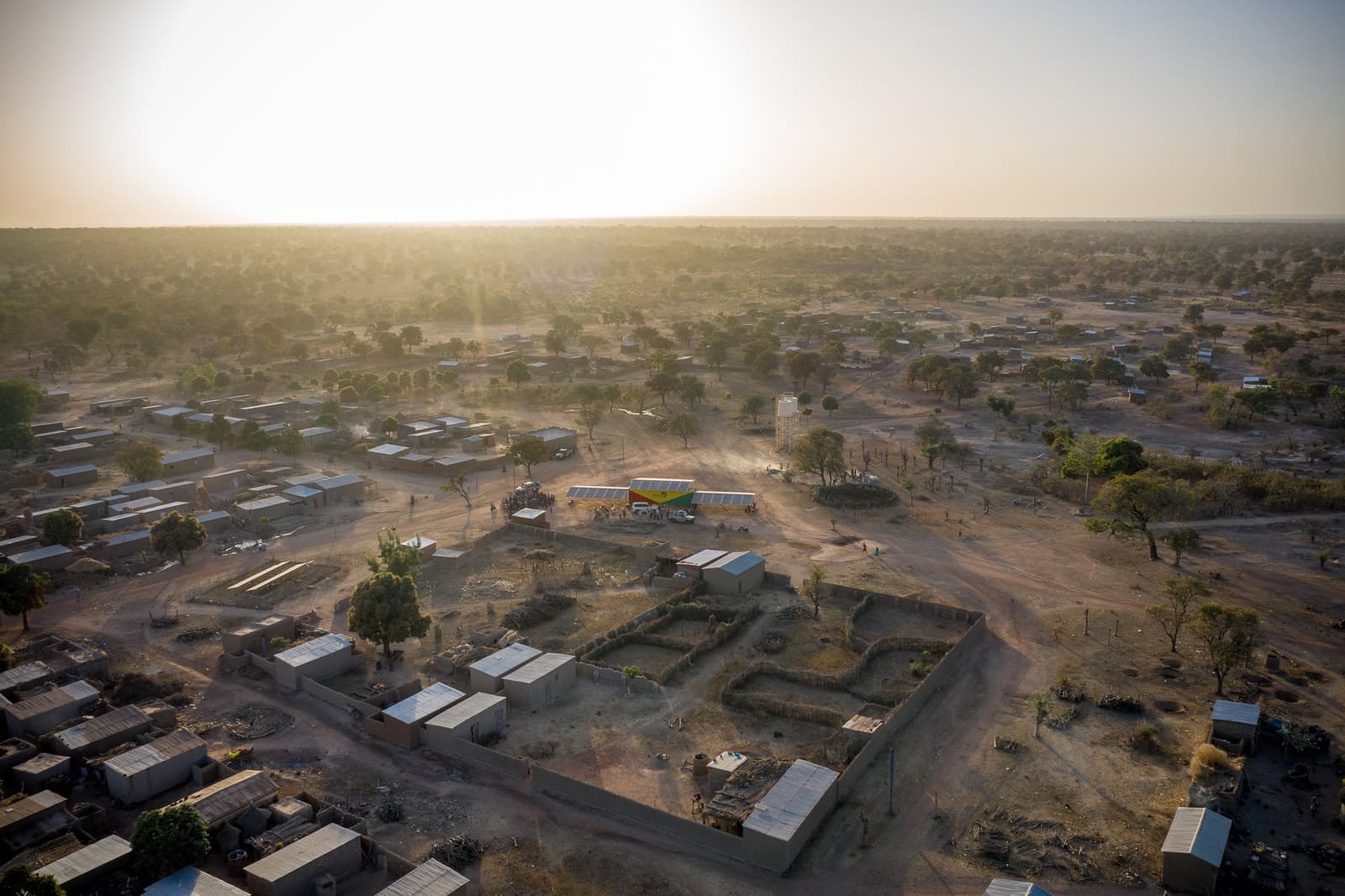
- Wikimedia Commons, "File:Solartainer in Foh (Sikasso-region) Mali.jpg" - documentary cover photograph of an off-grid solar container in rural Mali by Torsten Schreiber.