As of 2026-04-16 09:11 UTC, Kīlauea is in one of the most easily misread states a volcano can occupy: quiet enough to look finished, active enough that USGS is already pointing to the next likely episode. The Hawaiian Volcano Observatory's daily update on Wednesday morning says the Halemaʻumaʻu summit eruption is paused, but summit inflation is underway, glow and intermittent flames have been visible at the south vent, and forecast models now place the next likely lava-fountaining episode, episode 45, sometime between Sunday, April 19, and Saturday, April 25.[1]
That matters because the last burst was not a minor flicker. Episode 44 ended on April 9 after about 8.5 hours of continuous lava fountaining from the north vent, with a plume rising to roughly 15,000 feet above sea level and tephra falling into public areas of Hawaiʻi Volcanoes National Park and nearby communities.[3] The current pause should therefore be read as a reset window inside an episodic eruption sequence, not as an all-clear signal that the summit has returned to ordinary visitor conditions.[1][3][5]
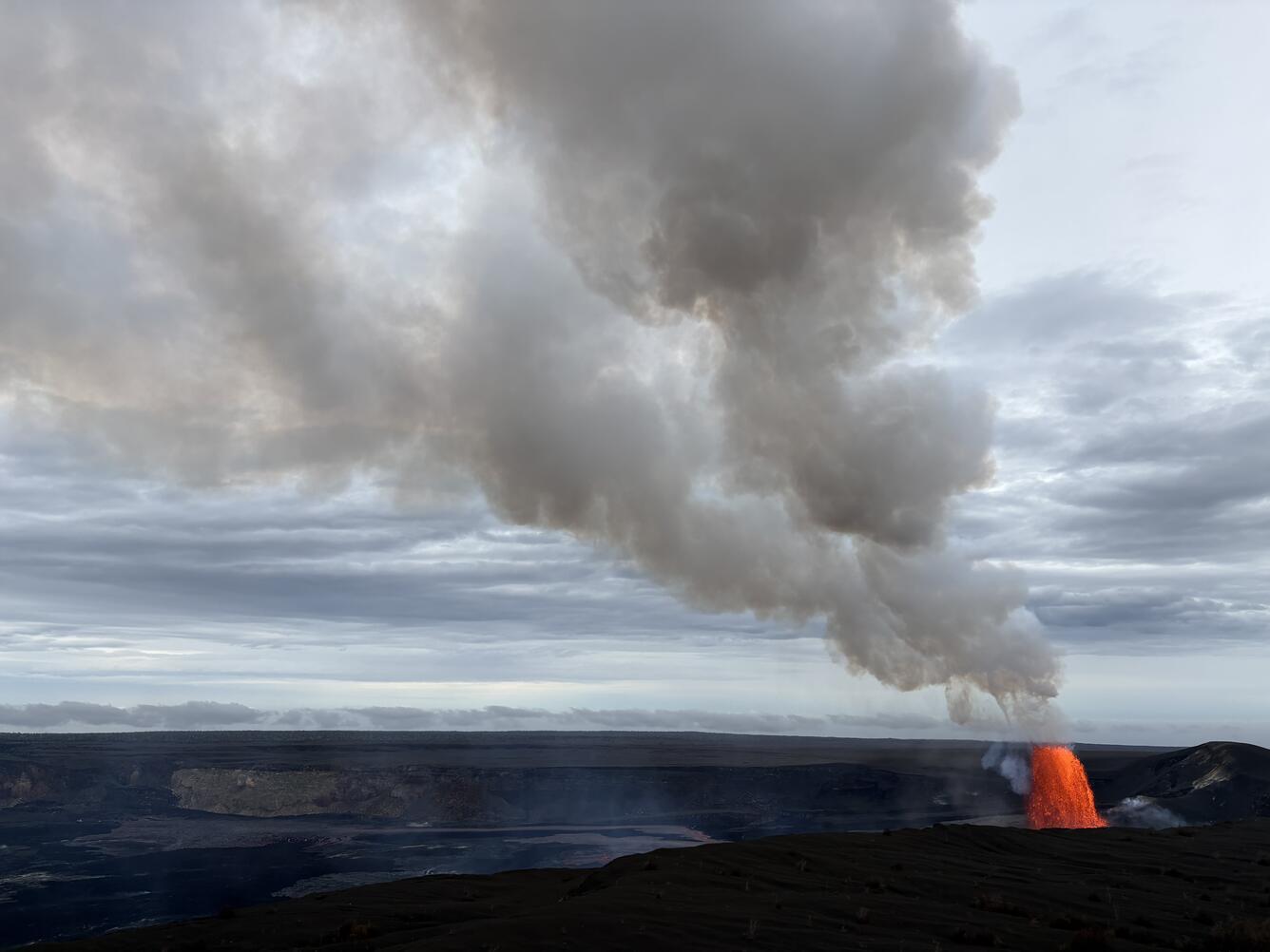
Image context: the cover photo shows episode 44 lava fountaining from Uēkahuna on April 9. It is the most relevant real-world image because the current story is not about a generic volcano. It is about a specific summit system whose most recent active phase already sent ash, Pele's hair, and other tephra beyond the closed area, which is why the next forecast window matters operationally as much as visually.[3][4][5]
Current status
- Alert posture: Kīlauea remains at Volcano Alert Level ADVISORY and Aviation Color Code YELLOW.[1]
- Immediate physical signal: USGS says summit inflation has continued since episode 44 ended, while glow and periods of flaming have remained visible at the south vent.[1]
- Forecast window: HVO's models place the next likely lava-fountaining episode between April 19 and April 25.[1]
- Monitoring recovery: most Kīlauea data streams are operating again after the radio-telemetry outage that began on April 11 and was largely restored on April 14.[1][2]
- Hazard footprint: even the last episode's relatively short fountain sent tephra into public areas north of the caldera and into adjacent communities, with fine ash and Pele's hair reported far from the vent area.[3]
- Visitor baseline: Hawaiʻi Volcanoes National Park continues to direct visitors to current conditions, air-quality alerts, and eruption-viewing guidance rather than treating the summit as an ordinary walk-up attraction.[5][6]
What changed after April 9
The cleanest way to understand the present moment is to start with what episode 44 proved. It was smaller than some of the immediately preceding episodes, but it still had enough force, duration, and wind alignment to push hazards beyond the crater interior.[3] USGS says the episode produced continuous lava fountaining from the north vent, a substantial ash-and-gas plume, and tephra fallout within the park and in neighboring communities. Highway 11 through Volcano and parts of the national park were closed during the episode, and the National Weather Service escalated from an ashfall advisory to an ashfall warning as conditions worsened.[3]
That record is why the present pause cannot be read in isolation. HVO's Wednesday update says the eruption has been episodic since December 23, 2024, with lava-fountaining episodes often lasting less than 12 hours and pauses sometimes stretching longer than three weeks.[1] In other words, a quiet summit at this stage does not necessarily mean the system is winding down. It can also mean pressure is rebuilding between discrete fountaining bursts. The return of inflationary tilt and vent glow is exactly the kind of signal USGS uses to frame that transition.[1]
Why the telemetry outage mattered, and why it matters less now
One reason the last several days were unusually tricky is that HVO lost part of its radio-telemetry network on Saturday, April 11, creating visible gaps in some seismic and other monitoring data.[2] If that outage had persisted into the next fountain-up phase, it would have complicated outside interpretation and reduced confidence in real-time public reading of the summit's progression.
But the April 15 daily update materially improved that picture. USGS says most data streams are operational again after restoration work on April 14, although some summit stations remain offline because deep tephra south of the caldera still limits access.[1][2] The practical result is not perfect visibility, but it is much closer to a normal monitoring posture than the raw outage notice suggested several days ago. That narrows one uncertainty: the observatory is no longer warning that major gaps dominate the public data picture.[1][2]
Still, restored telemetry is not the same thing as diminished hazard. The monitoring recovery helps USGS see the volcano more clearly. It does not change what the volcano can do once another episode starts. The April 9 report remains the better guide for that question: tephra can move beyond the immediate vent area, winds can turn a summit event into a broader air-quality and driving problem, and park access can change quickly once fountain height and plume direction shift.[3][5][6]
What the April 19-25 window actually means
The most important boundary in the USGS language is that the next episode is forecast, not scheduled. HVO says the current timing is based on summit inflation models and on the same pattern of precursory behavior that has separated recent eruptive episodes.[1] That makes the April 19-25 range a serious operational window, but not a promise that the next fountain will wait politely for the middle of next week.
For readers outside Hawaiʻi, the temptation is to treat that forecast like a weather countdown. The better comparison is a pressure-and-access warning. NPS already highlighted before episode 44 that a wind shift can turn the same summit eruption into a far broader public nuisance through vog and tephra fallout.[5] That matters again now because the next episode's public effect will depend on more than whether lava reappears. It will depend on which vent leads, how high fountains climb, and where the wind sends the plume.[1][3][5]
So the key news signal is not that USGS has solved the exact timing. It is that the observatory has enough recovered monitoring, enough inflation, and enough visible vent activity to frame the next watch period in days rather than in some vague future horizon.[1][2]
What to watch next
The first thing to watch is whether inflation, glow, and gas behavior continue to strengthen over the next several days.[1] The second is whether HVO begins posting short observatory messages about overflows, spattering, or stronger tremor before a full fountain-up phase, because episode 44 was preceded by repeated overflow activity rather than by a single abrupt switch.[3] The third is the park's visitor guidance: if air quality worsens or fallout risk rises, closures and route changes can become part of the story quickly.[5][6]
The most accurate bottom line is therefore procedural rather than dramatic. Kīlauea is paused, but the observatory is treating that pause as a between-episodes state. As of April 16, the live question is not whether the summit looks calm in a single frame. It is whether the rebuilt monitoring picture, the renewed inflation, and the vent behavior are pointing toward another short, high-impact summit episode inside the April 19-25 window that USGS is now openly flagging.[1][2][3]
Sources
- U.S. Geological Survey Hawaiian Volcano Observatory, "Hawaiian Volcano Observatory Daily Update" for Kīlauea (Wednesday, April 15, 2026, 17:48 UTC).
- U.S. Geological Survey Hawaiian Volcano Observatory, "Information Statement" on the partial monitoring network outage (April 12, 2026).
- U.S. Geological Survey Hawaiian Volcano Observatory, "Status Report" for Kīlauea episode 44 (April 10, 2026).
- U.S. Geological Survey, "April 9, 2026 episode 44 lava fountaining from Uēkahuna" (direct image asset used for the article cover).
- Hawaiʻi Volcanoes National Park, "Hawaiʻi Volcanoes National Park prepares for next eruption" (April 3, 2026).
- Hawaiʻi Volcanoes National Park, "Current Conditions" (closures, air quality, and visitor alerts).