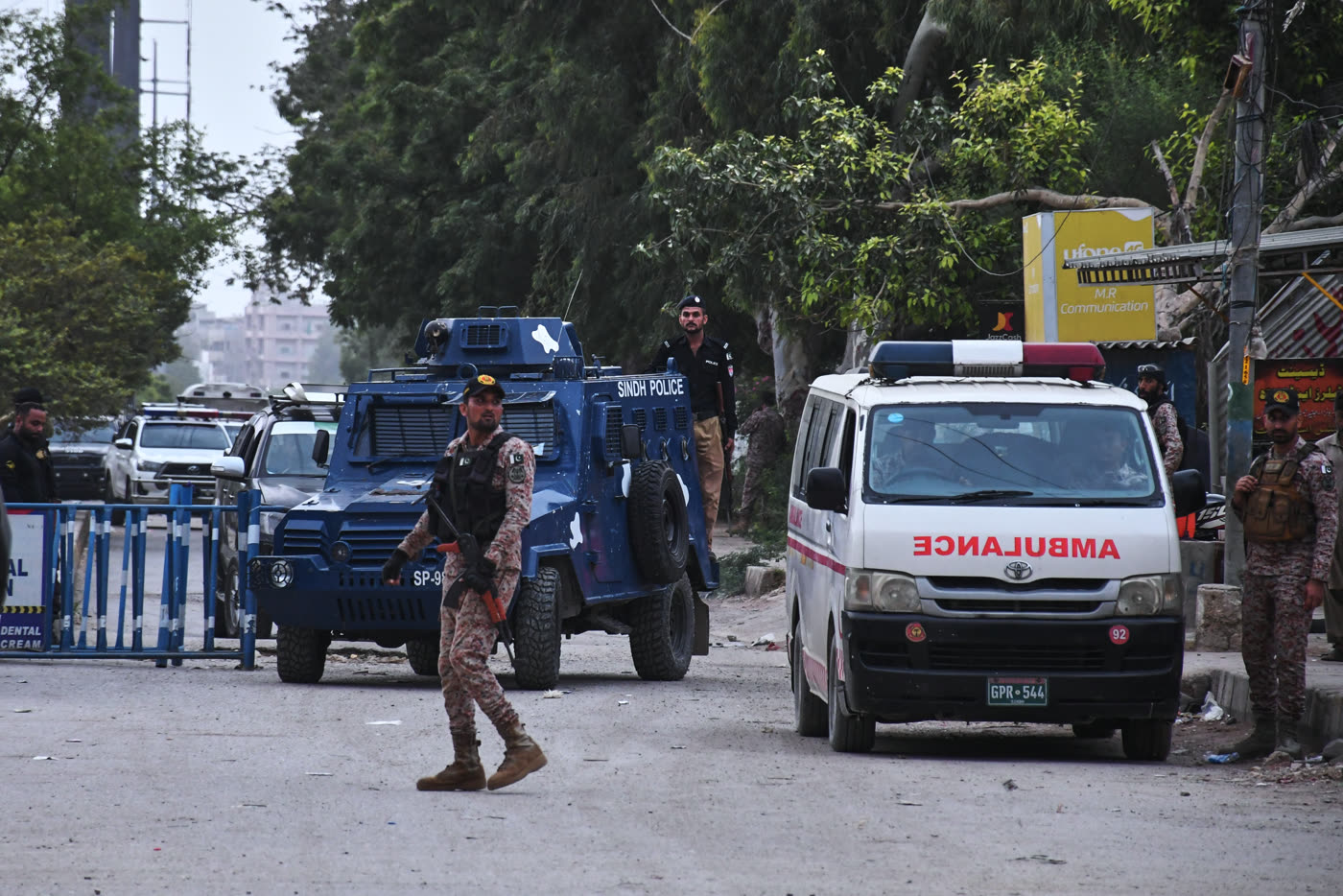
As of 2026-06-28 09:40 UTC, the useful reading of the attack on a Pakistan Rangers facility in Karachi is not simply that militants struck again. It is that the first response clock has split into three lanes: keep the casualty and clearance record accurate, identify the attackers without over-reading early claims, and prevent attribution language from forcing a wider Pakistan-Afghanistan or Pakistan-India escalation before evidence is public.
Associated Press, Dawn, and Reuters reported that three Rangers personnel were killed and four were wounded after attackers struck the Pakistan Rangers (Sindh) camp in Karachi's Gulistan-i-Jauhar area late on June 27.[1][2][3] Dawn, citing Pakistan's military public-relations wing, said three Jamaatul Ahrar attackers were killed and one injured attacker, described by the military as an Afghan national, was captured.[2] Reuters carried the same basic count through The Star, while Al Jazeera and Xinhua reported earlier police-linked accounts saying four attackers were killed.[3][4][5] That difference is not a contradiction to dramatize; it is a normal early-reporting boundary. The hard fact is the casualty toll among security personnel. The exact attacker status should be treated as provisional until the security operation, custody record, and forensic account converge.
The broader risk is that attribution can move faster than evidence. Pakistan's military attributed the attack to Jamaatul Ahrar and used its now-familiar language of externally backed or India-linked militancy.[1][2] Jamaatul Ahrar's connection to the Pakistani Taliban orbit is relevant to the security problem, but the sponsorship claim is a separate evidentiary matter. The decision failure to avoid is simple: turning a captured suspect, a group label, and a political accusation into one merged conclusion before officials publish what was found at the site, who planned the vehicle-borne blast, and where the weapons, phone records, financing, or safe houses point.
Fact File
| Signal | What is known now | Confidence note |
|---|---|---|
| Attack site | The target was a Pakistan Rangers (Sindh) facility in Gulistan-i-Jauhar, with Dawn placing the attack around the Block 5 / Mosamiyat Chowrangi area and describing a vehicle-borne improvised explosive device followed by gunfire.[2] | High for site and attack pattern; exact tactical sequencing can be refined by investigators. |
| Casualties | Three Rangers personnel were killed and four soldiers were wounded, according to AP, Dawn, and Reuters-linked reporting.[1][2][3] | High; multiple credible outlets align on the security-force toll. |
| Attacker outcome | Dawn and Reuters reported three attackers killed and one captured; Al Jazeera and Xinhua carried initial accounts that four attackers were killed.[2][3][4][5] | Medium; early casualty/status counts often change after clearance and custody confirmation. |
| Attribution | Dawn and Reuters identify the assailants as Jamaatul Ahrar militants, with Dawn citing the military's statement.[2][3] | Medium-high for claimed group attribution; lower for any state-sponsorship claim until supporting evidence is public. |
| Trend backdrop | Dawn, citing Pakistan Institute for Conflict and Security Studies data, said Pakistan saw 128 terrorist attacks in May, up from 101 in April.[2] | Medium-high for trend context; it does not prove operational linkage to this specific Karachi cell. |
| Urban significance | Reuters reported the attack was the most significant in Karachi since an October 2024 blast targeting a Chinese convoy, while Dawn points back to the February 2023 Karachi Police Office assault as the previous major security-installation case.[2][3] | Medium-high; useful as context, not a full Karachi threat baseline. |
Decision Impact
Next 24 hours: the operating priority is clean separation between clearance, casualty notification, and attribution. Karachi authorities need a reliable site record before political statements harden. Residents, universities, hospitals, and businesses near Gulistan-i-Jauhar need practical information: which roads remain closed, whether there are secondary searches, and when normal movement resumes. Public communication should avoid inflating the attacker count or treating sponsorship claims as established evidence.[2][4]
Next 7 days: the key test becomes whether the captured attacker, if the custody report holds, produces a narrow investigative trail rather than a broad political one. A useful response would identify facilitators, vehicles, explosives supply, rented rooms, phone contacts, and local reconnaissance. A weaker response would rely mostly on labels. Pakistan's security planners also have to ask an operational question: if attackers could ram a Rangers gate with an explosive vehicle in Karachi, which other urban security compounds have the same approach-road vulnerability?
Next 30 days: the file moves from Karachi policing to regional signaling. CFR's Global Conflict Tracker describes Pakistan's militancy problem as tied to the Pakistani Taliban and instability along the Afghanistan border, with Islamabad and Kabul repeatedly accusing each other over militant safe haven and cross-border violence.[6] If Pakistan says the captured attacker or forensic trail points into Afghanistan, pressure for raids, strikes, expulsions, or border restrictions will rise. If the evidence stays local or ambiguous, the better response is narrower: Karachi cell mapping, perimeter redesign, and intelligence work inside Sindh rather than a regional escalation cycle.
Scenarios
Base case: the attack is contained as a major but bounded counterterrorism case. The site is cleared, the injured stabilize, the captured suspect remains in custody, and investigators pursue local facilitators. The trigger that keeps this path intact is evidence-led language: officials distinguish the attackers' group identity from larger claims about who enabled them.[1][2][3]
Upside case: the captured attacker materially improves the investigation. That means usable information on reconnaissance, safe houses, explosive assembly, and local support, followed by arrests that are specific enough to reduce copycat risk. The visible proof would be a sequence of named search operations and recovered materials rather than only generalized vows of revenge.
Downside case: attribution outruns verification. If Pakistan publicly treats the attack as proof of Afghan or Indian direction before releasing supporting evidence, the crisis can become larger than the Karachi cell. The clearest downside triggers would be cross-border strikes, mass detentions untethered to evidence, diplomatic expulsions, or new attacks on urban security installations framed as retaliation.[3][6]
Action Checklist
- Track confirmed casualty and custody updates separately from claims of responsibility or sponsorship.
- Watch whether officials publish forensic details: vehicle origin, explosives type, phone data, weapons, safe houses, or financial links.
- Treat "Jamaatul Ahrar" and "foreign-backed" as different categories; one identifies an alleged militant network, the other asserts a sponsor.
- For Karachi residents and institutions, use road closures, school or university advisories, and hospital load as practical near-term indicators of disruption.
- For regional-risk monitoring, watch Pakistan's wording toward Kabul first; that is where a local attack can become a border-pressure file.[3][6]
- Reassess if the attacker count changes, if the captured-suspect claim is withdrawn, or if independent reporting contradicts the official sequence.
The main invalidation condition is a converged investigative record that points away from the current group attribution or substantially changes the attacker count, custody status, or casualty toll. Until then, the most disciplined reading is narrow: Karachi suffered a serious attack on a security facility, but the policy choice is whether the response remains evidence-led or becomes an escalation machine.
Sources
- Associated Press, "Pakistan's military says 3 soldiers were killed in militant attack in Karachi and vows retaliation" (June 28, 2026) - current casualty count, military attribution, and AP cover photograph context.
- Dawn, "3 personnel martyred as attack on Rangers facility in Karachi foiled: ISPR" (June 28, 2026) - local reporting on location, attack pattern, ISPR statement, attacker count, road closures, and PICSS trend context.
- Reuters via The Star, "Three Pakistani rangers killed in Karachi attack, military says" (June 28, 2026) - Reuters reporting on the blast, gunfire, witness account, casualty count, captured attacker, and regional escalation risk.
- Al Jazeera, "Three security personnel killed in attack in Pakistan's Karachi" (June 27, 2026; modified June 27, 2026) - early police-linked report on the Rangers facility attack and attacker count uncertainty.
- Xinhua, "3 paramilitary soldiers, 4 terrorists killed in attack on paramilitary camp in Pakistan's Karachi" (June 28, 2026) - wire account of the attack, casualty count, and official condemnation.
- Council on Foreign Relations, Global Conflict Tracker, "Islamist Militancy in Pakistan" - background on Pakistani Taliban-linked militancy, Afghanistan-border tensions, and Pakistan's counterterrorism context.