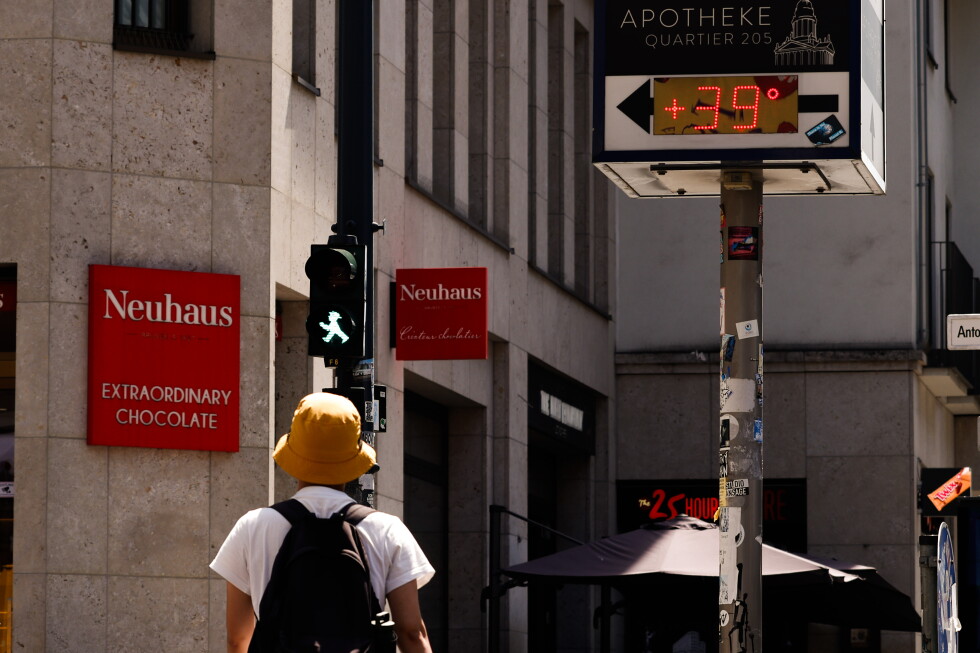
As of 2026-06-28 11:35 UTC, Europe's late-June heatwave has moved beyond a simple record chase. The useful read is that temperature verification, public-health response, transport reliability, event planning, and power resilience are now running on the same clock.
Associated Press reported record temperatures across Switzerland, Denmark, and Czechia, with Germany seeing heat damage on the Autobahn and travel warnings, France facing hospital pressure and postponed events, and Italy under red alerts.[1] The UK Met Office, meanwhile, said Santon Downham in Suffolk provisionally reached 37.3 degrees Celsius on June 26, which would be the UK's third consecutive new June maximum-temperature record if verified.[2] The Guardian reported that more than 191 million people in Europe faced temperatures of at least 35 degrees Celsius on Sunday as the heat shifted east into Germany, Czechia, Poland, Hungary, and Slovakia.[3]
The analysis problem is timing. Meteorological agencies have to verify records slowly enough to protect the climate archive. Emergency managers have to act quickly enough to protect people, roads, railways, schools, hospitals, and public events. Those two speeds are both legitimate, but they create tension when the same day produces provisional national records, ambulance pressure, course-shortened races, rail advisories, power cuts, and storm damage.
Fact File
| Signal | What is known now | Confidence note |
|---|---|---|
| UK record verification | The Met Office said Santon Downham provisionally reached 37.3C on June 26, exceeding June figures reported on June 24 and 25. It also said any national records must pass site and equipment checks before entering the official record.[2] | High for provisional reading and verification process; final record status remains pending. |
| Continental record spread | AP reported record heat in Switzerland, Denmark, and Czechia; The Guardian reported Denmark's 36.6C reading north of Odense as its highest since measurements began in 1874, while Czechia's all-time record was broken Saturday and expected to be challenged again Sunday.[1][3] | High for broad record pattern; exact country records should be treated as provisional where national services have not completed validation. |
| Population exposure | The Guardian reported that more than 191 million people in Europe faced at least 35C on Sunday, with extreme heat warnings in Germany, Czechia, Poland, and Hungary.[3] | Medium-high; useful for scale, but exposure estimates change with forecast updates and thresholds. |
| Surface heat | Copernicus Sentinel-3 observations for June 23 showed land surface temperatures exceeding 50C in parts of central and southern France and northern Spain, while noting that land surface temperature is not the same as air temperature.[4] | High for satellite observation and boundary note; not directly comparable to weather-station air records. |
| Operational disruption | Euronews reported power cuts, UK school closures, restricted hours at Paris landmarks, Italian city heat warnings, and drowning deaths as people sought cooling during the heatwave.[5] The Guardian also reported Deutsche Bahn nonessential-travel advice and heat damage to a lane of Germany's A7 autobahn.[3] | Medium-high; event, transport, and utility details are real-time and can be revised. |
| Health timing | WHO says heat deaths and hospitalizations can occur rapidly, on the same day or following days, and that heat can disrupt transport, water, power, and health-service capacity.[6] | High for mechanism; not a real-time mortality count for this event. |
What The Records Do Not Settle
The record numbers matter, but they do not tell authorities what to do by themselves. A verified temperature record is a climate datum. A heat emergency is an operating condition. The difference is why the UK Met Office can properly say that the Santon Downham value needs equipment and site checks, while local agencies still need to decide in real time whether to keep schools open, staff ambulances differently, delay outdoor events, change rail guidance, or open cooling support.[2][5]
The Copernicus image of the day makes the boundary visible. Its Sentinel-3 land-surface map showed patches above 50C, but the accompanying note explicitly distinguishes ground temperature from air temperature.[4] That distinction is not pedantry. Asphalt, roofs, fields, and plazas can become dangerously hot before a national air-temperature record is certified. The public experiences that heat through pavement, train tracks, classrooms, apartments, and outdoor work sites, not through the final status of a weather-station reading.
The movement east also changes the risk. Western Europe has already absorbed records, hospital strain, school and event disruptions, power incidents, and storm-after-heat damage.[3][5] As the system pushes toward central and eastern Europe, the question is not only whether Poland, Czechia, or Slovakia breaks old temperature marks. It is whether the institutions in the path of the heat can update warnings, staffing, public transport advice, and vulnerable-person checks before the hottest hours arrive.
Decision Impact
Next 24 hours: treat Sunday and Monday as an operations window, not a retrospective climate debate. Authorities in the hottest zones need to keep public guidance concrete: when to avoid exertion, where cooling is available, what travel is discouraged, which events are delayed, and which schools, care homes, hospitals, and outdoor employers have changed procedures. The clearest near-term failure would be agencies celebrating or disputing records while residents cannot tell what changes for them today.[2][3][6]
Next 7 days: the record-verification and public-health tracks should start to converge. The Met Office's process shows why official records take care and time; WHO's heat guidance shows why health effects cannot wait for final climatological confirmation.[2][6] The useful next-week indicators are ambulance calls, emergency admissions, rail cancellations, power incidents, school closures, water restrictions, and revised event permits, not only the final leaderboard of national highs.
Next 30 days: Europe will need a post-event audit that separates three questions. Which temperature records were verified? Which systems strained or failed? Which interventions reduced harm? A city that avoided hospital overload or kept transport running may have learned more than a city that merely posted the higher temperature. Conversely, a place with no national record can still have a serious heat emergency if night-time temperatures remain high and vulnerable residents cannot cool down.[3][6]
Scenarios
Base case: the heatwave remains severe but administratively manageable. Some provisional records are confirmed, some are adjusted or rejected, and the strongest operational stress appears in predictable channels: rail cautions, road-surface damage, event changes, hospital pressure, and public cooling demand. The trigger that keeps this case intact is clear, practical guidance from national and local agencies while the hottest air shifts east.[1][2][3]
Upside case: the record wave forces better synchronization. Meteorological services explain provisional versus official records clearly, public-health agencies publish timely burden indicators, rail and road operators pre-empt predictable heat failure points, and event organizers make earlier changes instead of last-minute cancellations. The proof would be fewer surprise closures and better published reasons for each disruption.[2][5][6]
Downside case: institutions lag the heat. The warning signs would be late school decisions, unexplained rail disruption, hospitals reporting pressure after capacity has already tightened, power or water incidents without local mitigation, and mortality figures emerging only after the event has moved on. In that case, the heatwave would expose not only a hotter climate baseline but also a coordination gap between weather data and public operations.[3][5][6]
Action Checklist
- Follow national weather agencies for record verification, but do not wait for final record status before acting on heat warnings.[2]
- Track local operational signals: rail advisories, road closures, power outages, hospital pressure, school decisions, event changes, and water-use guidance.[3][5]
- Treat satellite land-surface heat as a stress indicator for pavement, roofs, fields, and urban spaces, not as a direct replacement for air-temperature records.[4]
- Watch night-time temperatures closely; persistent warm nights reduce recovery time for people and infrastructure.[3][6]
- Mark mortality and hospital figures as provisional until official public-health agencies publish confirmed counts.[3][6]
- Reassess the event if thunderstorms, wildfire smoke, or power disruptions become the dominant risk rather than heat alone.[3][5]
The main invalidation condition is straightforward: if the next confirmed updates show that the highest readings were localized, records fail verification, health-system pressure eases quickly, and transport/power disruption remains limited, this becomes a sharp but bounded late-June heat event. If records validate while operational strain and delayed health counts grow, the story is larger: Europe will have just tested whether its summer systems can move at the speed of extreme heat.
Sources
- Associated Press, "Sweltering heat wave sets new records across Europe" (June 27, 2026) - record heat in Switzerland, Denmark, and Czechia; Germany travel and Autobahn damage; France hospital/event pressure; Italy red alerts; and AP cover photograph context.
- UK Met Office, "Third consecutive day of a new June temperature record with end of heatwave in sight" (June 26, 2026) - provisional Santon Downham reading, June record sequence, alert context, and official verification process.
- The Guardian, "Temperature records tumble across Europe as heatwave moves east" (June 28, 2026) - population exposure estimate, central/eastern Europe warnings, Denmark and Czechia records, rail advice, health-pressure reports, and storm/power disruptions.
- EU Space Support Office / Copernicus, "Heatwave affecting Western Europe in the third decade of June 2026" - Sentinel-3 land-surface temperature observation, France/Spain heatwave context, and air-versus-surface temperature boundary.
- Euronews, "Europe heatwave: Power cuts, school closures and 40 deaths in France" (June 24, 2026) - early operational disruptions, school closures, landmark restrictions, Italian warnings, and cooling-related drowning risk.
- World Health Organization, "Heat and health" fact sheet - heat-health mechanisms, rapid hospitalization/mortality timing, vulnerable groups, and infrastructure/service disruption risks.