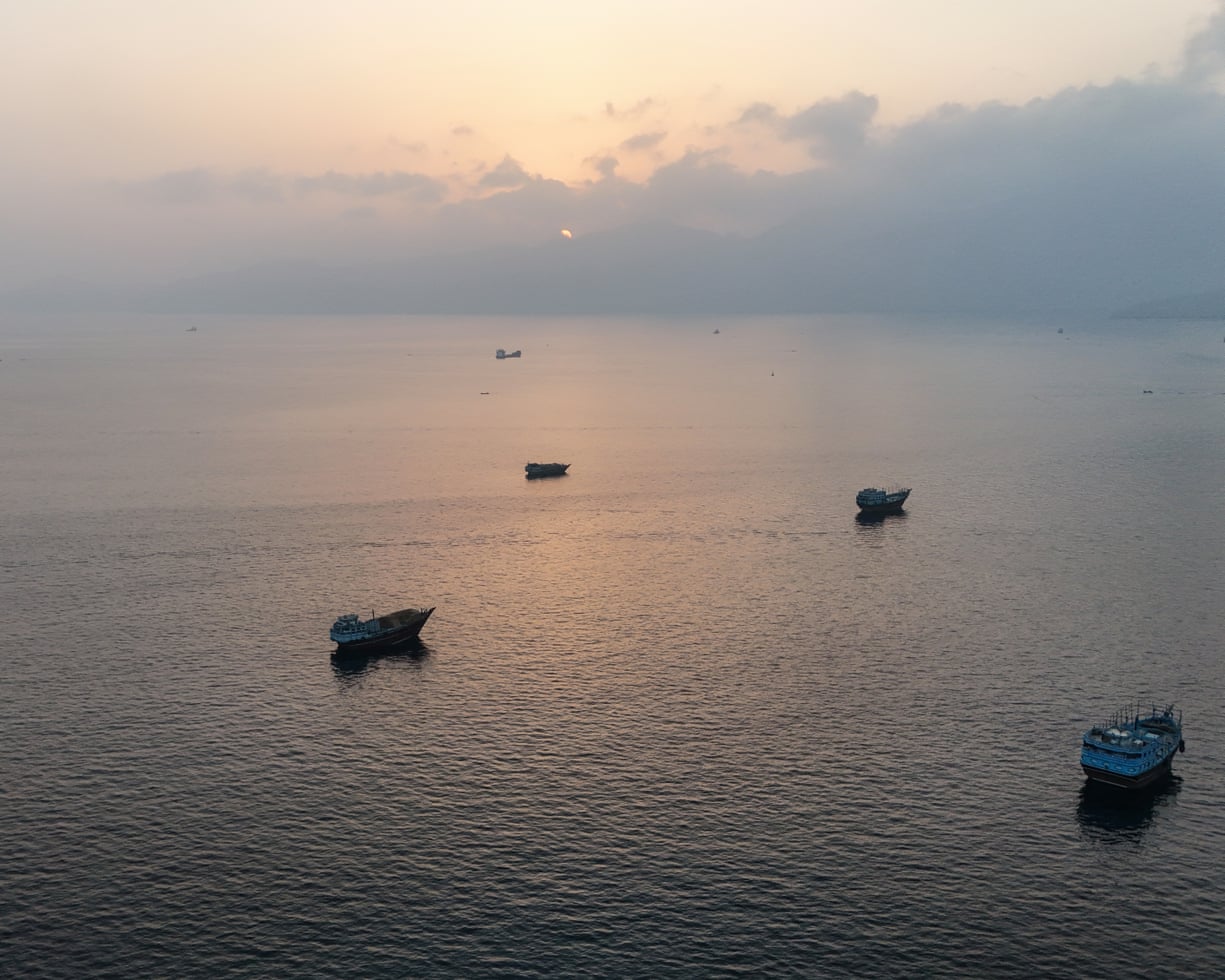
As of 2026-06-28 07:36 UTC, the useful reading of the latest Gulf escalation is not simply that the U.S.-Iran ceasefire is fragile. It is that the ceasefire is now being tested through host states. Associated Press and Al Jazeera reported that Iran said it launched drone and missile attacks tied to Kuwait and Bahrain after U.S. strikes on Iranian coastal and maritime targets, while The Guardian reported that Bahrain and Kuwait denounced the attacks and that it was not yet clear what, if anything, had been hit.[1][2][3]
That distinction matters because Kuwait and Bahrain are not interchangeable backdrops. Bahrain is central to the U.S. naval posture in the region: a 2025 Congressional Research Service report says Bahrain has hosted a U.S. naval command headquarters since 1948 and that Naval Support Activity Bahrain in Manama is the headquarters of the U.S. Navy's Fifth Fleet.[5] Kuwait is also part of the broader U.S. regional basing network. When missiles, drones, alerts, or claims move through those countries, the crisis stops being only a Washington-Tehran exchange and becomes a sovereignty-management problem for Gulf capitals.
The uncertainty boundary is important. Current reporting is still split between claims, denunciations, and incomplete damage information. Treat confirmed damage and casualties as provisional until official host-government, U.S. military, and independent reporting converge.[1][2][3]
Fact File
| Signal | What is known now | Confidence note |
|---|---|---|
| Current trigger | AP and Al Jazeera report that Iran said it targeted U.S.-linked military sites in Kuwait and Bahrain after U.S. strikes on Iranian coastal locations and maritime-related infrastructure.[1][3] | Medium-high for the claim and sequence; lower for exact battle-damage details. |
| Host-state reaction | The Guardian reports that Bahrain and Kuwait denounced the Iranian attacks, while the immediate physical effects remained unclear.[2] | Medium-high; diplomatic reaction is clearer than damage assessment. |
| Maritime context | AP places the flare-up inside efforts to reopen or manage Strait of Hormuz traffic after attacks on vessels and U.S. responses near Iran's coast.[1] | Medium-high; operational details can change quickly. |
| Strategic geography | EIA says 2024 oil flows through the Strait of Hormuz averaged 20 million barrels per day, about 20% of global petroleum liquids consumption, and about one-fifth of global LNG trade also moved through the strait.[4] | High for EIA baseline; it is not a real-time traffic count. |
| U.S. basing relevance | CRS identifies NSA Bahrain in Manama as the U.S. Fifth Fleet headquarters and notes the command relationship dates back decades, explaining why Bahrain is not just another Gulf location in this crisis.[5] | High for public basing context; current readiness details are separate. |
Decision Impact
Next 24 hours: the main question is whether the attacks produce acknowledged casualties, infrastructure damage, or new U.S. retaliation. If not, diplomacy still has room to frame the episode as contained escalation. If yes, host governments will face pressure to demand deterrence while also preventing their territory from becoming the next escalation lane.[1][2]
Next 7 days: watch whether maritime routing, insurance, port calls, and tanker behavior change more than official statements do. EIA's Hormuz baseline explains why even partial uncertainty has global price and logistics consequences: the waterway is not merely symbolic; it is a concentrated transit system for oil and LNG.[4]
Next 30 days: the stability test moves to basing politics. A ceasefire that repeatedly pushes risk onto Kuwait, Bahrain, Qatar, Oman, or the UAE will become harder for Gulf governments to host quietly. The U.S. can keep striking Iranian launch, radar, drone, or mining assets, but the political cost rises if local publics see U.S. access as importing retaliation into their own airspace and cities.[1][2][5]
Scenarios
Base case: both sides keep the episode bounded. Iran claims retaliation, the U.S. signals it will answer attacks on ships or bases, Gulf governments condemn violations of sovereignty, and negotiators keep some ceasefire channel open. The trigger to watch is whether subsequent statements shift from punishment language back toward verification and deconfliction.[1][3]
Upside case: the attacks make host-state risk visible enough to force tighter rules. That could mean clearer maritime corridors, stronger notification channels, explicit limits on strikes from or near host territory, and a narrower set of agreed ceasefire violations. The proof would be fewer claims of ambiguous base attacks and more public operational guidance for shippers.[1][4]
Downside case: ambiguous damage becomes an invitation to test again. If Tehran sees attacks near Gulf bases as a low-cost way to answer U.S. strikes, and Washington sees each ship or base claim as proof the ceasefire is being exploited, the crisis can escalate without either side formally renouncing talks. Host states would then absorb the political and physical risk of a war they are trying to contain.[2][3][5]
Action Checklist
- Separate claims from confirmed effects: who said an attack happened is not the same as what was damaged.
- Track host-government language, not only U.S. and Iranian statements; Kuwait and Bahrain are now part of the escalation map.
- Treat Hormuz traffic, tanker insurance, and port operations as practical indicators of market fear.
- Watch for U.S. military wording that distinguishes defense of forces from broader coercive strikes.
- Watch for Iranian wording that threatens negotiation channels; that is the clearest sign the ceasefire process itself is becoming leverage.
- Reassess if independent reporting confirms major casualties, major base damage, or a sustained interruption of inbound and outbound traffic near Hormuz.
The main invalidation condition is straightforward: if the next round of verified reporting shows no material base damage, no sustained shipping disruption, and resumed U.S.-Iran implementation talks, this looks like a dangerous but contained retaliation cycle. If damage or traffic disruption is confirmed, the story becomes larger: Gulf host states will have become the arena where the ceasefire either hardens into rules or breaks into a wider regional security crisis.
Sources
- Associated Press, "Iran targets Bahrain and Kuwait with drones and missiles" (June 28, 2026) - current attack chain, Guard claim, U.S. strikes, Strait route context, and ceasefire uncertainty.
- The Guardian, "US and Iran trade strikes as both sides accuse the other of endangering ceasefire" (June 27, 2026) - Bahrain and Kuwait reaction, uncertainty over what was hit, and cover photograph source.
- Al Jazeera, "Iran attacks Bahrain, Kuwait after US attacks, warns of 'crushing response'" live coverage (June 28, 2026) - live escalation updates and U.S. strike context around Sirik, Qeshm, and Hormuz.
- U.S. Energy Information Administration, "Amid regional conflict, the Strait of Hormuz remains critical oil chokepoint" (June 23, 2025) - oil-flow, petroleum-consumption, LNG-trade, and bypass-capacity baseline.
- Congressional Research Service, Bahrain: Issues for U.S. Policy (April 11, 2025) - Bahrain's U.S. naval command history, NSA Bahrain, Fifth Fleet headquarters, defense cooperation, and Gulf-policy context.