As of 2026-05-12 04:33 UTC, NASA and SpaceX are targeting 7:16 p.m. EDT on May 12 (23:16 UTC) to launch the CRS-34 Dragon cargo mission to the International Space Station, with autonomous docking scheduled for about 9:50 a.m. EDT on May 14.[2][4] Read narrowly, that is one more cargo run. Read against NASA's May 1 station schedule reset, it is the first live test of a tighter traffic pattern that now reaches from this May launch through a mid-September Crew-13 move-up, a fall CRS-35 mission, and a fall/winter NG-25 cargo slot, while a Boeing Starliner-1 cargo mission remains under review.[1]
That is why this launch matters more than its routine label suggests. NASA's own schedule note says the revised sequence is meant to better align logistics, mission planning, and timing for station operations.[1] Inference from the May 1 and May 6 NASA documents: CRS-34 is where that revised plan stops being a calendar and starts becoming a handoff chain. If Dragon launches and docks close to plan, the station gets a fresh science cycle, a new exterior instrument for space-weather work, and a cleaner bridge into a denser second half of 2026.[1][2][3][5]
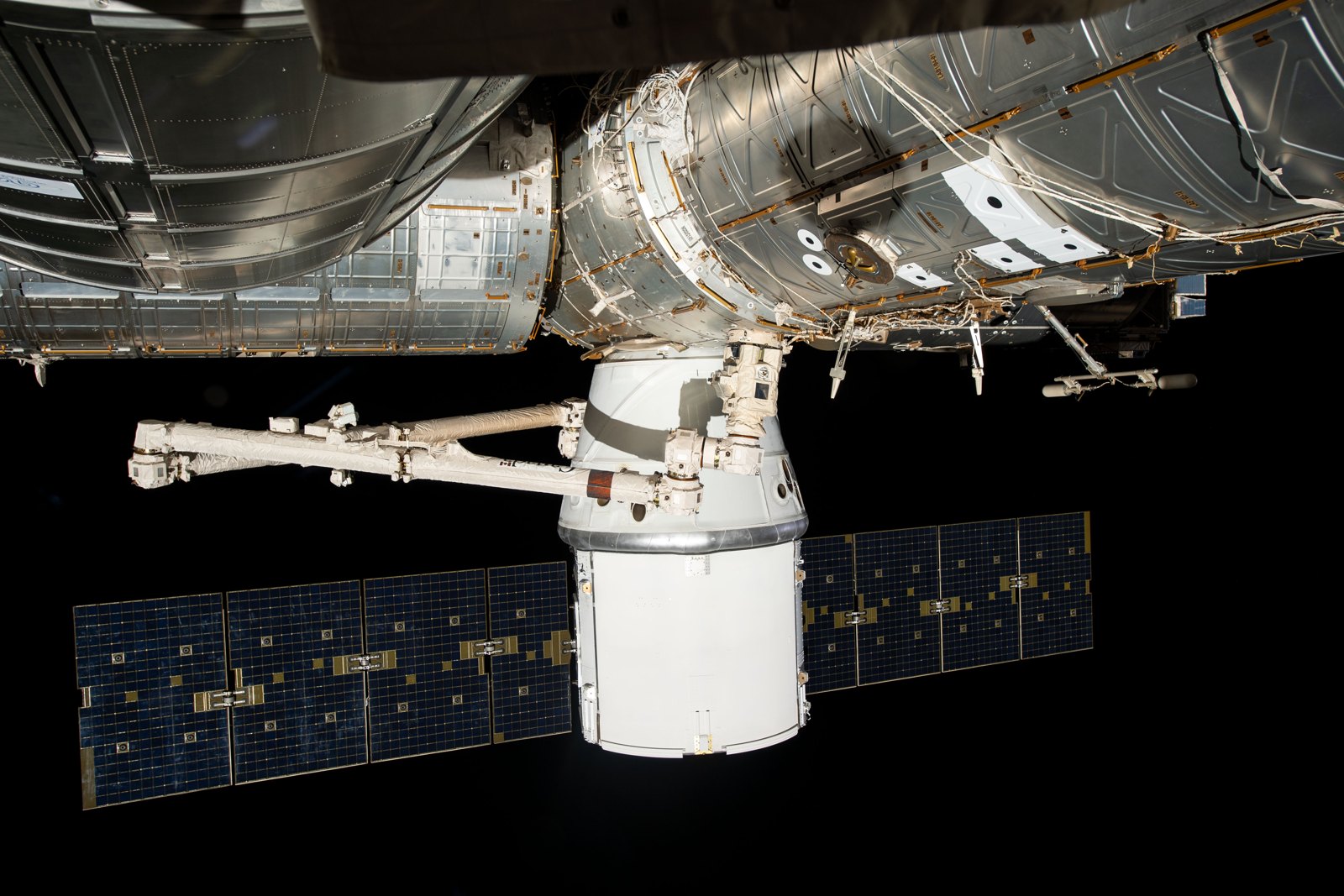
Image context: the cover uses NASA's real CRS-33 Dragon approach photo from the May 6 advisory.[2] It belongs here because the core question is neither branding nor launch theater. The question is whether NASA can keep station logistics boring and reliable while the 2026 flight plan becomes more compressed.
Fact file
| Item | What is confirmed now | Confidence note |
|---|---|---|
| Launch target | NASA and SpaceX are targeting 7:16 p.m. EDT on May 12, 2026 for CRS-34 launch.[2][4] | High; direct NASA mission and coverage pages. |
| Docking target | Dragon is scheduled to dock at about 9:50 a.m. EDT on May 14 to Harmony's forward port.[2] | High; direct NASA coverage advisory. |
| Cargo mass | NASA says Dragon is carrying about 6,500 pounds of cargo, supplies, and experiments.[2][3] | High; repeated across current NASA pages. |
| Near-term schedule reset | NASA moved Crew-13 forward from November 2026 to mid-September, targeted CRS-35 for fall, and NG-25 for fall/winter.[1] | High; direct May 1 flight-plan update. |
| Unresolved slot | NASA says launch opportunities for Starliner-1 cargo remain under review as teams work through Crew Flight Test issues and investigation actions.[1] | High; direct May 1 flight-plan update. |
| Mission duration | NASA says Dragon is expected to stay at the station until mid-June before returning time-sensitive research and cargo to Earth.[2] | High; direct NASA coverage advisory. |
| Science payload highlight | NASA says CRS-34 carries STORIE, which will study charged particles in the ring current after robotic installation on the station exterior.[3][5] | High; direct NASA science materials. |
| Station traffic context | NASA reboosted the station on April 16 to set altitude for the arriving Progress 95 cargo mission after Cygnus XL had already delivered new gear in April.[6] | High; direct station-operations blog. |
Why this launch is bigger than one cargo manifest
The strongest signal is the one NASA put in plain language on May 1. The agency is no longer talking about isolated flights; it is talking about a station schedule that has been reshaped to support operations, logistics, and science flow across the rest of the year.[1] Pulling Crew-13 forward to mid-September is especially revealing, because NASA said the move is meant to increase the frequency of U.S. crew-rotation missions to the station.[1] That puts more weight on the cargo side of the schedule too. Food, hardware, research, and return capacity all have to line up around a busier cadence.
CRS-34 sits at the front of that sequence. It follows an April period in which the station had already received Cygnus XL cargo and undergone an orbital reboost tied to the next Progress arrival.[6] It also precedes a second-half 2026 schedule where NASA has already penciled in more Dragon and Northrop Grumman traffic while leaving Starliner cargo timing unresolved.[1] In practical terms, that makes CRS-34 less a single delivery than a stability check on the new operating rhythm.
This does not mean one slip would collapse the year. NASA explicitly says all opportunities remain subject to operational readiness and future adjustment.[1][2] But it does mean the success criteria are tighter than "rocket leaves pad." The station needs the launch, the docking, the unloading cycle, the exterior-payload installation, and the eventual mid-June return leg to happen inside a schedule that has less visible slack than before.[1][2][5]
What Dragon is carrying that makes the timing matter
The cargo list is another reason the mission deserves more than a generic resupply label. NASA's May 8 mission overview says CRS-34 carries the ODYSSEY investigation to compare bacteria behavior in orbit with Earth-based microgravity simulators, a wood-derived bone scaffold experiment, equipment to study how red blood cells and the spleen adapt in space, and Laplace, a dust-collision study in microgravity.[2][3] Those are routine in one sense, because the station always runs mixed science cargo. They are not routine in the narrower scheduling sense, because each delayed arrival shortens useful time on orbit or pushes crew attention into a busier window.
The payload with the clearest operational edge is STORIE.[3][5] NASA says the instrument will ride on the Space Test Program – Houston 11 payload, then be robotically installed on the exterior of the station a few days after arrival.[5] Its job is to look outward at the ring current, the charged-particle population around Earth that affects satellites, power grids, pipelines, and drag on spacecraft during solar storms.[5] That makes CRS-34 part logistics run and part infrastructure mission for space-weather knowledge.
That science mix matters for the article's core claim. A tighter station traffic plan is not only about keeping crews fed. It is about protecting research tempo. NASA is trying to carry biological experiments, exterior hardware work, and future crew-rotation cadence inside one coordinated sequence.[1][2][3][5]
What to watch after launch
The first checkpoint is obvious: whether the launch and May 14 docking hold roughly to plan.[2] The second is whether NASA quickly moves from arrival coverage into the quieter but more important work of installation, unloading, and science activation. STORIE's exterior deployment is one of the cleanest signs that the mission is doing more than delivering boxes.[3][5]
The third checkpoint sits beyond this week. If CRS-34 reaches the station smoothly and stays until mid-June, NASA will have a cleaner runway into the schedule it published on May 1: Soyuz MS-29 in July, Crew-13 in mid-September, another Dragon cargo mission in the fall, and NG-25 in the fall/winter.[1][2] If the week goes badly, the visible consequence would be a launch or docking delay; the more interesting consequence would be added pressure on a 2026 traffic plan that NASA has already compressed while keeping one Starliner cargo option unresolved.[1]
The narrow conclusion is the right one. CRS-34 is still a cargo mission. It is also the first operational proof point for NASA's revised station sequence. The live question on May 12, 2026 is whether that sequence has enough rhythm to make the next six months feel like planned cadence instead of managed contingency.[1][2][3][4][5][6]
Sources
- NASA, "NASA, Partners Update International Space Station 2026 Flight Plan" (May 1, 2026).
- NASA, "NASA Sets Coverage for SpaceX 34th Station Resupply Launch, Arrival" (May 6, 2026).
- NASA, "NASA's SpaceX 34th Commercial Resupply Mission Overview" (May 8, 2026).
- NASA, "NASA's SpaceX CRS-34" mission page (accessed May 12, 2026).
- NASA Science, "NASA's STORIE Mission to Tell Tale of Earth's Ring Current" (May 1, 2026).
- NASA, "Station Orbits Higher as Crew Runs New Science Experiments" (April 16, 2026).