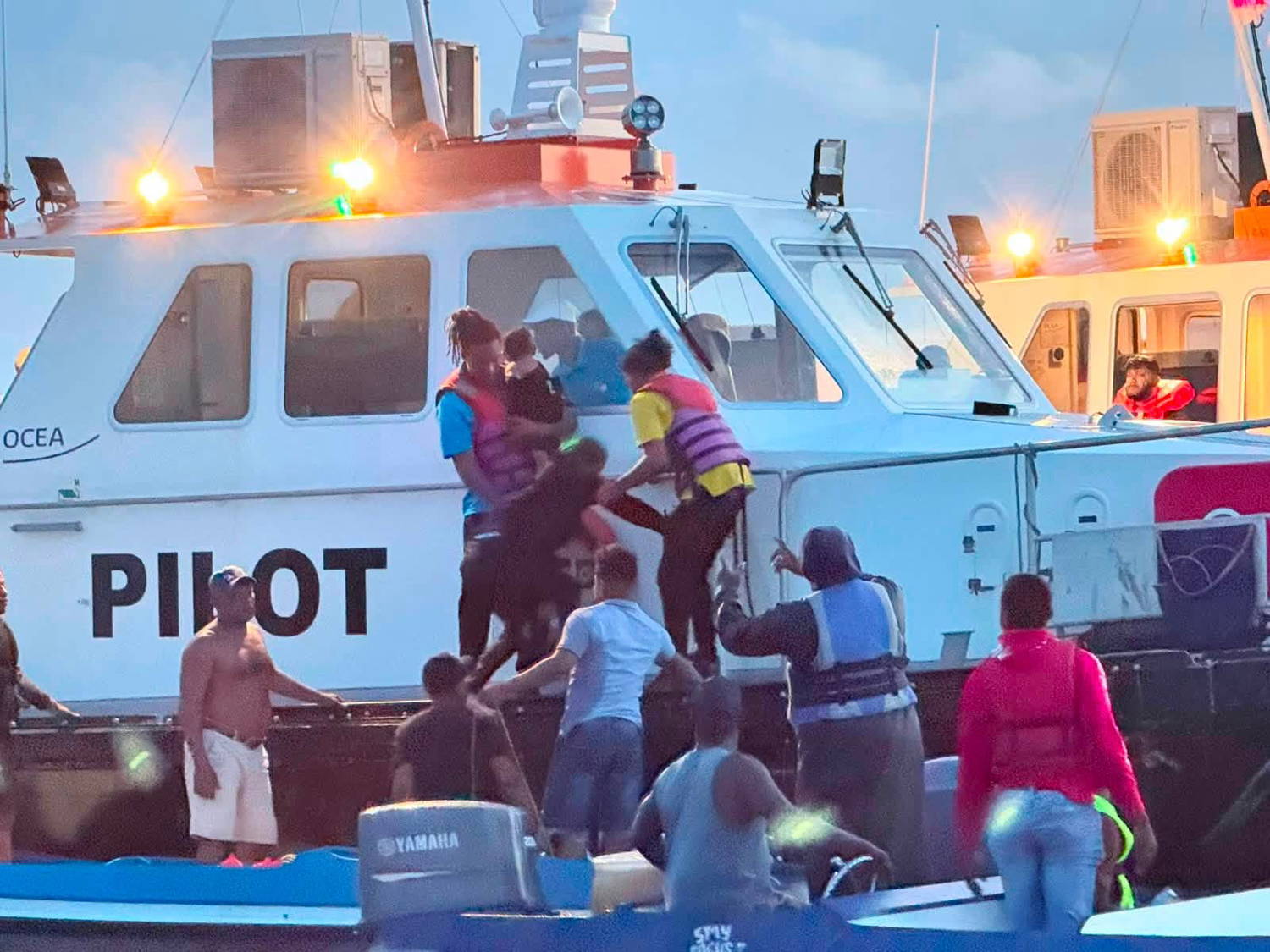
As of 2026-07-20 09:35 UTC, Guyana's search for people from the capsized MV Barima had three figures that should not be collapsed into one calculation: 67 people rescued, two deaths confirmed, and an initial official tally of 116 recorded passengers plus 17 crew.[1][2] The first two are reported outcomes. The 133-person tally is now a disputed denominator.
Officials said only 35 of the 67 rescued people appeared on the passenger manifest. Some rescued people were crew and would not be expected on a passenger-only list, so 32 is not an “unlisted passenger” count. Even so, officials said the comparison demonstrated that the manifest was not a true reflection of the people aboard. It omitted passengers, while the public evidence does not independently verify the boarding of each listed passenger. Subtracting 67 survivors and two deaths from 133 produces 64; it does not produce a defensible count of everyone still at sea.[2][3]
This is more than a bookkeeping failure discovered after a disaster. The manifest is part of the rescue equipment. It tells teams when the search population has been accounted for, gives families a common reference, and prevents an unlisted passenger from disappearing between the water, a rescue boat, a clinic and home. The international benchmark makes that function explicit: SOLAS Regulation III/27 directs that passenger details be recorded for search-and-rescue purposes and made available ashore, subject to stated exemptions.[9] Whether and how that international rule applied to this domestic route is a separate legal question not answered by the sources reviewed here. Until the tally is reconciled, any headline that derives one exact “missing” number from 133 is more certain than the evidence.
The Verified Record
| Time and source | What is established | Confidence boundary |
|---|---|---|
| About 15:15 Guyana time, July 18 | The government ferry left Georgetown for Port Kaituma with 116 passengers and 17 crew recorded. It capsized roughly seven miles offshore near the Pomeroon River.[2][3][5] | High confidence in the route and event. The 133 total describes the original record, not a verified head count. |
| 23:01 Guyana time, July 18 (03:01 UTC, July 19) | Air-traffic control received the vessel's distress call, activating state and private rescue assets.[4][5] | Strong agreement on the time. The public record reviewed here does not yet establish the initiating mechanical, stability, weather or human cause. |
| First light to noon, July 19 | The official update said the search area expanded from 400 to 1,070 square kilometres. Coast Guard and other state assets, private vessels, aircraft and local fishers participated; 67 people were reported rescued, including 15 children.[1] | Official operational snapshot. Reuters gave 1,040 square kilometres and AP 1,000 square miles—figures that are not equivalent—so the expanded area's precise size is unresolved.[3][4] |
| Later July 19 | Scanner-equipped private vessels and divers joined a search that had initially depended heavily on sight and sound in darkness.[3][6] | Strong evidence of expanded capability. No public sector-by-sector clearance map was available at this as-of time. |
| Sunday night | Officials said only 35 of 67 rescued people matched the manifest. Two deaths were confirmed, the captain and first engineer were taken into police custody after alleged positive cannabis tests, and a multi-agency investigation was announced.[2][5] | The manifest failure, custody and deaths are widely reported. A drug test or an arrest does not establish why the vessel capsized. |
Reuters reported that no additional survivor had been found after the Sunday-afternoon announcement of 67 rescues.[3] That is the latest status located for this report, not a declaration that no further rescue is possible. Search status, survivor count and confirmed deaths can all change after the as-of time.
Why The Denominator Changes The Search
The immediate correction has to work from people outward, not from a total downward. Each survivor needs to be identified once and linked to a rescue vessel, landing point and medical disposition. Families need to report relatives believed to have boarded even if no name appears on the list. Ticketing or payment records, crew recollections, port observations, phone records where lawfully available, and witness accounts can then test the original manifest. The result should be a ledger with separate columns for confirmed aboard, rescued alive, confirmed dead, reported but not yet verified aboard, and unaccounted for.
Those distinctions protect families from two errors. Someone omitted from the manifest must not be omitted from the search. Someone listed but later shown not to have boarded must not remain indefinitely counted as missing. The government established family-contact centres in Mabaruma, Port Kaituma and Georgetown; those centres should feed family-supplied boarding information into the reconciliation process as well as provide support.[1]
Capacity, Cargo And Cannabis Are Not Yet A Cause
Early public claims should be kept in their proper boxes. Guyana's official noon update said the vessel was licensed for more than 300 passengers, carried 250 life jackets, six inflatable life rafts and two rigid life rafts, and had 268 tonnes of cargo recorded against a 284-tonne capacity.[1] AP reported that Public Works Minister Juan Edghill rejected passenger or cargo overload and relayed survivors' account that tide conditions were involved.[4]
But Reuters later reported Prime Minister Mark Phillips giving a cargo figure of 286 tonnes against the same 284-tonne capacity.[3] That conflicts with the government's published 268-tonne figure. The difference may be a transposition, a later correction or evidence that two records were being cited; the available sources do not resolve it. The underlying cargo manifest, weighing method and loading plan—not either isolated number—must decide the issue.
The same discipline applies to the crew. News Room Guyana reported alleged positive tests for “narcotics”; the Guardian specified cannabis, while Reuters reported marijuana and said the captain and several crew were in custody.[2][3][5] That justifies preserving samples, documenting test timing and investigating fitness for duty. It does not by itself prove impairment at the critical moment, identify who had the watch, or explain the capsize. A technical investigation still has to reconstruct course, speed, tide and weather, vessel loading and stability, watertight integrity, machinery, alarms, commands and evacuation.
Maintenance is another live question, not a ready-made verdict. The government said MV Barima was last dry-docked in 2024 and remained inside its docking cycle.[1] Official records show critical repairs in September 2024 and a March 2026 invitation for an estimated $124.5 million in further docking and overhaul work.[7][8] Investigators need the actual work orders, inspection findings, completion status and defect logs. The existence of repairs proves neither seaworthiness nor failure; the records may show which.
This vessel was not a peripheral excursion boat. Government descriptions call the Georgetown–Port Kaituma service a vital passenger-and-cargo link for North West District communities, operating roughly three or four trips a month.[1][8] That makes continuity consequential, but it also makes an evidence-led safety decision more important than restoring the timetable quickly.
What Changes Over 24 Hours, 7 Days And 30 Days
Next 24 hours: search commanders should publish one time-stamped ledger without forcing a single missing total before the roster is reconciled. Every new rescue, recovery and family report should change named records, not only a headline number. Search sectors, weather constraints, scanner coverage and dives into the vessel should be described clearly enough to show what has and has not been cleared.[3][6]
Next 7 days: authorities should rebuild the boarding record and publish the method used. The inquiry should secure the original passenger and cargo manifests, ticket and payment records, port surveillance where available, radio traffic, navigation and engine data, crew duty records, drug-test chain of custody, maintenance files and survivor interviews. Other ferries on the route need a rapid manifest-control check before the same blind spot appears in another emergency.
Next 30 days: a preliminary technical account should separate four questions: how many people boarded, why the vessel capsized, how evacuation and lifesaving equipment performed, and how the rescue was commanded. Combining them into one negligence narrative would allow a dramatic allegation in one category to substitute for evidence in the others.
Three Paths From The Current Search
Base path — the ledger converges while the search continues. Family reports, survivor interviews and port records identify most people who boarded, and search teams work from a shrinking named list. Trigger: authorities publish a reconciled roster with a clear verification method and regular person-level updates.
Upside path — expanded assets find more survivors. Scanner-equipped vessels, fishers' local knowledge, aircraft or debris sightings direct teams to people outside the first search sectors. Trigger: officials confirm a new live rescue after the 67-person snapshot and identify where the lead came from.[1][3]
Downside path — the true passenger total rises or the operation changes to recovery. More unlisted travelers are verified, weather or sea conditions reduce coverage, and no new survivor is found as time passes. Trigger: a materially higher reconciled boarding count, suspension of surface searching, or a formal change in mission status. None of those conditions had been established in the sources reviewed by the as-of time.
The Checklist For The Next Update
- Do not calculate “missing” from 133 until authorities verify who actually boarded.
- Attach a local and UTC time to every rescue, death and search-area update.
- Keep confirmed aboard, reported aboard, rescued, hospitalised, dead and unaccounted for separate.
- Ask whether each search sector has been observed, scanned, dived or formally cleared; those are not interchangeable.
- Treat the 268-versus-286-tonne cargo discrepancy as unresolved until the source record is published.[1][3]
- Treat alleged positive drug tests as evidence for investigation, not as the cause of the capsize.[2][5]
- Preserve maintenance and repair records before deciding whether age or condition contributed.[7][8]
Invalidation condition: this report's central warning about the denominator should be retired once authorities publish a reconciled, auditable roster that accounts for everyone confirmed aboard. Its casualty and rescue figures must be revised sooner if an official update changes them. Until then, refusing to manufacture one exact missing count is not vagueness. It is the most accurate description of the search.
Sources
- Department of Public Information, Guyana, “Inter-agency operation continues as 67 rescued from MV Barima — PM Phillips” (July 19, 2026) — primary government snapshot of rescues, search-area expansion, command centres, safety equipment, published cargo weight and docking status.
- News Room Guyana, “MV Barima tragedy: Captain, first engineer arrested; only 35 of 67 rescued were on passenger list” (July 19, 2026) — local report from the Sunday-night briefing on the manifest failure, confirmed deaths, custody and source page for the Ministry of Public Works rescue photograph.
- Kemol King, Reuters via Internazionale, “Dozens feared dead after passenger ferry sinks off coast of Guyana” (July 20, 2026) — latest reviewed status, search limitations and expanded assets, manifest problem, crew investigation and conflicting reported cargo weight.
- Bert Wilkinson, Associated Press, “A ferry carrying 133 people capsizes off Guyana's coast, leaving dozens missing” (July 19, 2026) — independent account of departure, distress call, rescue composition, search scale and the minister's preliminary tide and loading claims.
- Neil Marks and Natricia Duncan, The Guardian, “Huge search operation after passenger ferry sinks off coast of Guyana” (updated July 20, 2026) — local reporting and independent cross-check of the manifest failure, investigation, deaths, route and survivor accounts.
- News Room Guyana, “MV Barima tragedy: Vessels with scanners, divers deployed as search continues” (July 19, 2026) — local operational detail on scanner-equipped vessels, divers and the search inside the capsized ferry.
- Department of Public Information, Guyana, “Repairs on MV Barima to be completed soon” (September 20, 2024) — primary record of the vessel's critical underwater repairs and inspection context during its last reported dry-docking year.
- Department of Public Information, Guyana, “Over $440M to be spent on major ferry repairs” (March 9, 2026) — primary record of planned MV Barima docking and overhaul work and the route's role for North West District communities.
- International Maritime Organization, Resolution MSC.47(66), amendments to SOLAS Chapter III (adopted June 4, 1996) — international safety benchmark requiring passenger details to be recorded for search-and-rescue purposes and kept available ashore.