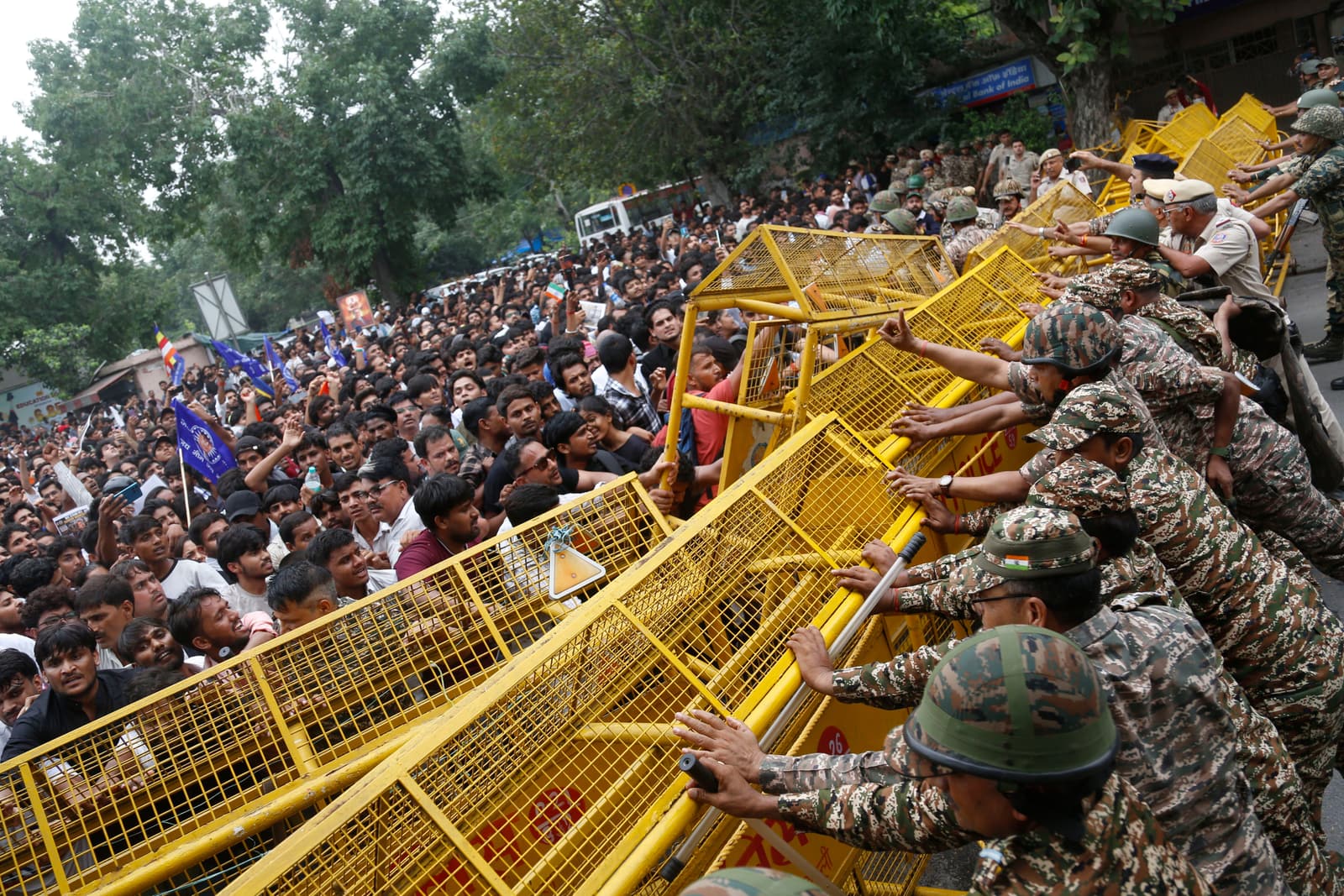
As of 2026-07-20 11:36 UTC, India's Cockroach Janta Party had crossed a line that internet movements often never reach: it had converted a viral joke into a large, physical confrontation over examination accountability. Thousands gathered at New Delhi's Jantar Mantar and tried to march toward Parliament to demand Education Minister Dharmendra Pradhan's resignation and changes to the examination system. After police moved hunger-striking activist Sonam Wangchuk to hospital two days earlier, movement founder Abhijeet Dipke also widened his demand to include Prime Minister Narendra Modi's resignation.[1][2][5]
Associated Press reported that police fired tear gas and charged with batons after demonstrators tried to breach security barricades. Reuters reported television images of police caning protesters; Delhi Police denied using force and said the protest was being handled professionally.[1][2] Those accounts establish a serious confrontation, but they do not yet supply an agreed toll of injuries, arrests or detentions.
One potentially important development remains less certain. CJP spokesperson Saurav Das told AP that he met Health Minister J.P. Nadda and presented the protesters' demands; AP described this as the first apparent sign of government outreach.[1] The sources reviewed here contain no government confirmation or account of that meeting. It should therefore be treated as movement-reported contact—not yet as a verified dialogue, and certainly not as a settlement.
What is established, and what remains claimed
| Signal | Public record | Confidence boundary |
|---|---|---|
| Crowd | Reuters quoted New Delhi Deputy Commissioner of Police Sachin Sharma estimating about 10,000 protesters on Monday morning; AP reported thousands at and around Jantar Mantar.[1][2] | Strong evidence of a large turnout, but not an independently audited final attendance figure. |
| Police response | AP reported tear gas and baton charges. Reuters reported images of caning while police denied using force.[1][2] | The deployment and confrontation are clear. A complete incident log and agreed casualty or detention count were not available at the as-of time. |
| March authorization | Delhi Police said no permission had been sought or granted for a march to Parliament. It said Section 163 orders barred marches and assemblies of five or more in New Delhi district, except at the designated Jantar Mantar site with prior permission.[4] | High confidence in the police's published legal position. That does not by itself adjudicate every action by police or protesters. |
| Examination case | India's Press Information Bureau said the Central Bureau of Investigation registered a case on May 12 over alleged irregularities and a paper leak involving the May 3 NEET-UG 2026 examination.[3] | The primary record confirms that an investigation exists and says the allegations indicate a possible integrity compromise. It does not prove the alleged leak, every protest claim or personal responsibility by the education minister. |
Step one: an insult became a membership badge
The movement's name came before its organization. In May, Chief Justice of India Surya Kant compared some unemployed young people to “cockroaches” during an unrelated hearing. Young critics appropriated the insult. Abhijeet Dipke posed the organizing question online—what if the cockroaches came together?—and built the satirical Cockroach Janta Party around the answer.[1][5]
That reversal did two jobs at once. “Cockroach” became a joke that was easy to reproduce in posts and short videos, but it also became a claim to endurance: people who felt treated as disposable could identify themselves as survivors. One plausible explanation for its rapid spread is that the label did not require a detailed ideology before someone could adopt it. The same feature creates a weakness: a shared meme can gather an audience faster than it can agree on leadership, evidence or attainable demands.
The CJP initially existed mainly as an online parody. Its June gathering at Jantar Mantar began the conversion from followers into participants; by July, the site had become a sustained encampment joined by students and other groups.[1][5] The observed sequence suggests the mechanism: satire supplied recognition, while repeated in-person organizing supplied continuity.
Step two: repeated exam failures supplied concrete stakes
An identity alone does not explain why people travelled to Delhi. The movement rallied around repeated examination leaks, cancellations and technical failures; the NEET-UG 2026 case is the best-documented example in the sources reviewed here.[1][2][5] The government's May 12 notice said the National Testing Agency had received information that documents linked to the medical entrance examination may have circulated without authorization before the test. The CBI opened a case covering alleged conspiracy, cheating, breach of trust, theft, destruction of evidence and corruption offences, and dispatched special teams.[3]
Reuters reported that the leak affected more than 2 million students and forced them to sit the examination again.[2] That scale turns a paper leak into more than a story about a stolen document. A high-stakes national exam allocates scarce educational opportunities after families have invested money, time and expectation in preparation. When its integrity fails, the injury is distributed across candidates who cannot know whether effort, access or fraud determined the result.
The movement attached those administrative failures to a political demand: Pradhan should resign. It also called for broader examination reform and compensation for families of students who died by suicide after leaks or results.[1][5] These must remain separate categories. The CBI notice is an official record of allegations and an investigation. The resignation and compensation demands are the protesters' proposed remedies. After Wangchuk's hospital transfer, Dipke added Modi's resignation to the campaign, showing that at least part of the leadership was broadening the protest beyond examination administration.[5] None of these demands proves personal criminal responsibility.
Step three: a hunger strike raised the stakes around an existing date
Educator and Ladakh activist Sonam Wangchuk gave the campaign a different kind of visibility when he joined it with a hunger strike beginning June 28. He announced the July 20 Parliament march on July 8.[5] Police moved him to hospital on July 18 after his condition deteriorated, citing medical need and a court order; his wife and movement supporters said the transfer was against his will.[2][5]
The hospital transfer did not create the deadline; it intensified mobilization around a date already chosen to coincide with Parliament's return. Reuters reported that thousands arrived overnight after the transfer.[2] Al Jazeera reported that Dipke then replaced Wangchuk on hunger strike and widened the leadership's resignation demand.[5]
July 20 mattered beyond crowd size because it was the opening day of Parliament's monsoon session, and organizers wanted lawmakers—not only education administrators—to receive the demands.[1][5] Police said Jantar Mantar was the designated protest site, subject to prior permission, while the route toward Parliament was prohibited.[4] That public order made confrontation foreseeable once organizers insisted on carrying the protest beyond the site.
Two observable shifts—and one unresolved claim
The turnout showed that the movement can mobilize offline at meaningful scale, not merely accumulate online attention. Exam accountability remained the common grievance, but Dipke's added demand for Modi's resignation showed that the leadership's frame had begun to widen.[1][2][5]
The unresolved claim is political access. Das's account of meeting Nadda could mark an opening, but it needs government confirmation before it can be described as a channel. Nor did the march establish that the CJP has become a durable political party or that all participants share its widened demands. Those questions require evidence different from a crowded street: named representatives, stable demands, written responses, parliamentary action and a verifiable reform timetable.
Three evidence clocks
| Horizon | Evidence that would change the story |
|---|---|
| 24 hours | Reconciled police and hospital figures for injuries or detentions; government confirmation or denial of Das's account; and a clear medical or legal update on Wangchuk. Live video can show a clash, but it cannot reconcile totals or verify a private meeting. |
| 7 days | A parliamentary question, debate or demand for records about examination failures and the protest response. A government-acknowledged meeting with a named office and next date would turn claimed contact into a process. |
| 30 days | Measurable examination-integrity steps from government, and evidence that the CJP can identify negotiators, maintain coherent demands and sustain local organization after the Parliament moment. |
The base path is continued protest without quick political resolution; its trigger is parliamentary attention or intermediary contact without a written reform process. The upside path is de-escalation through a public agenda with dates, owners and progress reporting. The downside path is escalation that eclipses the examination grievance, triggered by verified new violence or mass detention, or by leaders formally abandoning exam reform as the campaign's common centre.
Four rules keep the next headline honest:
- Separate the CBI investigation from claims of political responsibility.[3]
- Attribute every crowd, injury, arrest and detention total to a source and time.
- Keep the police denial of force beside AP and Reuters reporting of baton use until a fuller incident record resolves the conflict.[1][2]
- Track whether the demands remain centred on examination reform and whether any response appears in parliamentary or administrative records.[1][5]
Invalidation condition: the central interpretation—that July 20 proved offline mobilizing capacity but not durable organization or a government response—should be revised if a verified agreement, resignation or formal reform process emerges, or if reliable records materially overturn the reported scale or sequence of the confrontation. Injury and detention figures should be updated sooner whenever reconciled records appear.
Sources
- Sheikh Saaliq and Piyush Nagpal, Associated Press, “Police in India clash with youth-led Cockroach party supporters near Parliament” (July 20, 2026) — current event chronology, protest demands, crowd description, police action, claimed government outreach and source page for the hero photograph.
- Aftab Ahmed, Saurabh Sharma and Anushree Fadnavis, Reuters via Internazionale, “Police cane supporters of India's cockroach movement as thousands gather for march” (July 20, 2026) — police estimate, competing accounts of force, NEET scale and the effect of Wangchuk's hospital transfer.
- Press Information Bureau, Government of India, “CBI Registers Case in alleged Paper Leak in NEET-UG 2026” (May 12, 2026) — primary government record of the complaint, alleged pre-exam circulation, offences under investigation and CBI response.
- Scroll, “No permission granted for CJP march to Parliament on July 20, says Delhi Police” (July 19, 2026) — the police notice on authorization, Jantar Mantar and Section 163 restrictions.
- Yashraj Sharma, Al Jazeera, “Why have India's Gen Z protesters called for a march to parliament?” (July 19, 2026) — reported background on the movement's satirical origin, Wangchuk's hunger strike, expanded demands and choice of date.