As of 2026-07-20 02:47 UTC, Algeria has a final result for its July 2 legislative election. The National Liberation Front (FLN) leads with 91 of the People's National Assembly's 407 seats, followed by the National Democratic Rally (RND) with 74 and the Future Front with 56. The Movement of Society for Peace (MSP) has 43, the National Construction Movement, or El Bina, 40, and independent lists 33.[1]
The easy reading is that established parties recovered ground from independents. The complete arithmetic says something stranger. Independent lists did lose 51 seats compared with the final 2021 result, but the five named parties above, taken together, also lost a net four. The offset appears farther down the result: parties outside those six largest categories now hold 70 seats, up from 15.[1][3]
That makes this an election with two simultaneous reallocations, not one. It produced a workable pro-presidential number at the top and a much longer party tail below it. It did not by itself prove that voters moved directly from independent lists to any particular party.
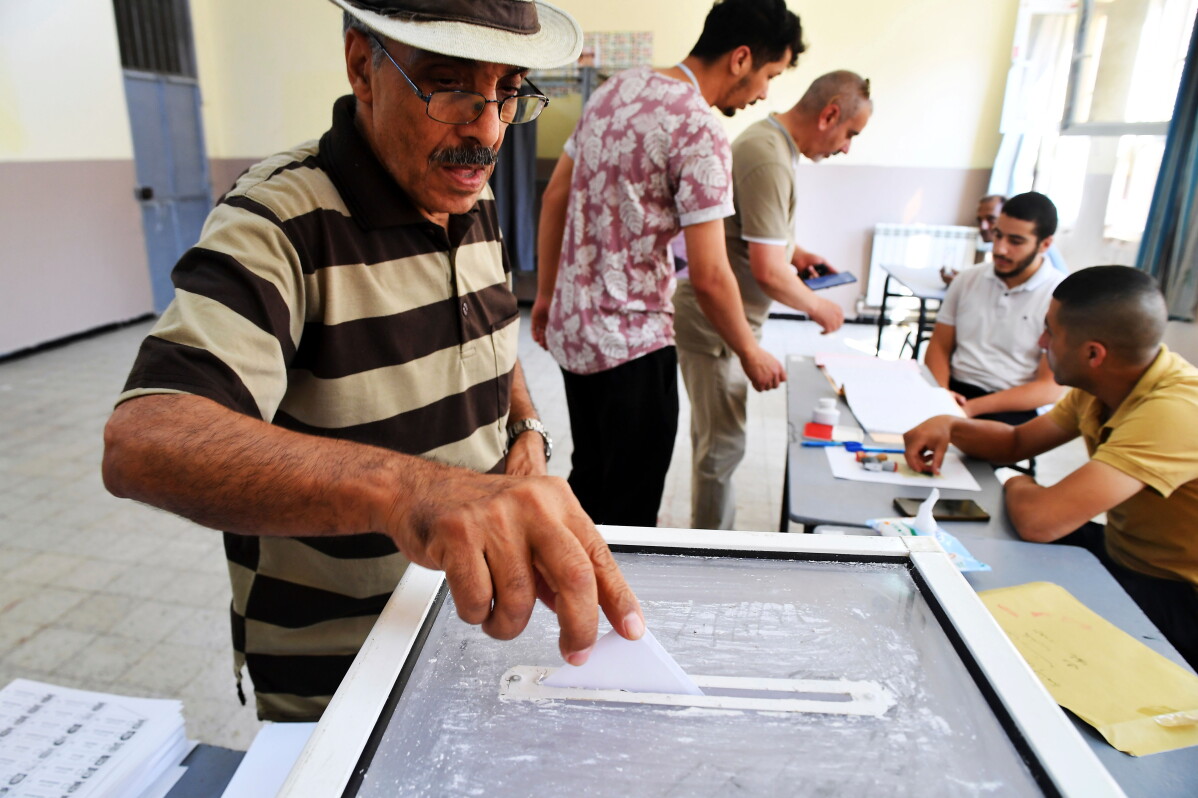
Image context: the cover is an AP photograph of an Algiers voter casting a ballot on election day. It documents the event itself rather than illustrating the analysis with a chart, logo, or generated scene.[5]
The Result, Compressed
- The FLN remains first, but with 91 seats, seven fewer than in 2021.[1][3]
- The RND rises from 58 to 74, while the Future Front rises from 48 to 56.[1][3]
- The MSP falls from 65 to 43. El Bina edges from 39 to 40.[1][3]
- Independent lists fall from 84 to 33, a loss of 51 seats.[1][3]
- Those six categories held 392 of 407 seats in 2021. They hold 337 now. The residual therefore rises from 15 to 70 seats, a gain of 55 for the smaller-party field.[1][3]
- A majority requires 204 seats. The FLN, RND, and Future Front have 221 between them.
The last two lines are the hinge. The chamber did not get larger: it had 407 seats in the cited final result for 2021 and has 407 again.[1][3] The 55-seat expansion of the residual is therefore not a rounding effect. Nor is it evidence that the big parties, collectively, absorbed the independent retreat. Gains for the RND and Future Front were more than canceled by losses for the FLN and MSP, leaving El Bina nearly flat.
A Seat Shift Is Not a Voter-Transfer Map
The comparison is strong at the level it actually measures: seats assigned to the same broad labels in two completed elections. It is weak as a claim about individual behavior.
A seat can change categories because a list was available in one constituency but not another, because turnout changed, because votes were distributed differently among candidates, because the seat-conversion rule produced a different result, or because a court adjusted a local count. Two national seat totals do not identify which voters switched, whether previous independent candidates joined parties, or whether people who voted in 2021 participated again in 2026.
So “independents lost 51 seats” is an observed comparison. “Independent voters returned to the major parties” would be a causal claim requiring constituency-level list results, candidate histories, and preferably survey evidence. The national result does not supply that proof.
It also matters what “independent” means. It is an electoral label, not a guaranteed position on every legislative vote. The same caution applies to the smaller parties: a longer list of party names can create more bargaining points without automatically creating a larger opposition.
A Majority Exists, but Its Operating Form Is Unsettled
After the provisional count, ANSA described the FLN, RND, and Future Front as the three parties supporting President Abdelmadjid Tebboune and reported a combined 222 seats: 90, 73, and 59 respectively.[4] The final result changed those components to 91, 74, and 56, reducing the sum by one to 221.[1]
Numerically, that is still 17 seats above the 204-seat threshold. Politically, it should be treated as a reported alignment rather than a signed coalition contract. Final party-group declarations, the distribution of chamber offices, and recorded votes will show whether 221 behaves as a disciplined majority. ANSA separately described El Bina as supporting Tebboune; its 40 seats could widen the president-friendly field, but adding them mechanically would overstate what is known about issue-by-issue coordination.[4]
The structure is therefore broad at the top but not dominant through one party. The FLN's 91 seats amount to about 22% of the chamber. Even the three-party sum depends on coordination, while the 70-seat smaller-party tail gives more actors a reason to negotiate over committees, leadership posts, amendments, and local interests.
The Electorate Did Not Widen
The Constitutional Court's final figures put domestic turnout at 21.24%: 5,071,020 voters out of 23,872,756 registered. It recorded 4,111,331 expressed votes and 959,689 invalid ballots. By calculation, invalid ballots were about 18.9% of domestic participants. Turnout among registered Algerians abroad was 10.75%, or 91,810 voters out of 854,285.[2]
The final 2021 result recorded turnout at 23%, with 5,628,401 voters, 1,111,678 invalid ballots, and 4,610,723 expressed votes.[3] On the official headline rates, domestic participation in 2026 was about 1.76 percentage points lower. That is a decline, not a mandate to assign one motive to nearly four voters in five.
AP's election-day reporting described cost-of-living strain and limited public excitement around the campaign. It also reported that 269 prospective candidates had been barred: the electoral authority cited links to illicit financial networks and suspicious political activity, while affected candidates alleged unfair or political application.[5] Those facts belong in the context. They do not, without additional evidence, tell us why each non-voter stayed home or which seat category benefited.
Low turnout narrows the legitimate conclusion. It supports saying that the election mobilized a small share of registered voters. It does not support treating abstainers as a coherent opposition bloc, nor does it convert seat shares into population-wide approval ratings.
Final Means Revised, Not Uncontested
The Constitutional Court recorded 320 appeals. It accepted 43, rejected eight on procedural grounds, and rejected 269 as unsubstantiated. The final announcement also recorded the annulment of votes assigned to parties in particular polling offices.[2]
Comparing the reported provisional and final top-line counts shows that the review moved seats: the FLN and RND each gained one, the Future Front lost three, and El Bina gained two.[1][4] But 43 accepted appeals do not mean 43 seats changed, and a changed local vote total does not necessarily change a mandate.
The defensible conclusion is narrower: judicial review altered parts of the count without overturning the ordering of the leading parties or the existence of a three-party numerical majority. Claims about the integrity of the whole process remain separate from that observable result.
What to Watch Next
Next 24 hours: replace provisional figures in any working brief with the final count. Keep the court's totals, the appeal outcome, and the election-day context in separate columns; each answers a different question.
Next 7 days: watch party-group declarations and the first negotiations over chamber organization. The critical test is not whether 221 exceeds 204 on paper, but whether the three parties present shared candidates and positions. Also watch where the 33 independents and 70 smaller-party seats choose to organize rather than assuming either category is a bloc.
Next 30 days: committee assignments, leadership votes, and early recorded divisions should reveal whether the longer party tail creates real bargaining leverage. This is a monitoring horizon, not a claim that each event must occur on that schedule.
Three readings are worth testing:
- Base case: the three president-supporting parties maintain a working majority, while smaller parties negotiate selectively without threatening overall control. Repeated joint votes would support this reading.
- Pluralist upside: the 70-seat tail wins meaningful committee representation or assembles cross-party amendments. Visible concessions, contested leadership votes, or shifting coalitions would be the evidence.
- Concentration downside: the chamber has more labels but little independent behavior, while low participation remains politically unresolved. Uniform roll calls and executive-driven organization would strengthen that interpretation.
The arithmetic will survive unless the official totals are corrected. The political reading should not. If formal group organization splits one of the three reported pro-presidential parties, or if early votes produce a different 204-seat coalition, the “working majority” conclusion must be revised. Until then, the clearest result is dual: independent lists sharply contracted, and the space below Algeria's largest parties became markedly more crowded.
Sources
- Algerian Radio, “July 2 Legislative Elections: The National Liberation Front Party Leads with 91 Seats” (July 18, 2026) — final 407-seat distribution.
- Algerian Radio, “July 2 Legislative Elections: The Participation Rate Reached 21.24% Inside the Country and 10.75% Abroad” (July 18, 2026) — final participation, ballot, and appeal totals.
- Radio Algérienne, “Législatives du 12 juin: le Conseil constitutionnel proclame les résultats définitifs” (June 23, 2021) — final 2021 turnout and seat distribution.
- ANSA, “Algeria, la maggioranza presidenziale confermata nelle legislative del 2 luglio” (July 6, 2026) — provisional count and reported pro-presidential alignments.
- Associated Press, “Algerians vote in parliamentary elections while facing cost-of-living strains and candidate bans” (July 2, 2026) — election-day context and the article's photograph.