As of 2026-06-18 11:31 UTC, the Federal Reserve's June decision looks simple only at the headline level: the Federal Open Market Committee voted 12-0 to hold the federal funds target range at 3.50%-3.75%.[1] The livelier news is that Kevin Warsh's first meeting as Fed chair changed the communication surface around that hold. The statement was shorter, the policy language more direct, and the market was left with less of the old forward-guidance cushioning that investors often use to pre-trade the next meeting.[1][4]
The hold itself was not a surprise. The Fed said economic activity was expanding at a solid pace despite elevated uncertainty, partly tied to the Middle East conflict, while productivity growth and capital investment remained strong and the unemployment rate had changed little.[1] But the statement also said inflation remained above the Fed's 2% goal and pointed to supply shocks, including energy, as part of the pressure.[1] That combination leaves the central bank in a narrower lane: the economy is not weak enough to demand immediate relief, and inflation is not low enough to make cuts easy.
Fast Facts
| Item | What is known | Confidence note |
|---|---|---|
| Policy rate | The FOMC kept the target range at 3.50%-3.75% by a 12-0 vote.[1] | High; this is the official FOMC statement. |
| Operating corridor | The implementation note kept reserve balances at 3.65%, standing overnight repo at 3.75%, and ON RRP at 3.50% with a $160 billion per-counterparty daily limit.[3] | High; these are operational settings in the official implementation note. |
| Growth and labor | The June projection materials put the 2026 median real GDP growth projection at 2.2% and the 2026 unemployment projection at 4.3%.[2] | High for projections; they are participant forecasts, not guarantees. |
| Inflation path | The 2026 median PCE inflation projection rose to 3.6%, with core PCE at 3.3%.[2] | High for the median projection; the outcome remains uncertain. |
| Market read | The Guardian reported that major U.S. stock indexes fell after the decision as investors absorbed the possible-hike signal.[5] | Medium-high; the market move is reported contemporaneously, but attribution is always partly interpretive. |
What Changed
The rate decision did not move, but the reaction function became less spoon-fed. In the Fed's own June 17 press-conference materials, Warsh framed the shorter statement as a deliberate move away from forward guidance in the current policy setting.[4] That matters because forward guidance is not just a communications habit. It is part of market plumbing. When the Fed strongly signals its likely path, Treasury yields, mortgage rates, equity multiples, and credit spreads can all adjust before the formal vote. When the Fed says less, more of that adjustment is pushed back into incoming data and meeting-by-meeting interpretation.
The June projections explain why Warsh may prefer that narrower posture. The Fed's own materials show a policy environment with still-solid growth and still-elevated inflation. Median real GDP growth for 2026 sits at 2.2%, while the median unemployment rate is 4.3%.[2] That is not a recessionary forecast. At the same time, median PCE inflation is 3.6% for 2026, and the distribution table shows many participants clustered in the 3.5%-3.8% range for headline PCE inflation.[2] In plain English: enough growth to wait, enough inflation to resist promising relief.
The most important boundary is that projections are not a promise. They are participants' views under their own assumption of appropriate policy. The table notes that 18 participants submitted June projections, and one did not submit projections for 2028.[2] That means the dots show a committee map, not an executable policy script. Under Warsh, the Fed appears to be telling markets to read the map but stop treating it as a turn-by-turn route.
Why It Matters
For households, the practical effect is patience, not an immediate shock. A steady target range does not instantly reset mortgage cards, auto loans, or credit-card APRs, but it keeps the broader rate environment from getting the easing signal many borrowers wanted. The implementation note confirms that the machinery of policy is still arranged around the same corridor: reserves at 3.65%, the repo ceiling at 3.75%, and ON RRP at 3.50%.[3] That is the plumbing beneath the headline hold.
For markets, the story is less comfortable. The Guardian reported stock declines after the announcement and framed the move around the possibility of a hike before year-end.[5] That reaction makes sense if investors had been leaning on the idea that the next meaningful move would be a cut. A no-change decision with a cleaner anti-inflation message is different from a no-change decision that quietly prepares the ground for easing.
For Fed watchers, the deeper shift is institutional. A shorter statement can reduce false precision, but it also raises the burden on the press conference, speeches, minutes, and incoming data. If the chair says less in the formal statement, every subsequent word can become more market-sensitive. The upside is discipline: less guidance can mean less over-promising. The downside is volatility: markets may overreact to fragments because the official statement gives them fewer guardrails.
Next 24 Hours, 7 Days, 30 Days
In the next 24 hours, the key question is whether rates markets keep treating June as a hawkish hold or fade the initial reaction. Watch Treasury yields and dollar strength more than the equity headline; they show whether the inflation message is changing policy-path expectations.
Over the next 7 days, the useful test is communication consistency. If Fed speakers repeat the same basic line--solid activity, little labor-market deterioration, inflation still too high--then Warsh's first meeting becomes a true reset. If officials immediately soften the message, the June statement will look more like a debut gesture than a policy framework.
Over the next 30 days, inflation and labor data have to carry more weight. That is the tradeoff of less forward guidance. Markets will be looking for evidence that the Fed's 2026 inflation projections are too high, too low, or roughly right. The clearest easing signal would be a run of inflation data that undercuts the 3.6% PCE and 3.3% core PCE medians without a damaging labor-market break.[2]
Scenarios
Base case: the Fed stays on hold while speaking less mechanically about future meetings. Inflation remains too high for an explicit easing bias, but growth and employment remain strong enough to avoid emergency language. Markets price a wider range of outcomes, which means more data-day volatility.
Upside case: inflation cools faster than the June median projections imply, especially outside energy-sensitive categories, while unemployment remains near the projected 4.3% area.[2] In that setup, Warsh's shorter-statement approach gives the Fed room to pivot later without having pre-committed now.
Downside case: supply shocks feed into broader prices, the 3.6% PCE projection starts to look low rather than high, and the committee is forced to validate the possible-hike signal. That would turn the June meeting from a communication reset into the first step of a renewed tightening debate.
Action Checklist
Separate the hold from the guidance change. The rate corridor did not move; the signal around future moves did.[1][3][4]
Treat the SEP as a risk map, not a promise. The committee's inflation medians matter, but the Fed can move if incoming data break the assumptions behind them.[2]
Watch whether other officials reinforce Warsh's message. A communication reset only sticks if it survives the first week of speeches, interviews, and market pressure.[4]
Do not over-read one equity close. The more durable signal is whether rates, inflation expectations, and the dollar reprice in the same direction after investors digest the shorter statement.[5]
Sources
- Federal Reserve Board, "Federal Reserve issues FOMC statement" (June 17, 2026) - official vote, target range, growth, labor, uncertainty, and inflation language.
- Federal Reserve Board, "June 17, 2026: FOMC Projections materials, accessible version" - median GDP, unemployment, PCE, core PCE, and participant-projection details.
- Federal Reserve Board, "Implementation Note issued June 17, 2026" - reserve balance, repo, ON RRP, and policy implementation settings.
- Federal Reserve Board, "June 16-17, 2026 FOMC Meeting" - press-conference materials and opening-statement transcript on the shorter statement and reduced forward-guidance posture.
- The Guardian, "Federal Reserve holds rates steady but signals possible hike before year's end" (June 17, 2026) - market reaction and broader policy framing.
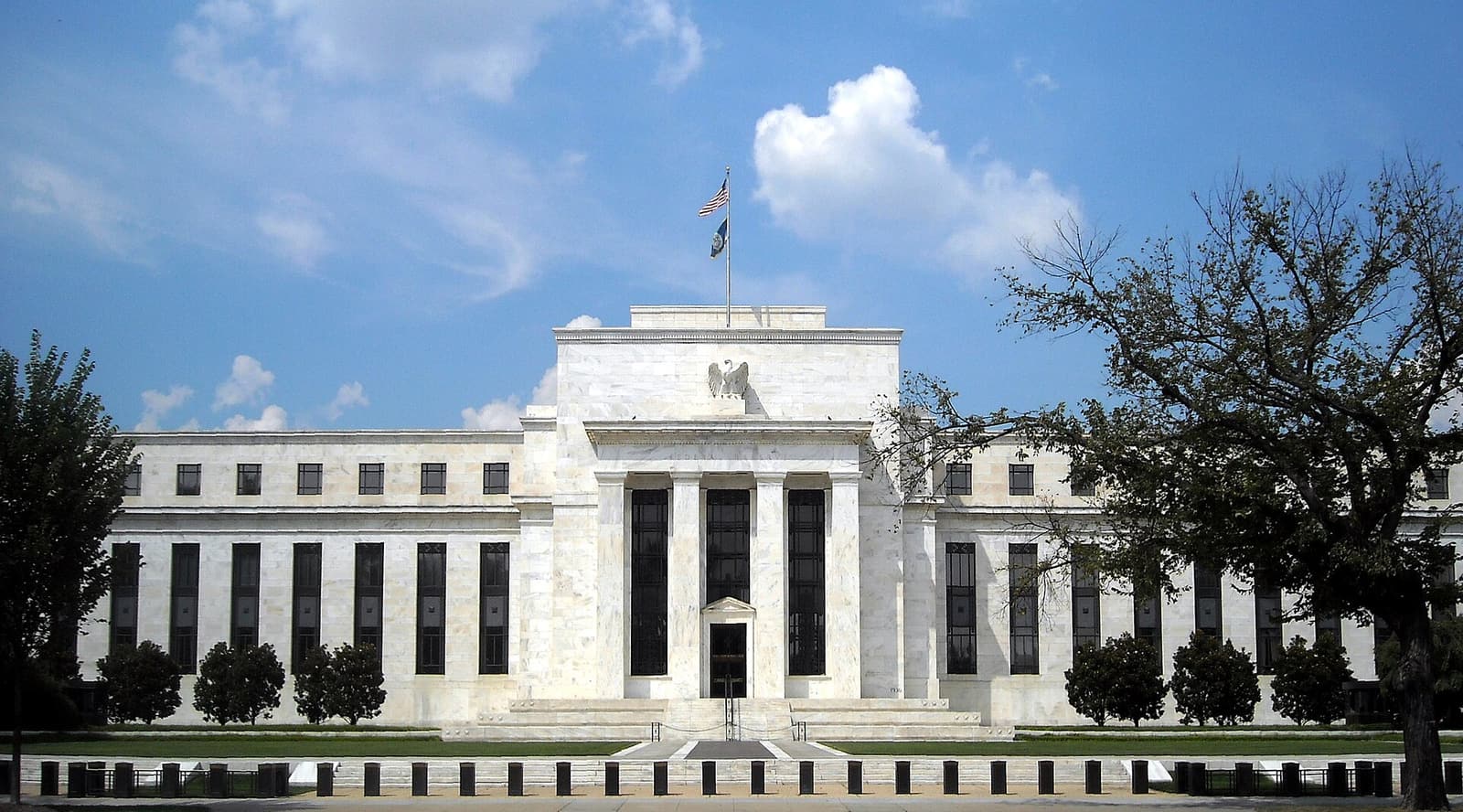
- Wikimedia Commons, "Marriner S. Eccles Federal Reserve Board Building.jpg" - APK photograph of the Fed's Eccles Building in Washington, D.C.