As of 2026-06-19 05:33 UTC, the Obama Presidential Center has moved from a long-running Chicago construction story into an operating public institution. The dedication ceremony on Thursday, June 18, brought Barack and Michelle Obama, three former presidents, performers, political figures, and thousands of nearby spectators into a highly staged civic moment. The center opens to the public on Friday, June 19, with a full weekend of public programming.[1][2]
The headline is easy to flatten into celebrity attendance or presidential nostalgia. The more useful analysis is institutional: this is not a conventional presidential library opening. It is a privately operated museum and civic campus in Jackson Park, while the official Obama Presidential Library remains a National Archives and Records Administration digital library, with records preserved and administered separately.[3] That split changes what the public is actually getting in Chicago. Visitors get a museum, public grounds, a Chicago Public Library branch, a basketball-centered community building, gardens, event spaces, and skyline views. Researchers get a separate digital access model for presidential records.
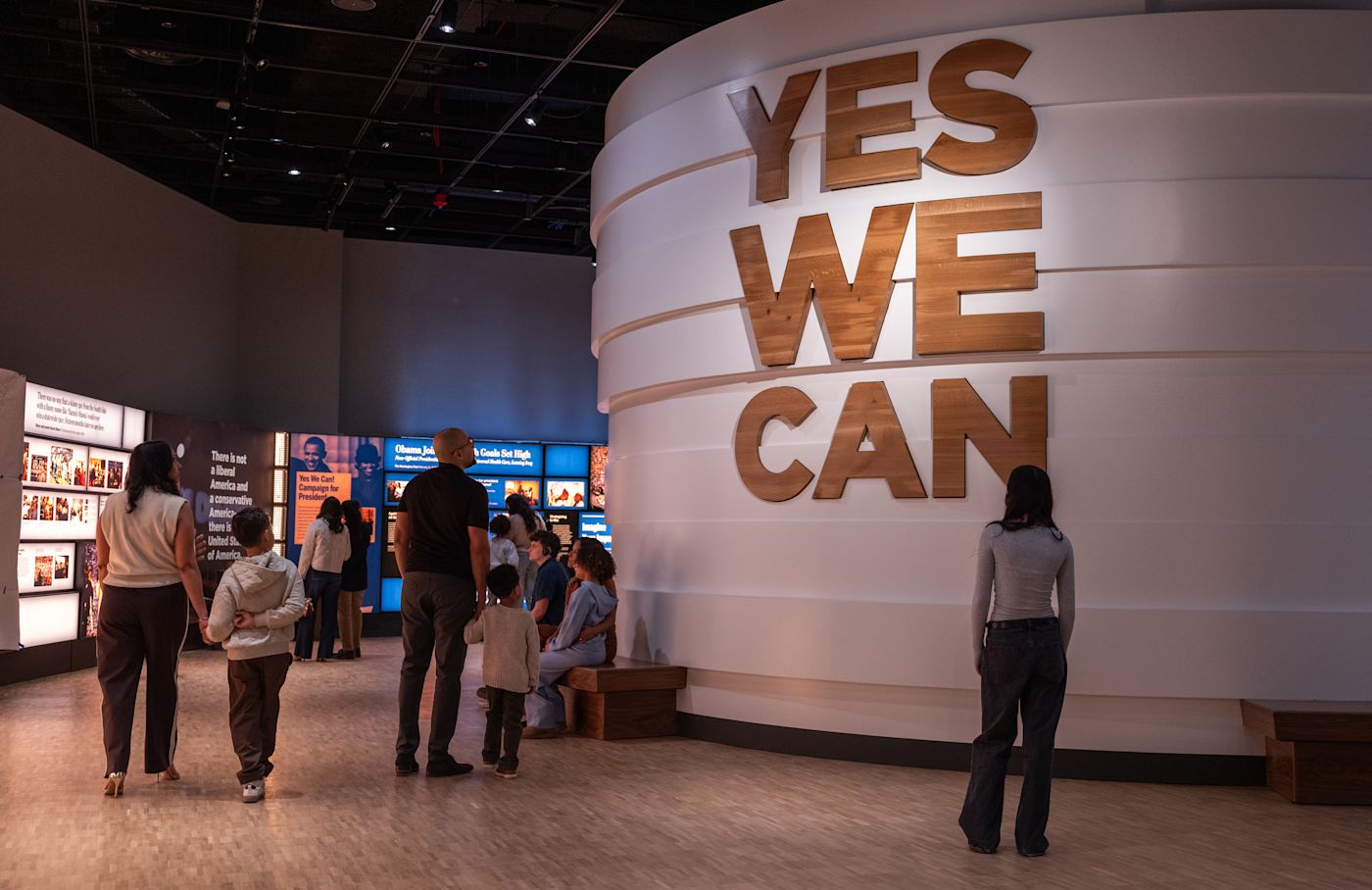
Fast Facts
| Item | What is known | Confidence note |
|---|---|---|
| Opening sequence | The invitation-only dedication took place Thursday, June 18; the center opens to the public Friday, June 19, with weekend events through June 21.[1][2] | High; AP and the Obama Foundation agree on the schedule. |
| Campus model | The Foundation describes a 19-acre campus in Jackson Park with public spaces, museum access, Home Court, and a Chicago Public Library branch.[2][6] | High for the operating description; programming will evolve after opening weekend. |
| Museum scope | The museum opens June 19 and presents the Obama presidency across four floors.[6] | High; this is the official museum page. |
| Archive model | NARA says the Obama Presidential Library is the first fully digital presidential library and that the center is privately operated and non-federal.[3] | High; this is the archival authority. |
| Demand signal | WBEZ reported that museum tickets are sold out from June through October, with openings in November; AP reported general admission sold out through the end of October.[1][4] | High for the initial demand window, but ticket availability can change. |
| New-model background | NARA says the Obama Foundation chose in 2017 not to construct a NARA facility for records and artifacts, while NARA retains custody and access obligations.[5] | High; this is the federal records authority. |
The Real News Is The Operating Model
The dedication ceremony deliberately framed the center as a democracy project. AP reported Obama saying he hoped the center would affirm the value of democracy and shared civic responsibility, while Michelle Obama described it as a place of respite in anxious times.[1] That rhetoric matters because the campus is built to behave less like a static monument than a mixed-use public room. The official opening page lists open-house weekend programming, first-come capacity limits, public schedules, and regular hours for the campus, museum, Forum Building, Home Court, and Chicago Public Library branch.[2]
The institution is therefore making two promises at once. First, it promises an interpretive story about Barack and Michelle Obama, their presidency, and the political coalition around them. Second, it promises daily civic use: library hours, a public campus, gardens, play spaces, sport, talks, tours, and community programming.[2][4][6] Those promises will be judged differently. A museum can succeed with strong exhibitions and timed-ticket demand. A civic campus has to prove itself through repeat use by neighbors, school groups, library patrons, and visitors who did not come for a presidential-history pilgrimage.
That is why the ticket sellout cuts both ways. It is a clear demand signal. WBEZ reported museum tickets sold out from June through October, with November availability, and the AP story said general admission was sold out through the end of October.[1][4] But a sold-out museum does not automatically prove local civic value. It proves opening-season scarcity. The more durable test is whether the parts not hidden behind a timed museum ticket feel genuinely public after the cameras leave.
Why The Archive Split Matters
The Obama Center's most important institutional difference is easy to miss because the phrase "presidential center" sounds close to "presidential library." NARA's own Obama Presidential Library page says the Obama library is the 14th presidential library administered by NARA, but unlike other NARA libraries it is the first fully digital presidential library. It also says the Obama Foundation's Chicago center is privately operated, non-federal, and has no National Archives presence on-site, though records and artifacts can be displayed there through cooperation with NARA.[3]
That distinction should shape expectations. If a visitor wants a high-production museum about the Obama era, Chicago is the place. If a researcher wants presidential records, the core public function lives through NARA's digital model, FOIA processing, catalog access, and archival preservation. NARA says about 95 percent of Obama administration presidential records were born digital, alongside roughly 30 million pages of unclassified paper records.[3] In that context, the fully digital library model is not just a branding novelty. It reflects the documentary reality of a presidency conducted through email, digital photos, videos, documents, and social media.
The tradeoff is trust. A private museum can move faster, commission art, design public amenities, and build a visitor experience with a sharper narrative voice. A federal archive carries a different obligation: custody, preservation, public access, and distance from the subject's preferred self-portrait. The best version of this model lets each side do what it is suited for. The risky version lets the museum dominate public memory while the harder archival work remains less visible.
Who Should Care
Chicago should care first. The center is a major South Side visitor magnet, but the local question is whether it functions as neighborhood infrastructure or as a destination that mostly absorbs outside attention. Public hours, library access, transport service, outdoor spaces, and free programming are not side details; they are the mechanisms by which the project can become useful beyond museum admissions.[2][4]
Museum and archive leaders should care because this is a live test of the presidential-library model after the paper era. NARA's background page says the Obama Foundation chose in May 2017 not to construct a presidential-library facility for NARA to house paper records and physical artifacts, and that NARA would instead maintain custody and provide access through a virtual model.[5] If the model works, future presidents may treat the public museum and the public archive as connected but separate institutions rather than one building with two missions.
Political observers should care because the opening was staged as a civic answer to polarization without becoming a campaign event. AP's report makes that balance clear: the event centered democracy, character, and shared civic responsibility, while President Donald Trump was physically absent and not named by speakers.[1] The center's political message is not subtle, but its operating challenge is practical. It has to turn ceremony into a place people use.
Scenarios
Base case: the museum runs hot through opening season, with sold-out demand carrying the first several months. The campus becomes a regular stop for visitors to Chicago and a useful public space for some South Side residents, but its archival distinction remains poorly understood by casual visitors.
Upside case: the free campus, library branch, Home Court, gardens, and programming become a durable local asset. In that outcome, the center is not judged only by presidential tourists. It becomes a working civic venue that gives the privately run museum a stronger public-interest argument.[2][4]
Downside case: the center is remembered mainly as a museum and celebrity opening, while the digital NARA library remains invisible to most of the public. In that scenario, the split model weakens historical understanding because the visitor experience overshadows the archival record.[3][5]
What To Watch Next
Watch visitor mix after opening weekend. The first test is not attendance alone, but whether repeat local use shows up once the dedication spectacle ends.
Watch access friction. If museum tickets remain scarce while free areas are easy to enter, the civic-campus argument strengthens. If the whole site feels hard to use, the project starts to look more like a conventional attraction with public-space branding.
Watch the NARA connection. The center's credibility as public history depends partly on whether visitors understand that official records are preserved through the Obama Presidential Library's digital model, not in a traditional on-site archive.[3]
Watch programming after the first month. A center built around democracy, community, and service has to keep producing civic life after the opening-weekend schedule is over.[2]
Sources
- Associated Press via WTOP, "Obama Center opens in Chicago with a call to defend democracy and a celebrity crowd" (June 18, 2026) - dedication ceremony, remarks, attendance, demand, and opening context.
- The Obama Foundation, "Grand Opening" - public opening weekend, campus hours, opening-event framing, and visitor logistics.
- Barack Obama Presidential Library, "About Us" - NARA administration, fully digital library model, custody of records, and non-federal status of the Chicago center.
- WBEZ Chicago, "What to know about the Obama Presidential Center's opening weekend and beyond" (June 17, 2026) - public access, ticket availability, transit, library hours, and weekend programming.
- National Archives, "Updated Information About Obama Presidential Library" - federal background on the new virtual model, NARA custody, records access, and the non-federal Chicago center.
- The Obama Foundation, "The Museum" - official museum opening page and source page for the downloaded museum photograph.