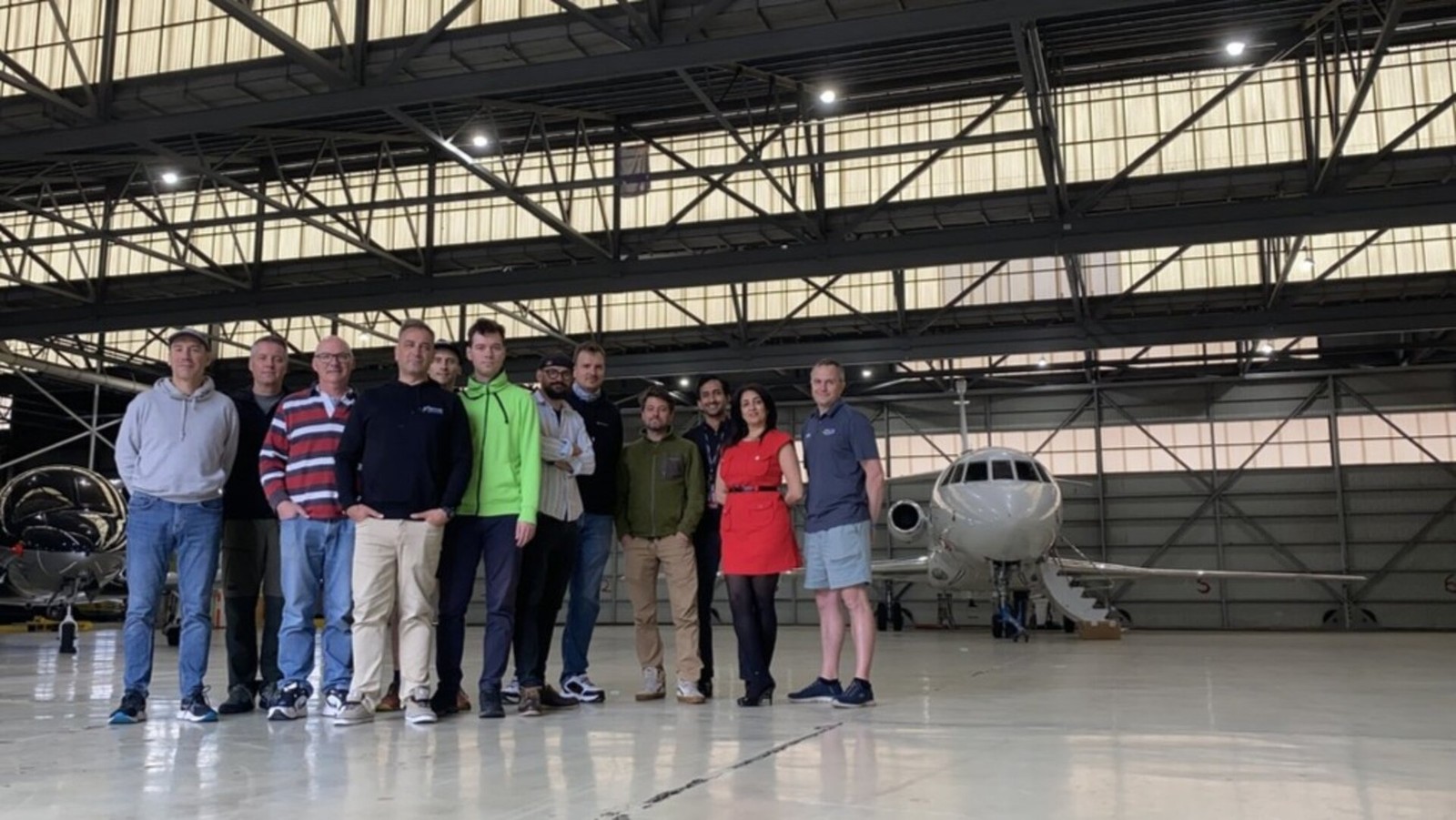
As of 2026-09-15 06:34 UTC, the last two satellites of ESA's Cluster mission had become an unusual laboratory experiment. Samba reentered over the South Pacific on August 31; Tango followed on September 1. A plane carrying the ROSIE observation team caught both breakups with 29 of its 30 instruments. ESA reported that the observations lasted about 50 seconds each on average.[1]
Those seconds are the reason to keep watching this story after the spacecraft have disappeared. Engineers need to know when a satellite opens up, which components fragment, and what happens to its materials. A successful encounter puts evidence into their hands. Turning that evidence into more reliable predictions is the next job.
Why move satellites to meet an aircraft?
The preparation began in orbit. ESA commanded small trajectory adjustments on January 19 and 20, bringing the planned reentry locations closer together. That made it feasible for the aircraft to return to land, refuel and give its crew a rest between two observations roughly a day apart.[3]
Cluster offered unusually accommodating orbital mechanics. Its spacecraft travelled on elongated orbits; long-term gravitational interactions with Earth, the Sun and Moon shaped their return. That differs from the gradual drag-driven descent of many satellites near Earth, allowing the team to arrange a more predictable meeting over the ocean.[4]
ESA calls this a targeted reentry: manoeuvres months or years beforehand line up a spacecraft's eventual descent over a limited region. The method does not require control of the satellite during reentry itself.[7] The distinction explains how a mission can plan its ending long before its final transmission.
The aircraft still had to reach the right patch of sky, point its instruments correctly and remain at the edge of the no-fly safety zone. For Tango, ESA says the pilot banked to keep the disintegrating spacecraft in view a few seconds longer.[1][4] Observation time was something the whole operation had to earn.
What can a camera learn from a streak of light?
A photograph records the visible breakup. Spectroscopy separates emitted light by wavelength to identify material signatures. Stuttgart's team combined imaging cameras, atomic spectral-line measurements and infrared observations across six observing stations.[5]
Connecting a material signature to a moment in the breakup can help reconstruct melting and vaporisation. That is the spectral measurements' purpose; the university's campaign report does not provide a completed inventory of detected materials.[5]
The engineering use is concrete. Designers want spacecraft components to break down sufficiently during reentry to reduce the chance of dangerous pieces reaching the surface. ESA calls this design for demise.[3] To assess such a design, a model needs a credible account of the destructive sequence, including what becomes exposed and when.
Why repeat the experiment with similar spacecraft?
An unexpected result from one reentry leaves several possible explanations. Conditions may have differed from the forecast; a model may need revision; the observation may have limitations. Repetition helps researchers separate those possibilities.
The earlier ROSIE campaign observed Cluster's Salsa in September 2024. ESA subsequently reported a mismatch of up to 20% against expected atmospheric density and a breakup that appeared to begin somewhat earlier than predicted.[4] Those are reasons to test the model again, rather than a basis for applying one correction to every future satellite.
The Cluster spacecraft share the same design, creating an opportunity to compare breakup along slightly different trajectories and in different conditions.[3]
Stuttgart's September 4 account says the models had already been developed further after Salsa and the aircraft route changed for the new campaign. Three spacecraft were observed by ROSIE: Salsa, Samba and Tango. Rumba reentered in 2025 without an observation.[5]
That makes the comparison valuable, with a boundary: identical spacecraft do not make the weather, viewing geometry or instruments identical. A persuasive result will explain those differences alongside any repeated behaviour.
Does burning up settle the environmental question?
Material vaporised during reentry can persist in another form. In a 2023 study, NOAA researchers identified spacecraft-derived metals in stratospheric aerosol particles. About 10% of the sulfuric-acid particles larger than 120 nanometres contained aluminium and other elements associated with reentry.[6]
That percentage describes the sampled particle population, not the share of a satellite's mass left in the atmosphere. The study identified material from spacecraft through its chemical composition; it did not measure the later Samba or Tango events. Its authors also identified uncertainty about how the added metals affect aerosol properties.[6]
The practical implication is that reducing the hazard from falling fragments and understanding atmospheric effects require different evidence. ROSIE's observations can help describe the breakup and release of materials. They cannot, by themselves, establish the eventual environmental consequences of a disposal method.
What changes now?
The public record separates three stages:
- Confirmed event: ESA's September 2 report records successful observations of both reentries.[1]
- Scientific purpose: Stuttgart's September 4 account explains how the measurements support comparisons of breakup and material behaviour.[5]
- Next experiment: ESA's September 2 update places Draco, a mission intended to record reentry from inside the spacecraft, on a 2027 launch schedule.[1] That remains a schedule, not a completed test.
For mission designers and readers assessing disposal claims, the next 24 hours call for checking the campaign record; the next seven days, for watching for an analysis or data-release update; and the next 30 days, for looking for comparisons that show whether model predictions improved. These are review horizons, not publication deadlines announced by the researchers.
The base case is continuing analysis, signalled by calibration and comparison updates. An upside case would be published results showing consistent, explainable differences from the predictions across multiple observations. A downside case would be reported measurement gaps that prevent the intended comparisons. Each depends on evidence still to be released in the cited campaign accounts.
What to check next
- Look for measured breakup sequences and their uncertainty before accepting claims of improved prediction.
- Check whether a result applies to Cluster's construction and orbit or has been tested more broadly.
- Keep atmospheric-impact claims tied to atmospheric evidence.
Update conditions: revise this assessment when the team publishes quantitative comparisons, identifies material limits in the observations, or changes the Draco schedule. For now, the achievement is a rare, repeatable view of spacecraft destruction—and a better opportunity to test how engineers explain it.
Sources
- European Space Agency, “Cluster’s encore for reentry science a success” (September 2, 2026) — observation results and Draco schedule.
- European Space Agency, “The ROSIE Samba and Tango team” (August 28, 2026) — photograph and provenance; credit Astros Solutions/ROSIE.
- European Space Agency, “Moving satellites to meet a plane for rare reentry data” (February 2, 2026) — January manoeuvres, flight logistics and design for demise.
- European Space Agency, “Observing Samba and Tango’s reentries” (August 28, 2026) — orbital conditions, instrument plans and lessons from Salsa.
- Dörte Mehlert, University of Stuttgart, “ROSIE: Universität Stuttgart beobachtet Wiedereintritt von Samba und Tango” (September 4, 2026; German) — instrument methods, repeated observations and comparison limits.
- NOAA Chemical Sciences Laboratory, “NOAA scientists link exotic metal particles in the upper atmosphere to rockets, satellites” (October 16, 2023) — research account and abstract of Daniel Murphy and colleagues’ PNAS study.
- European Space Agency, “Cluster reentry animation” (August 30, 2024) — written explanation of targeted reentry.