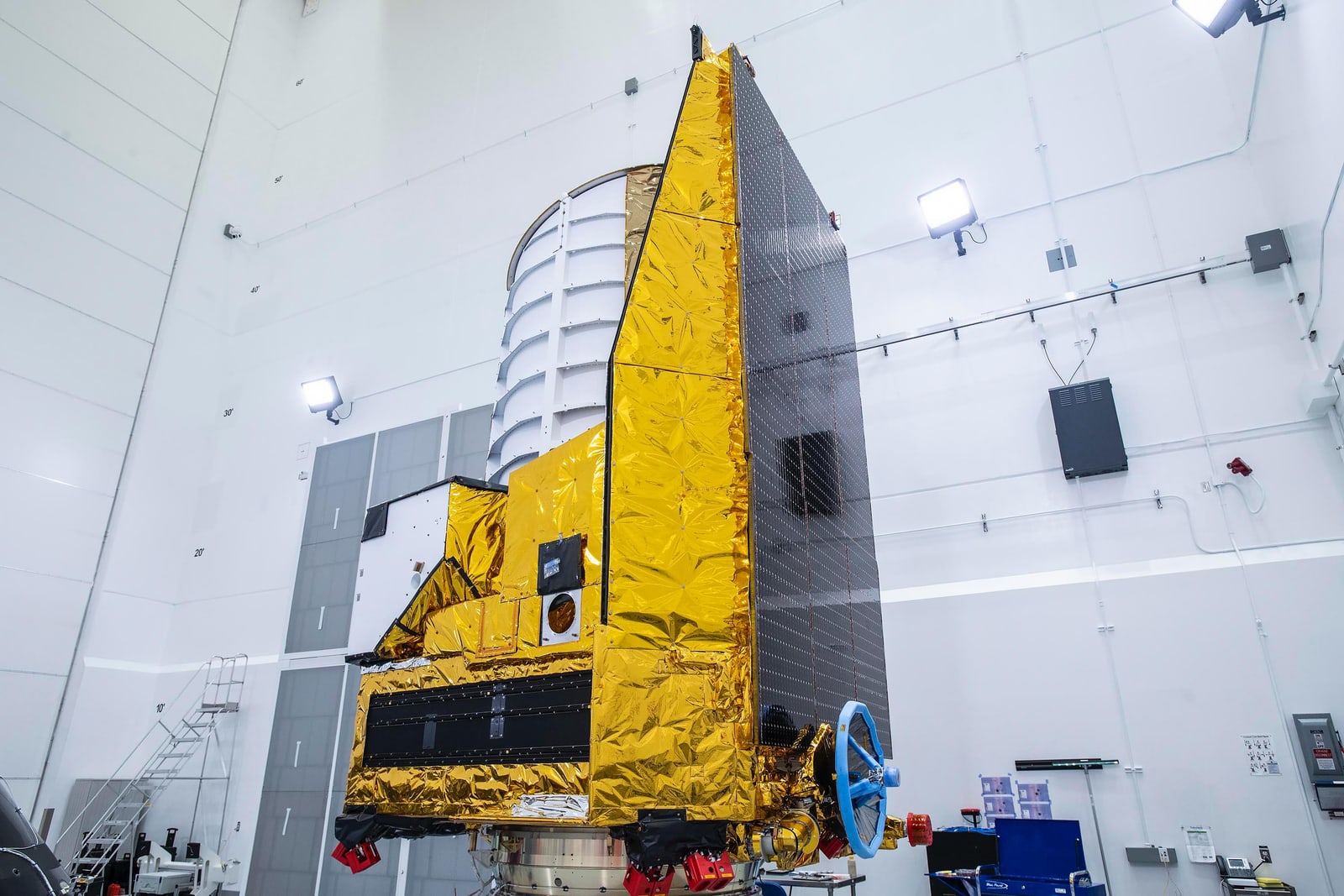
As of 2026-10-21 09:34 UTC, ESA has announced Euclid’s first discovery of a previously unknown comet. Named C/2026 S1 (Euclid), it appeared in September observations by a telescope built to survey distant galaxies. ESA announced the find on October 19.[1]
ESA says this comet is unsuitable for Comet Interceptor, but its discovery helps the two mission teams practise coordination.[1]
A streak in a steady exposure
Euclid launched on July 1, 2023. Its central task is to investigate dark matter and dark energy by building a three-dimensional map of the Universe. NASA, a contributor to the ESA-led mission, describes a project concerned with the Universe’s composition and evolution.[4] A nearby moving object enters those observations on a very different timescale: during a single exposure, it can shift against the distant background.
Mikko Pöntinen of the University of Helsinki and collaborators developed software to identify those elongated traces. The Euclid Consortium’s discovery account illustrates the distinction with a 560-second exposure: stars and galaxies remain fixed while the comet makes a short streak. Shorter exposures show the object with less motion blur. Its surrounding haze, or coma, helped distinguish it from an ordinary point of light.[2]
Finding movement was only the beginning. The researchers also had to establish whether the object was already known. Comparing its position with existing records turned an interesting detection into a candidate discovery; observations from the ground then helped establish its path.[2]
The published sequence is clear:
- September 16–24: Euclid captured the comet in five fields of view, yielding 16 exposures, according to ESA’s discovery report.[1]
- October 5–7: ground observers recorded additional reports of cometary activity, listed in the Minor Planet Center circular.[3]
- October 8, 15:40 UTC: the center issued MPEC 2026-T146, naming C/2026 S1 (Euclid) and publishing observations and an orbital solution.[3]
That circular provides evidence beyond the announcement. It lists four reports of a coma, one report of a tail, and an orbit calculated from 54 observations spanning September 16 to October 8. Its observer roster includes small observatories alongside facilities such as the Canada-France-Hawaii Telescope and the Zwicky Transient Facility at Palomar.[3] Confirmation depended on a network of measurements, with each contributing a dated position or a description of activity.
A secure discovery, a less settled distant future
The formal designation and observation record make this a confirmed discovery. They do not make every prediction about the comet equally secure.
The consortium’s account gives an estimated return time of about 345,000 years.[2] ESA explicitly says that the orbital period will be refined with further data.[1]
The discovery circular records a measurement span of roughly three weeks.[3] This report therefore treats the long return-time estimate as provisional; readers should not confuse an evocative number with a completed history of the comet’s orbit.
Euclid avoids the crowded plane of the Solar System, and its observing pattern generally prevents revisiting a new object on demand. ESA expects few new comet discoveries from the mission.[1]
This detection demonstrates a useful capability without establishing a predictable supply of future targets.
Why an early alert matters
Comet Interceptor is designed around a timing problem. A newly found comet can approach the Sun before a dedicated spacecraft could be designed, built and launched. ESA’s proposed solution is to send a spacecraft and two probes into space first, waiting near the Sun–Earth L2 point until a suitable target is identified.[5]
The mission aims to encounter a long-period comet and examine relatively unprocessed material from the early Solar System. Its three components would observe the encounter from different positions. Those ambitions make timely discovery useful, but identification alone cannot guarantee a visit: a target must also be suitable for the mission.[5]
The operational significance of Euclid’s find is consequently the sequence it exercised: detect an object, compare records, circulate positions and obtain further observations. The value lies in making an unexpected signal available to people who can act on it.
What to watch next
The following are conditional assessments, not announced outcomes. The base case is continued observation that refines this comet’s orbit. The upside would be further discoveries accompanied by timely alerts and successful independent follow-up, strengthening the evidence that the process is repeatable. The downside would be future candidates lacking enough observations for reliable recovery; that would limit their usefulness even if the initial detections were real.
For readers and observing groups following the story:
- Next 24 hours: use the official designation to locate the observation record; distinguish the confirmation date from the later publicity date.
- Next seven days: check for additional measurements and revised orbital information before repeating a precise return-time estimate.
- Next 30 days: look for documented follow-up or changes to the discovery workflow. These are monitoring windows, not promised release dates.
A revised orbital solution should replace the earlier estimate. A separate mission announcement would be needed before treating any Euclid discovery as a selected spacecraft target. For now, the reported achievement is concrete: a streak in a galaxy survey has become a comet that other astronomers can investigate.
Sources
- European Space Agency, “Euclid discovers new comet,” October 19, 2026 — discovery chronology, observing constraints, uncertainty and Comet Interceptor coordination.
- Knud Jahnke, Euclid Consortium, “Meet Euclid’s first comet discovery: ‘C/2026 S1 (Euclid)’,” October 19, 2026 — moving-object software, exposures, catalogue comparison and the preliminary return-time estimate.
- IAU Minor Planet Center, “MPEC 2026-T146: Comet C/2026 S1 (Euclid),” October 8, 2026 — designation, reports of activity, observations, participating observatories and initial orbital solution.
- NASA Science, “Euclid,” accessed October 21, 2026 — mission purpose, NASA’s participation and launch date.
- European Space Agency, “Comet Interceptor factsheet,” accessed October 21, 2026 — mission concept, waiting at L2, three-spacecraft design and target objectives.
- NASA Jet Propulsion Laboratory, “Euclid Spacecraft in Cleanroom,” July 1, 2023 — ESA photograph taken during launch preparations on June 23, 2023.