As of 2026-04-22 21:03 UTC, the European Commission has posted a notice for a May 5 housing event in Brussels co-hosted with the European Parliament's Special Committee on the Housing Crisis. The item is short, but the timing matters: it links a December 2025 Commission plan, a March 2026 Parliament resolution, and a spring consultation on an Affordable Housing Act into one implementation checkpoint.[1][2][3][4]
The news is not that Brussels has suddenly taken over housing policy. The Commission's own plan says it is meant to support national, regional, and local authorities, not replace them.[2] The news is that the EU housing file is moving from diagnosis to delivery tests: finance, construction capacity, state-aid rules, short-term rentals, stressed local markets, and young people's access to housing are all now scheduled topics rather than background grievances.[1]
What is confirmed
| Item | Confirmed detail | Why it matters |
|---|---|---|
| Timestamp | The Commission notice was published on April 22, 2026.[1] | It creates a dated handoff after the December 2025 plan and March 2026 Parliament vote. |
| Event window | May 5, 2026, 08:30-12:30, European Parliament Brussels.[1] | The next public checkpoint is less than two weeks away, before the file can drift into general affordability rhetoric. |
| Hosts | Parliament's HOUS committee and the Commission Housing Task Force.[1] | The format joins the elected chamber's recommendations to the Commission's policy and investment machinery. |
| Agenda themes | Financing the housing transition, areas under housing stress, construction, and housing for young people.[1] | These are the practical bottlenecks that decide whether a plan becomes units, permits, funding, and tenant relief. |
| Confidence note | High for schedule and institutional framing; medium for policy outcome. | The event is confirmed, but it has not yet produced legal text, financing allocations, or national commitments. |
Why this is more than a calendar item
The European Affordable Housing Plan, presented in December 2025, organizes the EU role around four pillars: boosting supply, mobilizing investment, enabling immediate support while driving reforms, and protecting the most affected.[2] That structure is broad enough to sound familiar. Housing crises across Europe already have a known vocabulary: rents, mortgages, permits, shortage, energy cost, tourist pressure, underbuilding, and youth exclusion.
The May 5 event matters because it is a forum for narrowing that vocabulary into mechanisms. The Commission's plan points to construction-sector productivity, modular and offsite methods, digitalization, a housing simplification package, and faster permitting.[2] Parliament's March vote added political pressure by calling for measures such as less red tape, tax incentives, protection against short-term rental pressure in cities, stronger construction capacity, and a 60-day ceiling for planning permits.[4] None of those items automatically builds a home. Together, they define the claims that will have to survive contact with member-state law, municipal planning, construction labor, capital costs, and neighborhood politics.
The investment side is equally concrete. The Commission plan refers to a Pan-European Investment Platform with the European Investment Bank and public promotional banks.[2] The EIB said in December that it was targeting 6 billion euros in housing lending in 2026, with a focus on innovation, renovation, and new building.[6] That number does not close Europe's housing gap by itself. It does, however, gives the May 5 event a measurable finance lane: what projects can absorb capital quickly, what state-aid changes make public support easier, and what counts as affordable enough to justify EU-backed financing.
The stress-zone problem
The Commission's March consultation on the Affordable Housing Act shows where the legal fight is likely to concentrate. It asks how to identify "areas under housing stress" using public data and how to address the impact of short-term rentals on affordability while preserving their benefits.[3] That phrasing is careful because the EU is not one housing market. A rental cap, tourist-apartment rule, or permit target that looks urgent in one city can be irrelevant or counterproductive somewhere else.
Eurostat's housing data underline the uneven map. In 2023, 10.6% of the EU city population lived in households spending more than 40% of disposable income on housing, compared with 7.0% in rural areas.[5] Greece and Denmark had the highest city housing-cost overburden rates in that publication, while Cyprus and Croatia were at the low end.[5] Eurostat also reported that EU households on average spent 19.7% of disposable income on housing, but the burden reached 38.2% for people below 60% of national median income.[5]
Those numbers explain why a single EU housing headline can mislead. The relevant test is local stress plus household vulnerability. A student city, a capital with high short-term rental pressure, a post-industrial region with empty but inefficient stock, and a tourist-heavy island may all sit inside the same EU policy file while needing different tools.
Decision impact
City governments and housing ministries should treat the May 5 event as a signal to prepare evidence, not slogans. The Commission is already asking for public-data methods to identify stressed areas.[3] Authorities that want flexibility on short-term rentals, state aid, or financing will need local vacancy, rent, permit, construction-cost, and household-burden evidence.
Developers, housing associations, and construction firms should watch whether Brussels emphasizes financing volume or delivery capacity. If the event foregrounds EIB-linked finance without a credible permitting and labor path, the plan risks becoming a capital pool searching for projects. If it foregrounds construction productivity and faster approvals without affordability conditions, it risks increasing supply while leaving the worst-burdened households behind.
Renters, students, and young households should watch the youth-housing lane. The Commission plan names student housing, innovative models for young people, and support for mobile disadvantaged students.[2] Parliament's March process also framed the crisis as a generational constraint.[4] The policy question is whether youth housing becomes a measurable pipeline, or remains a sympathetic category inside a larger construction agenda.
Scenarios to watch
The base case is a coordination event that clarifies workstreams and keeps the Affordable Housing Act, state-aid revision, construction strategy, and investment platform moving through 2026. That would matter because housing policy often loses momentum between diagnosis and local execution.
The upside case is sharper: Brussels identifies a common data approach for housing-stress zones, ties EIB and EU-backed financing to concrete affordable projects, and gives cities usable cover to manage short-term rental pressure where evidence supports intervention.[3][6] In that scenario, the May 5 event becomes the start of a practical rulebook.
The downside case is that the file remains a high-consensus forum with weak enforcement. Housing is politically popular as a problem statement, but implementation cuts across property rights, tourism income, fiscal capacity, construction shortages, and local zoning. If the event produces only broad alignment, the next real test moves to the draft legal text and financing terms.
Action checklist
For public authorities: prepare area-level evidence before the May 5 discussion, especially rent-to-income burdens, permit timelines, short-term rental density, vacant or underused stock, and construction bottlenecks.
For market participants: separate "more housing finance" from "more deliverable affordable homes." The EIB target is a useful anchor, but absorption capacity, permitting, and subsidy design will decide the conversion rate.[6]
For observers: watch three dates and documents. First, the May 5 event programme and closing remarks. Second, the Affordable Housing Act follow-up after the March consultation. Third, any state-aid revision or investment-platform detail that turns the plan into a financing rule.
The invalidation condition is straightforward: if the May 5 event does not clarify who owns each workstream, how housing-stress areas will be measured, and how financing will reach deliverable projects, then the April 22 notice is only a procedural update. If it does clarify those points, it becomes the moment when the EU housing file starts to operate like an implementation calendar.
Sources
- European Commission, "Join the European Parliament and Commission for the High-Level Event on Housing" (22 April 2026).
- European Commission, "The European Affordable Housing Plan" policy page.
- European Commission, "Have Your Say: EU consults on the Affordable Housing Act" (6 March 2026).
- European Parliament, "Tax incentives, renovation and less red tape to tackle the EU's housing crisis" (10 March 2026).
- Eurostat, "Housing in Europe - 2024 edition," affordability and housing-cost overburden data.
- European Investment Bank, "EIB Group doubles its financing to €6 billion for homes contributing to the European Commission's Affordable Housing Plan" (16 December 2025).
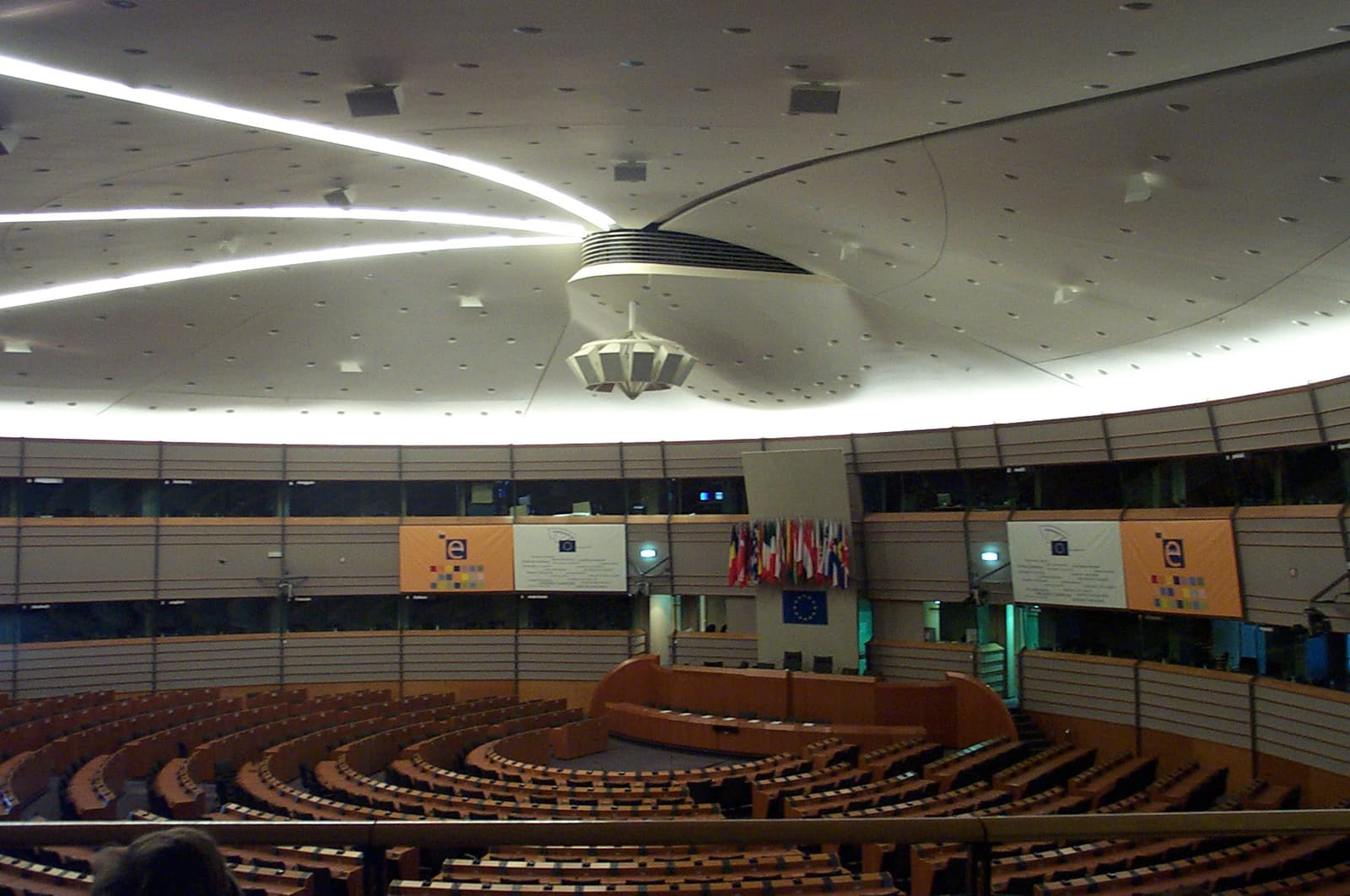
- Wikimedia Commons, "European Parliament hemicycle Brussels 200406.jpg" (lead image source).