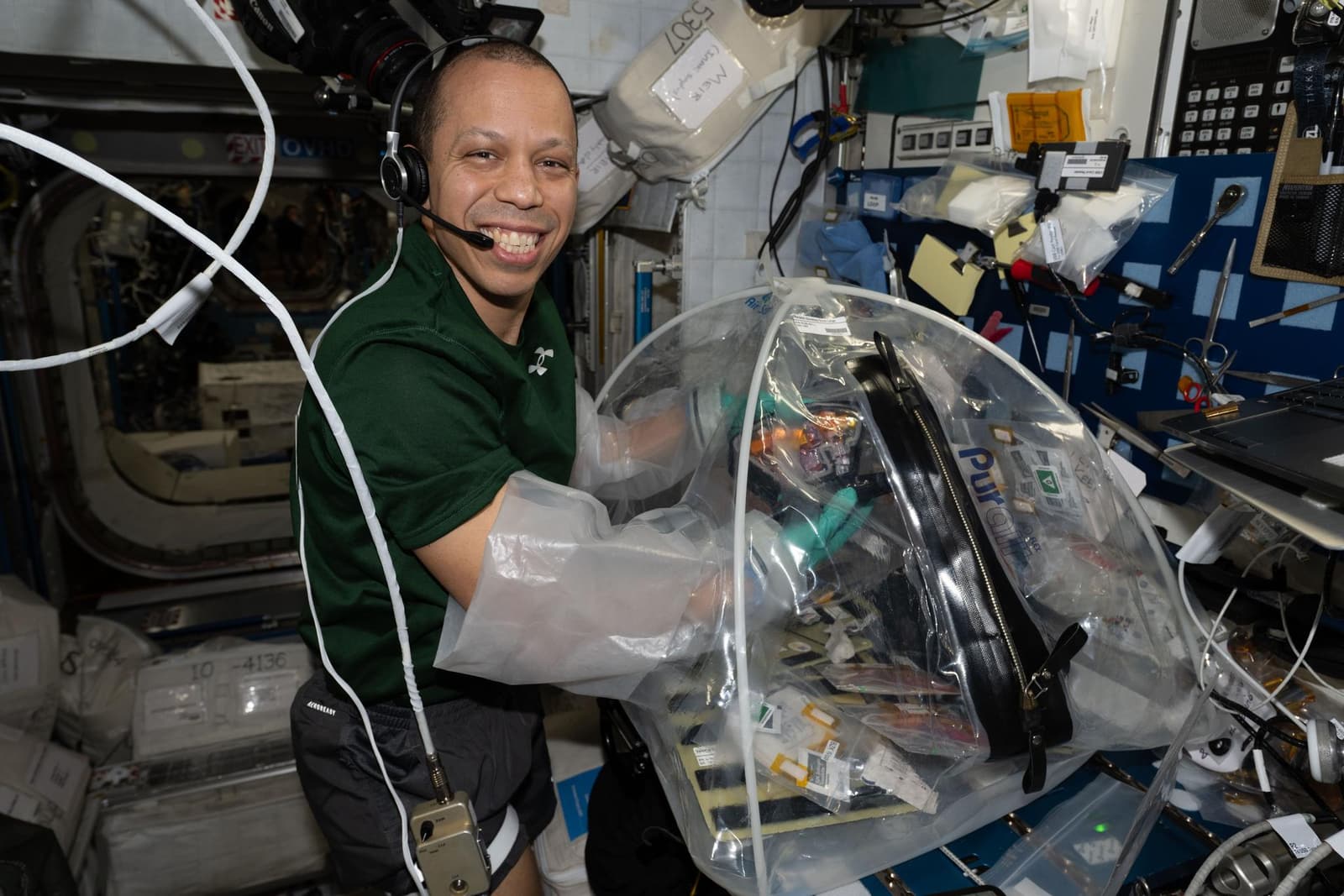
As of 2026-04-22 17:04 UTC, the useful ISS headline is operational rather than spectacular. NASA's Wednesday station update describes one crew day in which biotechnology samples, radiation-biology hardware, exercise-device installation, vision testing, and cargo unpacking all had to fit into the same orbital schedule.[1]
That mix matters because it shows the station doing two jobs at once. It remains a near-Earth laboratory for experiments that could help terrestrial medicine, and it is also a proving ground for equipment and procedures that have to survive longer missions to the Moon, Gateway, and Mars. The new information is not that any one experiment has produced a clinical result. The news is that several exploration-relevant workstreams moved through hands-on crew operations in the same cycle.[1][2][3]
Facts on the File
| Item | What is now live | Confidence note |
|---|---|---|
| Timestamp | NASA posted the station update on April 22, 2026, at 12:24 p.m. Eastern time.[1] | High: NASA published the operations note and image metadata on the same page. |
| DNA Nano Therapeutics-3 | Chris Williams of NASA and Sophie Adenot of ESA processed genetic-material samples in Kibo for an investigation using DNA-inspired assembly techniques to manufacture nano-therapies, with orbital spectrophotometer analysis and later Earth-side analysis planned.[1] | High for station activity; therapeutic value remains research-stage. |
| Lux in Space | Jessica Meir worked in ESA's Columbus module on BioLab hardware supporting Lux in Space, an investigation of how DNA damaged by space radiation repairs itself.[1][3] | High for hardware activity; biological conclusions depend on the experiment runs and ground analysis. |
| E4D exercise hardware | Meir checked and secured power connections for the European Enhanced Exploration Exercise Device, and NASA had described the device's activation and installation work the prior week.[1][2] | High for checkout status; long-duration exercise value requires continued in-orbit testing. |
| Exploration context | NASA's technical-report abstract says E4D was selected as the exploration prototype to be evaluated on ISS as a single multi-modality exercise device for future missions.[4] | High for program intent; operational adoption still depends on test results and integration decisions. |
| Workload backdrop | Jack Hathaway activated Kibo's Life Science Glovebox, photographed BioLab work, unpacked Cygnus XL cargo, and restocked medical inventory while Russian segment crew prepared for Progress 95 rendezvous and docking practice.[1] | High for daily operations; schedule effects can change quickly. |
What Changed
The April 22 update is best read as a readiness snapshot. DNA Nano Therapeutics-3 is the most directly biomedical item: it uses DNA-like nanomaterials and DNA-inspired assembly as a route toward nano-therapies such as chemotherapy and immunotherapy, while keeping the actual output inside a research pipeline rather than a treatment claim.[1] NASA's earlier ISS daily summary for DNA Nano Therapeutics-Demo 2 framed the technology as a way to evaluate in-space manufacturing of nanomaterials with potential therapeutic, vaccine, and regenerative-medicine applications, while also noting the limits of current manufacturing options.[5]
Lux in Space adds a different biology question. OHB, which developed and operates the hardware for ESA, described the investigation as a DLR-led experiment studying how radiation-induced DNA damage is repaired under microgravity, using a bioluminescent bacterial measurement system and ground support during the in-orbit operations.[3] That makes the BioLab work relevant to exploration health as well as basic radiobiology: crews going beyond low Earth orbit face different radiation exposure, and the repair process is part of the risk picture.[1][3]
E4D brings the same day back to crew physiology. NASA's April 15 update said the new ESA exercise machine was being configured for activation and installation in Columbus, and the April 22 note shows the checkout moving into power and connection work.[1][2] The NASA Technical Reports Server abstract is explicit about the program logic: exploration missions need a lightweight, small-footprint device that can provide enough stimulus and variability to counter muscle and bone loss.[4]
The operational link across the three lines is crew time. These are not isolated press-release topics. They compete for gloveboxes, incubators, laboratory modules, crew procedure time, photography, sample handling, power checks, cargo transfers, and medical inventory work.[1] That is the station's practical value: it reveals whether promising research and support hardware can be run inside the daily mechanics of a spacecraft.
The Next 24 Hours, 7 Days, and 30 Days
Over the next 24 hours, the most useful signals are mundane: whether NASA posts follow-on station reports confirming additional sample processing, BioLab run continuity, E4D checkout steps, and Cygnus XL transfer progress.[1][2] A clean day of follow-through would matter more than a bigger headline.
Over the next 7 days, watch for the work to move from setup and activation into repeatability. For DNA Nano Therapeutics-3, that means more evidence that orbital measurements and return-sample handling stayed on track. For Lux in Space, it means BioLab operations that support the planned experiment runs. For E4D, it means checkout activity that looks like a device entering a test campaign rather than remaining a piece of delivered hardware.[1][3][4]
Over the next 30 days, the question becomes whether the station can turn these tasks into usable data packages. The strongest near-term output would be procedural confidence: samples handled, equipment powered, data captured, and handoffs to ground teams completed without consuming disproportionate crew time.[1][3][4] Clinical conclusions, exercise-prescription changes, and Gateway hardware decisions sit farther out.
Scenarios
Base case: the April 22 workload continues as a normal station research sequence. NASA reports more processing and checkout work, the samples and hardware stay inside planned procedures, and the immediate value is operational confidence rather than a scientific conclusion.[1][2]
Upside case: BioLab, Kibo, and E4D work all produce clean early operations. That would strengthen the case that the ISS can support overlapping biotechnology and crew-health tests while preparing for exploration hardware demands.[1][3][4]
Downside case: a glovebox, incubator, power, sample, or scheduling issue slows the sequence. That would not invalidate the research aims, but it would push the news back toward integration risk: the hard part would be running the work reliably inside station constraints.[1]
Action Checklist
For space-research readers, keep the boundary clean. DNA Nano Therapeutics-3 and Lux in Space are research operations, not proof that a therapy or radiation countermeasure is ready. The milestone is sample and hardware execution in orbit.[1][3][5]
For exploration-program watchers, track E4D as a systems question. A future Moon or Mars exercise device has to satisfy physiology, mass, power, volume, vibration, software, maintenance, and crew-time constraints at once.[4]
For anyone reading the medical angle, avoid treating microgravity as magic acceleration. The station can expose biology and materials to conditions that are difficult to reproduce on Earth, but every claim still has to survive measurement quality, sample size, return analysis, and replication.[1][3][5][6]
The invalidation condition is straightforward. If NASA, ESA, OHB, or a later ISS daily report says one of these runs was delayed, repeated, degraded, or rescheduled, the near-term read changes from "clustered execution" to "integration watch." Until then, the April 22 file is a compact example of what the ISS is now asked to do: run biomedical experiments, test astronaut-support hardware, and keep cargo and vehicle operations moving in the same day.
Sources
- NASA, "DNA Research on Station Promoting Cancer Therapies, Radiation Repair" (April 22, 2026).
- NASA, "Crew Begins New Space Research and Installs New Science Gear" (April 15, 2026).
- OHB, "OHB bringt Spitzenforschung ins All: 'LUX in Space' untersucht DNA-Schäden und ihre Reparatur auf der ISS" (April 16, 2026).
- NASA Technical Reports Server, "Exploration Exercise System (EES) Development" (2024).
- NASA, "ISS Daily Summary Report - 3/28/2024," including DNA Nano Therapeutics-Demo 2 operations.
- ISS National Laboratory, "NASA's SpaceX Crew-10 Returns Safely After Completing Dozens of ISS National Lab-Sponsored Investigations" (August 11, 2025).