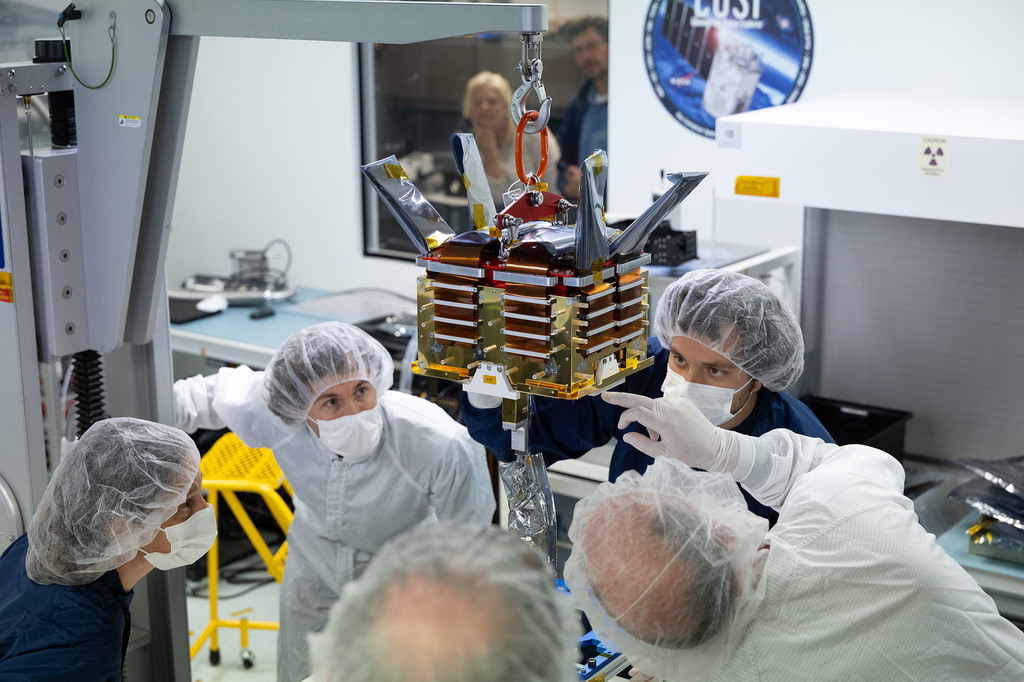
As of 2026-09-20 17:35 UTC, NASA has highlighted assembly work on COSI, the gamma-ray telescope intended to investigate the Milky Way’s antimatter and the formation of chemical elements. Its September 18 photo feature shows engineers and managers watching the detector assembly lift from a laboratory table. NASA continues to list launch in 2027.[1][2]
The photograph records work on July 8, rather than a new operation performed this week. It also appeared in NASA’s August 31 assembly archive. Read alongside the project’s engineering record, the scene offers a useful view of a mission moving toward flight: sensitive hardware being handled by people who must turn a scientific design into a working observatory.[3]
What the public record establishes
Three dates help place the latest feature:
- July 8: the photographed detector assembly was raised and guided toward its baseplate at UC Berkeley’s Space Sciences Laboratory. NASA’s archive identifies the personnel and equipment.[3]
- July 23: the Government Accountability Office published its annual NASA project assessment. It described COSI as operating within its cost and schedule baselines and listed a system integration review for September.[5]
- September 18: NASA featured the July photograph. The accompanying text describes the hardware and mission, without announcing a completed integration review or a launch-readiness decision.[1]
Confidence is high in the documented photograph dates and the published 2027 launch target. The outcome of the September review is not established by the sources checked for this report. The GAO assessment is an earlier status record, not a real-time account of work in the laboratory.
A telescope built around collisions
The instrument in Alan Toth’s photograph looks like a compact gold box, suspended amid a circle of cleanroom-clad staff. Silver coverings protect the flexible circuits that connect the detectors to their readout electronics. NASA’s wider archive also shows engineers checking detector spacing and alignment during the summer.[1][3]
Those measurements matter because COSI reconstructs the sky from interactions inside its detector. Its instrument design uses sixteen germanium detectors. When a gamma-ray photon scatters, it deposits energy at successive locations; measuring those deposits helps constrain the direction from which it arrived. One event gives a ring of possible directions. Combining many events allows the instrument’s analysis to recover the source location.[4]
That is a demanding connection between physical assembly and scientific interpretation. The hardware records the interactions, while reconstruction turns those records into an image. As an inference from the design, a convincing photograph of the assembled box can document construction progress, but it cannot establish the accuracy of a future sky map.
What COSI is intended to see
COSI’s planned observing range, 0.2 to 5 million electron volts, captures radiation associated with processes inside atomic nuclei. NASA identifies several scientific goals: locating sources of galactic positrons, mapping element formation, measuring gamma-ray polarization and identifying light associated with events detected through other signals, including gravitational waves.[2]
The antimatter question illustrates the opportunity. When positrons meet electrons, their annihilation produces characteristic gamma rays. Astronomers have observed this emission near the Milky Way’s centre for decades, but its origin remains unresolved. COSI is designed to help investigate where the positrons come from. That is a research aim; the assembly feature reports no discovery about their source.[2]
The breadth of the mission also changes what a useful image means. COSI’s detectors and reconstruction methods support both measurements of photon energy and constraints on arrival direction. Together, these let researchers ask what produced the radiation and where that process occurred.[4]
The engineering issues behind the picture
GAO reported insufficient clearance between detector fasteners and a high-voltage component. The correction required removing the detector housing from its cold enclosure, or cryostat. That consumed some schedule reserves, although other integration and testing could proceed alongside the work.[5]
A separate cooling problem was considered resolved as of February 2026: the flight cryostat achieved lower temperatures than the troublesome engineering model. GAO also reported the team’s judgment that remaining cost and schedule reserves could cover potential risks.[5]
The chronology matters. Later photographs cannot establish closure of every previously reported issue; that requires a subsequent engineering or review outcome. Equally, an earlier account of a problem cannot prove that it remains unresolved today.
Preparation is also happening away from the cleanroom. The COSI team has released its fourth public data challenge, using simulated observations to develop analysis tools and help scientists learn to work with the expected data. This gives prospective users something substantive to examine before flight. The simulations remain preparation material, rather than observations collected by the spacecraft.[6]
What to watch next
For researchers and readers following the mission, the immediate task is to distinguish dated assembly records from certification milestones. Over the next week, a review outcome would be more informative than another photograph. Over the next month, an updated integration and testing account would help connect the July scene to the current launch plan. These are reporting horizons, not additional deadlines announced by NASA.
The base case remains development toward the published 2027 target, supported if the mission continues to report integration progress without revising that target. An upside case would gain evidence from a successful review and documented closure of outstanding hardware work. A downside case would become credible if new rework consumed remaining schedule margin or NASA revised the launch plan. These are conditional ways to assess subsequent news, not forecasts.
For the next update:
- Check for an explicitly dated review result and the testing it authorizes.
- Compare any revised launch target with the current mission page.
- Keep simulated-data results distinct from future flight observations.
Update conditions: a published review outcome, a revised schedule or a new engineering assessment would supersede the relevant parts of this account. For now, the photograph’s strongest contribution is concrete: it shows the people and hardware behind a difficult astronomical measurement.
Sources
- NASA, “COSI Telescope Comes Together” (September 18, 2026) — dated photograph feature and description of the detector assembly.
- NASA Science, “COSI: Compton Spectrometer and Imager” — mission status, planned 2027 launch and scientific objectives; checked September 20, 2026.
- NASA Scientific Visualization Studio, “UC Berkeley Assembles Upcoming COSI Mission” (August 31, 2026; updated September 1) — summer assembly chronology and photographs credited to UC Berkeley/Alan Toth.
- UC Berkeley COSI team, “Instrument” — germanium detectors, Compton imaging and reconstruction principles; checked September 20, 2026.
- U.S. Government Accountability Office, “NASA: Assessments of Major Projects,” GAO-26-108556 (July 23, 2026), COSI profile — cryostat issues, reserves and planned September integration review.
- UC Berkeley COSI team, “The Compton Spectrometer and Imager,” Data Challenge section — fourth public challenge and the distinction between simulated and flight data; checked September 20, 2026.