As of 2026-05-26 04:03 UTC, the Bundibugyo Ebola outbreak in the Democratic Republic of the Congo and Uganda is best read as a response-capacity emergency, not as a sign that a pandemic is inevitable. WHO determined on May 17 that the epidemic is a public health emergency of international concern but said it did not meet the International Health Regulations criteria for a pandemic emergency.[1]
That distinction matters. The risk is urgent in the affected and neighboring areas, especially because case counts have risen, the geography has widened, and Bundibugyo virus does not currently have an approved vaccine or treatment equivalent to the better-known Ebola-Zaire countermeasures.[1][2][5] But the policy problem is still concrete: find cases, protect health workers, trace contacts, keep borders visible to health teams, and avoid both panic and complacency.
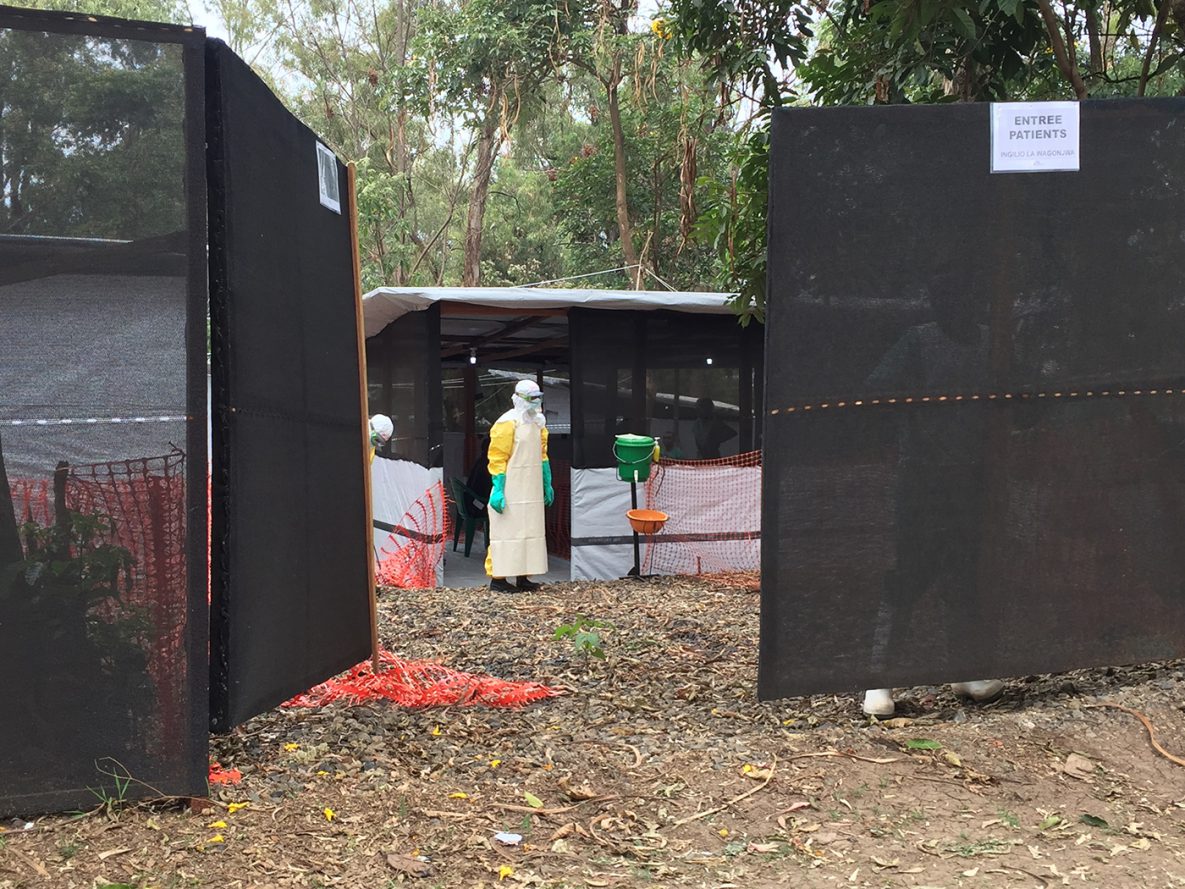
Image context: the image is a real CDC photograph of an Ebola transit center in Bukavu, DRC, not a virus graphic or generated illustration.[7] It is included because this story is operational. The decisive work happens in places where people in PPE, community health workers, ambulance teams, laboratories, and local leaders turn a global alert into daily containment.
Fact File
| Item | What is known | Confidence note |
|---|---|---|
| Formal status | WHO determined the DRC-Uganda Bundibugyo epidemic is a PHEIC, but not a pandemic emergency.[1] | High; direct WHO emergency-committee statement. |
| Local risk grading | WHO assessed risk as very high for DRC and high for Uganda as of May 22.[1] | High; direct WHO statement, but risk can change with transmission evidence. |
| Case movement | WHO's May 21 disease notice reported rapid increases in DRC, spread into North Kivu and South Kivu, and 85 confirmed cases across both countries as of that date.[2] | High for the WHO timestamp; counts are explicitly evolving. |
| Latest U.S.-tracked update | CDC's May 25 situation page said DRC and Uganda ministries reported 105 confirmed cases in DRC and 7 confirmed cases in Uganda; AP separately reported Uganda's rise to seven confirmed infections the same day.[5][6] | Medium-high; CDC is relaying ministry reports and flags fluidity. |
| Countermeasure gap | WHO says there are no currently approved therapeutics or vaccines against Bundibugyo virus; CDC says treatment is supportive care.[1][5] | High; direct WHO and CDC statements. |
| Regional coordination | ECDC's May 21 threat assessment notes that Africa CDC declared a Public Health Emergency of Continental Security on May 18 and says ECDC deployed an expert to Africa CDC headquarters for coordination and planning support.[4] | High; direct ECDC threat assessment. |
| U.S. posture | CDC says the overall risk to the American public and travelers remains low, while enhanced screening and routing measures are in place.[3][5] | High for U.S. public-risk posture; not a measure of risk in affected communities. |
What Changed
The headline event is not only that WHO used the PHEIC label. It is how WHO segmented the response. Countries with documented Bundibugyo detection, DRC and Uganda, are being asked to operate emergency coordination systems, maintain line lists of suspected and confirmed cases, monitor contacts for 21 days, strengthen laboratories, build safe referral pathways, protect health workers, and manage safe burials.[1] Neighboring countries are being asked to raise readiness, including border-area surveillance, sample referral, rapid-response teams, and mechanisms for international contact tracing.[1]
This structure is important because it avoids two common mistakes. One mistake is to treat a PHEIC as if it automatically means global travel shutdowns. WHO explicitly did not recommend suspending flights or denying entry to travelers and conveyances from states with documented detection at the time it issued the temporary recommendations.[1] The other mistake is to treat "not a pandemic emergency" as a calming label that reduces the need for speed. WHO's own text points the other way: the affected areas face weak follow-up, insecurity, movement restrictions, and operational access problems.[1][2]
The case curve is the reason the operational posture tightened. WHO said DRC declared its 17th Ebola outbreak on May 15 after laboratory confirmation of Bundibugyo virus disease in eight samples, while Uganda confirmed an outbreak the same day after identifying an imported case from DRC.[2] By May 21, WHO reported 746 suspected cases and 176 suspected deaths in DRC, plus 85 confirmed cases across both countries.[2] By May 25, CDC's situation page, citing DRC and Uganda ministries, listed higher confirmed totals in DRC and Uganda and warned that the situation was rapidly evolving.[5]
Why This Is Harder Than a Case Count
Bundibugyo changes the response geometry. Ebola response systems often draw public attention around vaccines, but WHO says the current Bundibugyo epidemic lacks an approved vaccine or therapeutic.[1] CDC's current situation page makes the same practical point: there is no vaccine for Bundibugyo virus, and care is supportive.[5] That pushes the burden back onto classic outbreak control: early detection, isolation, infection prevention and control, contact monitoring, safe transport, safe burials, community trust, and laboratory throughput.
The geography compounds the problem. WHO identified Ituri, North Kivu, and South Kivu as affected provinces in DRC and highlighted cross-border risk tied to insecurity, humanitarian crisis conditions, high mobility, urban and semi-urban transmission hotspots, and porous borders.[2] ECDC's threat assessment adds a second external read: the outbreak is recent, the epidemiological information still carries uncertainty, and it is probable that the outbreak is larger than currently reported in both case burden and geographic extent.[4]
Health-worker exposure is another warning line. WHO's May 21 notice reported four health worker deaths in DRC, while CDC separately reported that an American surgeon working in DRC had tested positive after exposure during patient care and had been transferred to Germany.[2][5] The exact transmission chains are still under investigation, but the implication is already clear: if facilities cannot triage, isolate, equip, and support staff quickly, the health system becomes part of the amplification route rather than only the response.
The Decision Impact
For public-health agencies in and near the affected region, the next 24 hours are about visibility. Alerts need to be investigated quickly, line lists need to stay current, laboratories need safe sample pathways, and contacts need daily follow-up. WHO's recommendations are built around a simple test: can responders maintain a live picture of who is sick, who was exposed, and who has moved?[1]
For governments outside the region, the practical stance is narrower. CDC says the risk to the U.S. public remains low and that Ebola does not spread through casual contact or air.[3][5] That supports targeted travel screening, traveler information, post-arrival health assessment capacity, hospital readiness, and exposure management rather than generalized fear.
For NGOs, missionaries, humanitarian teams, researchers, and medical responders, the current file is a deployment-risk problem. WHO asks all other states to prepare to facilitate evacuation and repatriation of nationals, including health workers, who may be exposed.[1] Organizations sending personnel into the response should treat exposure protocols, PPE training, insurance, evacuation pathways, and post-exposure monitoring as core logistics, not afterthoughts.
Scenarios
Base case: DRC remains the center of the outbreak, Uganda's cases stay epidemiologically linked to DRC exposure or known contacts, and neighboring countries increase readiness without broad regional spread. In this branch, the story becomes a difficult but bounded containment operation whose success depends on access, contact monitoring, community engagement, and health-worker protection.[1][2][4]
Upside case: contact tracing and community surveillance catch chains earlier than the initial suspected-case curve suggests. Treatment and isolation capacity improves in affected zones, health-worker exposures decline, and Uganda does not develop sustained local transmission. The signal to watch is not only total cases; it is whether the share of unlinked cases and deaths outside care begins to fall.
Downside case: insecurity and movement restrictions keep follow-up weak, cases continue appearing across additional health zones, and border-area surveillance falls behind mobility. The most concerning trigger would be confirmed, unlinked transmission in a new urban center or neighboring country, especially if health facilities report new staff infections.
Action Checklist
For readers outside the affected region, do not interpret the PHEIC as a reason for broad panic. Use official travel and health notices, know that the current U.S. public-risk assessment is low, and seek medical advice promptly if you have relevant travel or exposure history and develop compatible symptoms.[3][5]
For hospitals and clinicians receiving travelers or responders, the invalidation condition is clear: unexplained fever or hemorrhagic symptoms after relevant exposure should not be handled as routine. Facilities need screening questions, isolation protocols, PPE access, and a pathway to public-health authorities.
For response funders, the priority is not only headline vaccine research. The immediate control stack is field operations: surveillance teams, PPE, lab capacity, safe transport, treatment units, burial teams, risk communication, and support that makes isolation and contact monitoring feasible for communities.[1][2][4]
For analysts, keep the uncertainty explicit. Confirmed counts, suspected counts, and deaths are moving on different clocks, and WHO says investigations are still reclassifying suspected cases and tracing the outbreak's origin.[2] The report should be updated when ministries, WHO, CDC, Africa CDC, or ECDC publish revised numbers or evidence of sustained transmission outside the known chains.
Sources
- World Health Organization, "First meeting of the IHR Emergency Committee regarding the epidemic of Ebola Bundibugyo virus disease in the Democratic Republic of the Congo and Uganda 2026 - Temporary recommendations" (May 22, 2026).
- World Health Organization, "Ebola disease caused by Bundibugyo virus - Democratic Republic of the Congo" (Disease Outbreak News, May 21, 2026).
- CDC Newsroom, "CDC Mobilizes International Response Following Ebola Disease Outbreak in DRC and Uganda" (May 17, 2026; updated May 18, 2026).
- European Centre for Disease Prevention and Control, "Threat assessment brief: Ebola disease outbreak caused by Bundibugyo virus - Democratic Republic of the Congo and Uganda - 2026" (May 21, 2026).
- CDC, "Ebola Disease: Current Situation" (May 25, 2026).
- Associated Press, "Ugandan health officials report new Ebola virus infections, bringing cases to 7" (May 25, 2026).
- CDC archive, "Photos from the Field: The Ebola Response in the Democratic Republic of the Congo" (archival photograph source page).