As of 2026-05-04 12:06 UTC, Berkshire Hathaway's first annual meeting under Greg Abel looked less like a coronation than a reframing exercise. The ceremonial succession already happened a year ago, when Warren Buffett said he would ask the board to install Abel as chief executive effective January 1, 2026, and Berkshire's directors then voted unanimously to make that switch while keeping Buffett as chairman.[1] The live question in Omaha on May 2, 2026 was narrower and more consequential: what exactly are shareholders supposed to judge now that the company is no longer being narrated by Buffett in real time?[1][4][5]
The meeting's answer was practical. Judge Berkshire on culture retention, capital discipline, and operating depth, not on whether Abel can imitate Buffett's stage presence. Berkshire's own advance notice had already signaled the change in tone: Abel would deliver the business update, then share the question sessions with Ajit Jain, Adam Johnson, and Katie Farmer, a broader operating cast than the old Buffett-centered ritual.[2] By the time the meeting ended, that new structure looked intentional rather than transitional. Berkshire was presenting itself as a company with an institutional bench, not a one-man show waiting to be missed.
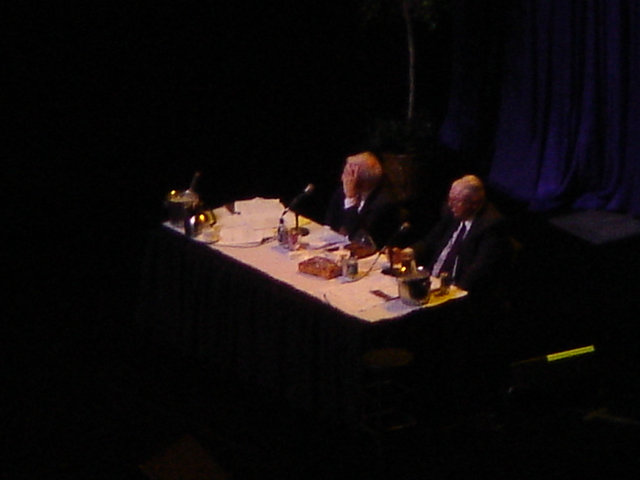
Image context: the cover uses a real archival photograph of Warren Buffett and Charlie Munger at a Berkshire shareholders meeting.[6] It is the right documentary image because this year's Omaha event was defined by comparison. The room was measuring what remained of the old Berkshire atmosphere and what had already shifted into a more managerial, less theatrical form.
What changed in Omaha
The first change was formal but important: this was the first Berkshire annual meeting with Abel running the event as chief executive, four months after taking the job at year-end.[1][4][5] Buffett was still present, still chairman, and still able to endorse his successor from the front row. But the center of gravity moved. Reuters reported that Abel used the stage to promise that Berkshire would stay decentralized, avoid bureaucracy, keep evaluating acquisitions and investments, and resist any breakup logic.[4] AP described the meeting in similar terms: less folksy banter, more detailed operating discussion, and a room that behaved more like a business session than a cultural festival.[5]
The second change was visual and social. AP reported that the Omaha arena was only a little over half full, while Reuters described several thousand empty seats in a venue that Buffett and Charlie Munger once filled to capacity.[4][5] That does not mean Berkshire's following disappeared. It means the event's old entertainment premium has faded, at least for now. A company that spent decades turning an annual meeting into a pilgrimage is learning what attendance looks like when the draw is governance continuity rather than the last great public performance of a legendary allocator.
The third change was financial context. Berkshire's quarter-end balance sheet showed $51.478 billion in cash and cash equivalents plus $339.261 billion in short-term U.S. Treasury bills as of March 31, 2026.[3] That is the backdrop that makes the succession story harder than a simple personality handoff. Abel is not inheriting a clean slate. He is inheriting a conglomerate that still throws off cash at huge scale, still has to decide when not to spend it, and still has to defend that patience to shareholders in a market that is increasingly impatient with anything that looks slower than artificial-intelligence momentum.[3][4][5]
The real test is no longer "Who replaces Buffett?"
That headline question has largely been answered on paper. The more useful question is what kind of institution Berkshire becomes when Buffett is no longer the active explainer-in-chief. Reuters' reporting from the meeting is revealing on this point. Abel stuck to Berkshire's familiar vocabulary: patience, selectivity, autonomy, long-duration ownership, and aversion to bureaucracy.[4] Buffett, for his part, publicly reinforced the continuity line, saying Abel was doing everything he used to do and more.[4][5]
But continuity language does not remove the burden of proof. It simply relocates it. Under Buffett, investors often granted Berkshire time because Buffett himself was the proof of judgment. Under Abel, time has to be defended by process and results. That is why the cash number matters so much. A balance sheet with more than $390 billion in cash and Treasury bills is not just a comfort blanket; it is also a standing challenge. Every quarter that money stays unspent, Berkshire is making an argument that restraint is better than forced action.[3][4]
This is where the meeting became a news event rather than a timeless company profile. Reuters reported that Berkshire's shares had lagged the S&P 500 by 39 percentage points since Buffett announced last year that he would step down as CEO.[4] AP, meanwhile, emphasized how much of the May 2 session was devoted to actual business conditions, from insurance and railroads to artificial intelligence and geopolitical stress.[5] Put together, those reports show the new Berkshire problem clearly: the company must persuade shareholders that deliberate capital allocation is still a competitive advantage even when the market reward system favors faster stories.
Why the room felt smaller
The attendance drop matters because it revealed what part of Berkshire's public identity was portable and what part was not. Buffett and Munger created an unusual corporate ritual in which investors came not only for information but for live interpretation of markets, temperament, and business life.[6] Once that layer thins, Berkshire becomes easier to compare with ordinary large-cap companies, and that comparison is not obviously flattering in a momentum-driven tape.
AP's account suggests the company knows this. The meeting opened with a tribute to Buffett, retired symbolic jerseys for Buffett and Munger, and then moved quickly into operating substance.[5] In other words, Berkshire did not pretend the old era was still intact. It acknowledged the loss and then tried to show that the enterprise itself remained broad, staffed, and durable. That is probably the only viable path. Trying to recreate the old charisma would have looked weak. Showing that Berkshire can survive reduced spectacle is harder, but strategically cleaner.
What to watch next
The first watch item is cash deployment. The official quarter-end figures show Berkshire still building an enormous liquid reserve.[3] If Abel keeps that posture, investors will want clearer evidence that the opportunity set remains unattractive rather than merely deferred.
The second is operating earnings quality. Reuters reported $11.35 billion of first-quarter operating profit and noted the return of Berkshire share repurchases, though only at a modest scale.[4] The next few quarters will matter because Abel does not need one dramatic acquisition as much as he needs repeatable evidence that Berkshire's existing businesses can still grow and that buybacks remain a disciplined option rather than a symbolic gesture.
The third is cultural transmission. The May 2 meeting was the first real public test of whether Berkshire's decentralized identity can survive outside Buffett's voice.[2][4][5] If future Omaha meetings keep broadening the operating bench, the company may gradually replace personality trust with institutional trust. If they do not, the succession story will keep snapping back to one uncomfortable question: whether investors were loyal to Berkshire's system or to Buffett's presence.
The narrower conclusion is also the strongest one. Berkshire's first Abel meeting did not settle the succession debate by giving investors a new celebrity to follow. It did something more concrete. It showed that the post-Buffett Berkshire case now rests on three hard claims: the culture can persist without bureaucracy, the company can sit on very large liquidity without panicking, and the operating bench is deep enough to carry the story when Buffett is no longer the main narrator.[2][3][4][5]
Sources
- Berkshire Hathaway, "News Release" announcing Greg Abel's appointment as President and CEO effective January 1, 2026 (May 5, 2025).
- Berkshire Hathaway via Nasdaq, "Berkshire Hathaway Inc. Information Regarding First Quarter Earnings Release and 2026 Annual Shareholders Meeting" (April 29, 2026).
- Berkshire Hathaway, Quarterly Report on Form 10-Q for the quarter ended March 31, 2026.
- Reuters via WHTC, "CEO Greg Abel moves to assure Berkshire shareholders in a post-Buffett world, with record cash" (May 2, 2026).
- AP News, "Crowd shrinks as Berkshire Hathaway's new CEO leads the annual meeting for the first time Saturday" (May 2, 2026).
- Wikimedia Commons, "File:Buffett & Munger.jpg" (archival shareholders-meeting photograph used as the article image).