As of 2026-05-18 06:31 UTC, the immediate nuclear-safety signal from Abu Dhabi is contained: no injuries have been reported, UAE authorities say radiological safety levels were unaffected, and the Federal Authority for Nuclear Regulation said Barakah's essential systems remained ready with all units operating normally.[1][3]
The strategic signal is not contained. A drone strike on an electrical generator outside the inner perimeter of the Arab world's only nuclear power plant has widened a Gulf conflict story into a nuclear-site security story. The incident did not become a radiological emergency, but it crossed a visible threshold: a civilian nuclear facility was close enough to the fight that the International Atomic Energy Agency said it was following the situation and called for maximum restraint near nuclear power plants.[3]
The UAE has condemned the attack, saying the drone entered from the western border direction and struck a generator outside the Barakah plant's inner perimeter.[1] Qatar News Agency's account of the UAE Defence Ministry statement said investigations were under way to determine the source of the attacks.[4] That attribution gap matters. The facts currently support a report of a strike and fire; they do not yet support a public finding of who launched it.
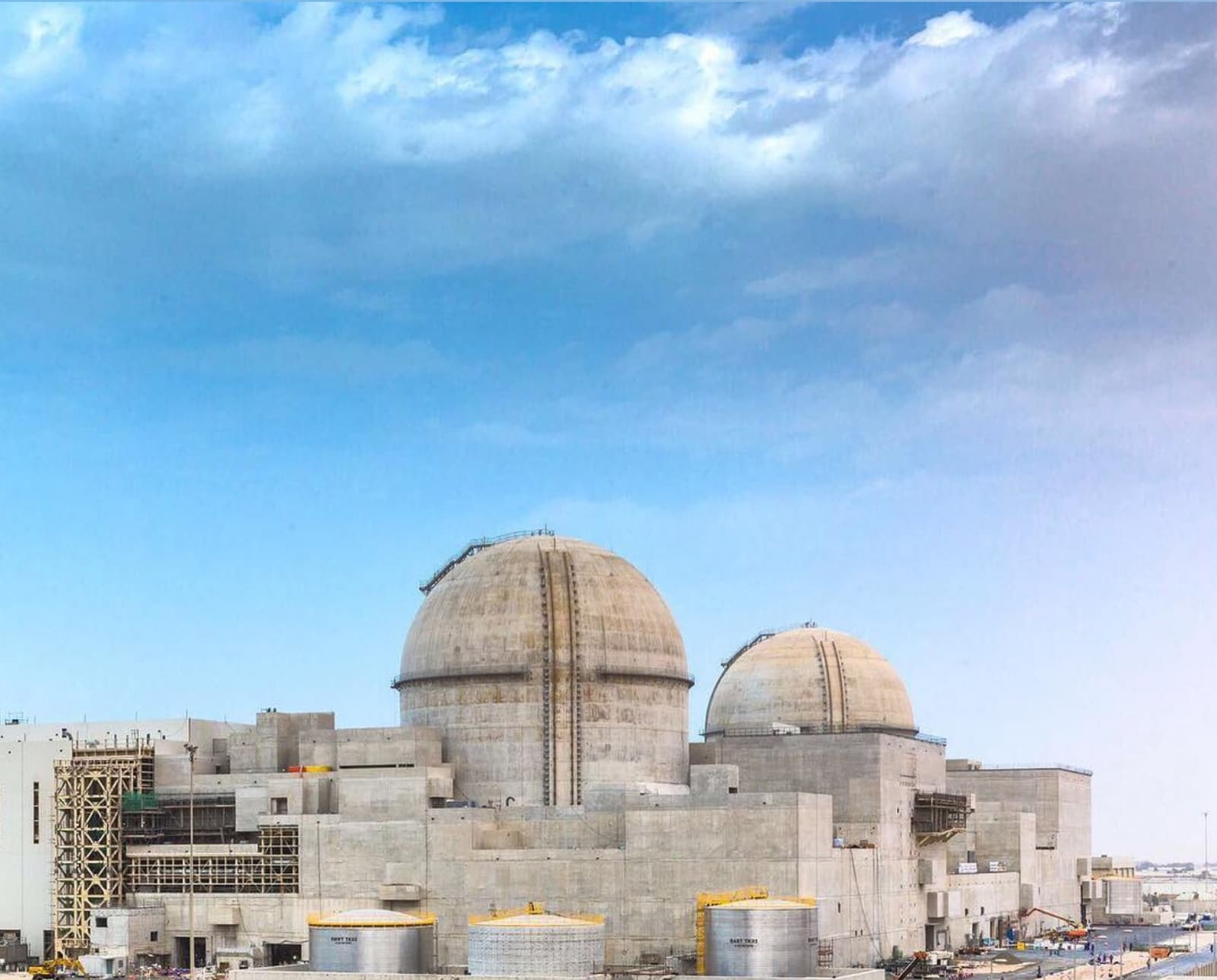
Image context: the article uses a real photograph of the Barakah nuclear power plant, not a generated or symbolic news image. The photo predates the incident, but it shows the actual facility whose outer electrical infrastructure is now part of the escalation story.[8]
What Is Known
The clearest account is narrow. Abu Dhabi authorities responded on Sunday, May 17, 2026, to a fire in an electrical generator outside the inner perimeter of the Barakah Nuclear Power Plant in the Al Dhafra region.[1][3] The UAE Foreign Ministry said the attack caused no injuries and had no impact on radiation safety levels.[1]
The UAE Defence Ministry account, reported by Qatar News Agency, adds the drone sequence: three drones entered UAE airspace, two were intercepted, and the third hit the generator near Barakah.[4] Investigations were still under way to identify the source of the attack.[4]
The IAEA piece is the important safety boundary. The agency said the UAE informed it that radiation levels remained normal, no injuries were reported, and emergency diesel generators were providing power to Unit 3 after the incident.[3] That does not make the strike routine. It means the reported damage sat outside the core radiological barrier, while safety systems and monitoring remained the decisive facts to watch.
Associated Press reporting published by ABC News placed the incident inside a broader regional rupture: stalled diplomacy, pressure around the Strait of Hormuz, and repeated warnings that hostilities could resume.[2] The AP also noted that Barakah came online in 2020, was built with South Korean help, and is the first and only nuclear power plant in the Arab world.[2]
Why Barakah Is Not Just Another Power Site
Barakah is not a symbolic building on the edge of the desert. ENEC says the four-unit plant can produce up to 5,600 megawatts and about 40 terawatt hours of clean electricity annually, supplying approximately 25% of the UAE's electricity needs.[7] In practical terms, that makes the plant a large grid asset, a national decarbonisation asset, and a high-consequence security asset at the same time.
That combination changes the risk calculation. A strike on an ordinary substation can be serious for power reliability. A strike on electrical infrastructure near a nuclear plant carries an additional public-confidence burden even if it does not touch the reactor, fuel, cooling systems, or containment. The public question becomes: did the plant's layered defences work, and what would happen if the next drone reached a more sensitive support system?
So far, the answer from reported facts is that the most important nuclear-safety layers held. The fire was described as outside the inner perimeter, essential systems were reported unaffected, and radiation levels remained normal.[1][3] The unresolved issue is whether the attack exposes a perimeter-security gap, an air-defence saturation problem, or simply the difficulty of protecting every piece of external electrical infrastructure during a regional drone war.
The Escalation Layer
The attack landed at a bad diplomatic moment. Associated Press placed the incident inside a shaky ceasefire and a wider fight over the Strait of Hormuz, while Al Jazeera reported that U.S. and Iranian demands remained far apart and that the final end of the war and unblocking of the strait were still unresolved.[2][5]
The UAE's public language is careful but severe. The Foreign Ministry called the Barakah targeting an unprovoked terrorist attack and said the country reserved its right to respond under international law.[1] Al Jazeera reported that there was no immediate claim of responsibility and that the UAE had not publicly blamed any country for the Barakah strike.[5]
That distinction is the uncertainty boundary. The strike clearly raises pressure on Iran-related diplomacy because it happened inside the same conflict cycle and against a Gulf state that has been part of the regional security picture. But until the UAE completes and publishes attribution findings, the article's facts should stop short of saying who ordered or launched the drone.
Market Reaction
Oil markets treated the incident as part of a broader supply-risk bundle rather than a stand-alone nuclear event. Reuters, in a report published by The Indian Express, said Brent crude climbed to around $111.27 a barrel by 0432 GMT, after touching $112 earlier, while U.S. West Texas Intermediate traded near $107.75 after rising to $108.70.[6] Both contracts had gained more than 7% the previous week as hopes faded for a peace deal that would end attacks and seizures around the Strait of Hormuz.[6]
That price action does not prove that Barakah itself is an oil-supply chokepoint. It shows how quickly Gulf infrastructure events get priced together when Hormuz, drone attacks, and U.S.-Iran military options are already live. The same Reuters report said Trump was expected to meet top national-security advisers on Tuesday to discuss military options regarding Iran, while drone incidents in the UAE and Saudi Arabia raised concerns about escalation.[6]
The market read is therefore less "nuclear plant damaged, oil up" than "regional critical infrastructure remains reachable, diplomacy is stuck, and traders are paying for a wider conflict tail risk." That is a meaningful difference. A contained generator fire is not the same as a reactor accident. But the location of the fire tells energy markets that the conflict's target set may keep expanding.
What To Watch Next
First, watch the attribution process. If the UAE identifies a launcher, proxy, or state actor, the story will move from incident response to retaliation risk. If attribution remains incomplete or classified, the region may stay in a more ambiguous deterrence loop: everyone assumes the strike has meaning, but no public record cleanly assigns responsibility.
Second, watch Unit 3's external-power status and any follow-up from the IAEA or UAE regulator. Emergency diesel generators are designed for backup power, but their use after a strike near a nuclear plant is exactly the kind of operational detail that deserves transparent updates.[3] The key question is not whether diesel backup worked once. It is whether off-site power, switchyard protection, and redundant electrical paths remain robust under repeated drone pressure.
Third, watch whether the incident changes U.S. and Gulf military posture. Air defence around energy infrastructure is already stretched by drones, missiles, and maritime threats. A nuclear-site perimeter event could push more interceptors, radars, and foreign personnel toward Gulf facilities, which may strengthen defence while also making those facilities more visible in the conflict.
Finally, watch the oil market's sensitivity to follow-on incidents. If prices relax while radiation readings remain normal and no further attacks occur, Barakah will be remembered as a serious but contained warning. If additional drones target power, port, or desalination infrastructure, the Barakah strike will look like an early sign of a wider campaign against Gulf civilian systems.
Bottom Line
The hard news is not a radiation leak. It is a boundary test. A drone reportedly reached electrical infrastructure outside Barakah's inner perimeter, safety systems held, and the UAE and IAEA say the nuclear-safety picture remained stable.[1][3] That is the reassuring part.
The destabilising part is that a civilian nuclear site has now entered the regional targeting conversation. Barakah's reactors did not need to be hit for the incident to matter. The strike showed that in a Gulf conflict where oil routes, drones, and nuclear politics already overlap, even a contained fire outside the inner perimeter can become a signal to governments, regulators, grid operators, and markets at once.
Sources
- UAE Ministry of Foreign Affairs, "UAE Condemns Terrorist Targeting of Barakah Plant Perimeter" (May 17, 2026).
- Associated Press via ABC News, "Drone strike sparks fire on the edge of the UAE's nuclear power plant in latest blow to Iran truce" (May 17, 2026).
- The National, "Drone strike causes fire at Barakah nuclear plant perimeter in Abu Dhabi" (May 17, 2026; updated May 18, 2026).
- Qatar News Agency, "UAE Defense Ministry Confirms Engagement of Three Drones" (May 17, 2026).
- Al Jazeera, "Drone strike sparks fire on perimeter of UAE's Barakah nuclear power plant" (May 17, 2026).
- Reuters via The Indian Express, "Oil prices touch two-week high after drone attack on UAE nuclear power plant" (May 18, 2026).
- Emirates Nuclear Energy Corporation, "ENEC Operations: Overview" (plant capacity and operating role).
- Wikimedia Commons, "File:Barakah nuclear power plant.jpg" (photograph source, taken May 17, 2017).