As of 2026-05-17 08:01 UTC, the Justice Department's lawsuit over Connecticut Senate Bill 397 has turned a state transparency law into a live federalism test. The complaint, filed on May 15, 2026, asks a federal court to block Connecticut from enforcing new rules that restrict mask use, require identification, and set force-reporting duties for federal law-enforcement officers operating in the state.[1][2]
The dispute is easy to misread as a symbolic fight over whether officers should show their faces. The legal question is more mechanical: when federal officers are carrying out federal duties, how far can a state go in telling them what they must wear, say, display, or document? Connecticut says the law is a public-accountability measure designed to prevent secret policing and impersonation. DOJ says it directly regulates federal officers and therefore collides with the Constitution's supremacy structure.[1][2][4]
That matters beyond Connecticut because similar state and local proposals have been moving through a post-2025 politics of immigration enforcement, protest policing, and public trust.[6] A federal appeals court recently refused to let Los Angeles enforce a similar mask rule against federal immigration officers while litigation continues, giving DOJ a fresh appellate signal to cite even though the Connecticut case will run on its own record.[5]
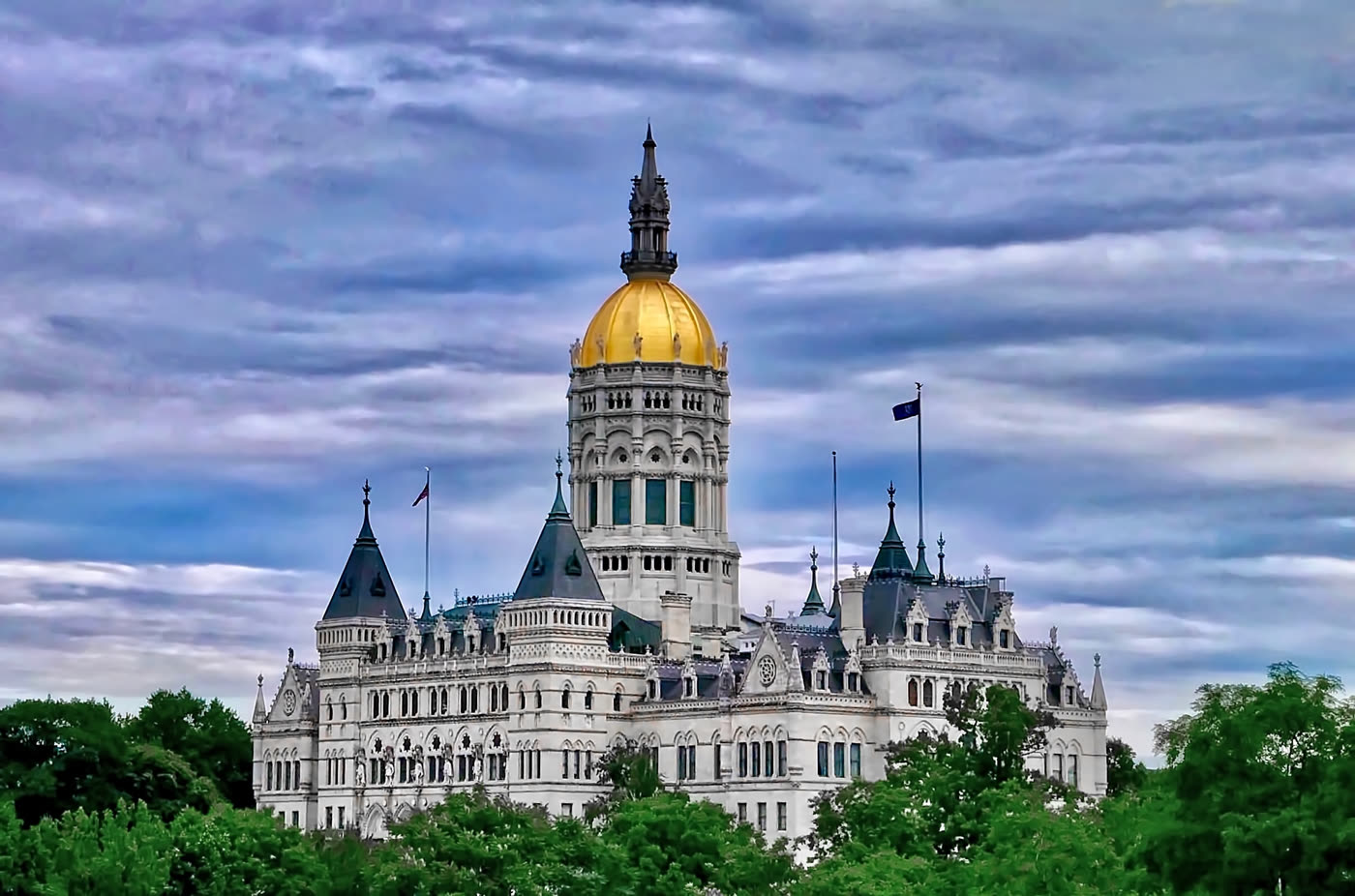
Image context: the cover uses a real photograph of the Connecticut State Capitol because the concrete event is legislative and institutional. The law was enacted through the statehouse, and the lawsuit is now testing how far that statehouse can reach into federal field operations.[7]
The Short Version
Connecticut SB 397 is now Public Act 26-14. The bill record shows final passage in early May 2026 and the governor's signature on May 4, 2026.[3] The law's core provisions target law-enforcement conduct: restrictions on face coverings, identification expectations, and limits tied to use of force. State officials frame the measure as a way to preserve accountability when officers operate in public.[3][4]
DOJ's complaint argues that those provisions cannot be applied to federal officers because they interfere with federal functions. In DOJ's reading, the state law would force federal officers to change operational choices during federal enforcement actions, expose them to state penalties or state-created constraints, and create a patchwork of state rules over federal work.[1][2]
Connecticut's attorney general had praised the bill before the lawsuit, saying the measure responds to public concern about masked enforcement and the need to know who is acting under official authority.[4] That gives the case its real tension: the state is not only making an abstract policy point. It is trying to regulate a visible public encounter between law enforcement and residents. DOJ is not only objecting to transparency. It is asserting that federal officers cannot be made answerable to a separate state operational code while performing federal duties.[1][2][4]
Facts on the File
| Item | What the source record says | Confidence note |
|---|---|---|
| Federal action | DOJ announced on May 15, 2026 that it filed a complaint challenging Connecticut's law as applied to federal law enforcement.[1] | High; direct DOJ release and complaint. |
| State law | SB 397 became Public Act 26-14 after passage by the Connecticut legislature and governor signature on May 4, 2026.[3] | High; bill-status record. |
| State rationale | Connecticut Attorney General William Tong publicly supported the bill as an accountability measure before final enactment.[4] | High; direct state attorney general release. |
| Core legal theory | DOJ's complaint relies on federal supremacy and intergovernmental-immunity arguments: states generally cannot directly regulate the federal government's lawful operations.[2] | High for DOJ's claim; outcome uncertain. |
| Comparator | The Ninth Circuit on April 22, 2026 blocked Los Angeles from enforcing a mask rule against federal immigration officers while that case proceeds.[5] | High; court opinion, but not binding on Connecticut. |
| What is uncertain | The Connecticut court has not yet ruled on a preliminary injunction, the law's final enforceable boundary, or how any state-law provisions might be severed or narrowed.[1][2] | Medium; litigation has just opened. |
Why the Mask Rule Is Only Part of the Case
The public-facing hook is masks. In immigration-enforcement disputes, face coverings have become politically charged because they affect how residents, lawyers, reporters, and local officials identify who is conducting an operation. Connecticut's supporters treat visible identity as part of democratic control: the public should know whether a person using coercive authority is a legitimate officer, which agency that officer represents, and whether the officer can be held responsible afterward.[4]
But DOJ's complaint is broader than a discomfort with being seen. It treats the mask and identification provisions as state commands aimed at federal operations. In that frame, an officer deciding how to dress or identify during an arrest is making an operational choice connected to safety, tactical surprise, intimidation risk, retaliation risk, and agency policy. If each state can substitute its own answer, DOJ argues, federal enforcement becomes subject to a local rulebook.[1][2]
The same logic applies to use-of-force provisions. A state can generally regulate its own police. It can also enforce ordinary criminal law against people, including officers, when federal immunity does not apply. The harder question is whether it can prewrite a state operational code for federal agents while they are doing federal work. That is why this case is more than a dispute about one piece of clothing. It is a boundary dispute over command authority.[2]
The Federalism Mechanism
The doctrine underneath the case is usually less visible than the politics. The Constitution's Supremacy Clause makes valid federal law superior to conflicting state law. Intergovernmental immunity, a related constitutional principle, limits states from directly regulating or discriminating against the federal government and its operations. DOJ's complaint says Connecticut's law crosses that line by targeting federal officers' field conduct.[2]
Connecticut's likely defense is not hard to infer from its public framing. The state can argue that it is not trying to nullify federal immigration law, decide who may be arrested, or stop federal agencies from operating. It is instead setting generally applicable public-safety and accountability rules: do not hide official identity without justification, do not let masked actors create confusion, and keep force use within state-recognized guardrails.[3][4]
The court's job will be to decide whether those rules operate as neutral accountability standards or as impermissible control over federal work. That distinction is the case. If the judge sees the law as direct regulation of federal officers in the field, DOJ has the stronger path to an injunction. If the judge sees parts of the law as neutral anti-impersonation or public-safety rules that do not obstruct federal duties, Connecticut may preserve more of the statute.[2][5]
The Los Angeles comparator matters because the Ninth Circuit already treated a local mask rule as a likely problem when applied to federal immigration officers. It is not binding on a Connecticut district court, which sits in the Second Circuit, and the Connecticut statute has its own text. Still, the opinion gives DOJ a recent judicial template: mask rules can be framed not as ordinary local transparency, but as interference with federal enforcement discretion.[5]
Who Should Care
Federal agencies should care because the case will shape how much state-by-state variation they must plan around during visible enforcement work. If Connecticut's law is blocked quickly, federal officers get another signal that mask and identification choices remain primarily internal federal policy questions. If the law survives, agencies may need operational guidance for states that adopt similar transparency rules.[1][2][5]
State lawmakers should care because the case will test drafting strategy. A broad law that appears to command federal field conduct is vulnerable. A narrower law focused on impersonation, state officers, public reporting, or post-incident transparency may have a different litigation profile. The Connecticut case will therefore become a drafting lesson even before final judgment.[2][3]
Residents should care because the dispute sits where accountability and operational power meet. The state concern is real: masked officers can make public enforcement harder to verify and easier to abuse by impersonators. The federal concern is also real: officers may face safety risks, retaliation risks, and operational constraints if every state dictates exposure rules. The lawsuit is where those two claims stop being slogans and become a judicial line-drawing problem.[1][2][4]
Scenarios
Base case: the federal court grants at least partial preliminary relief against applying the most direct mask, identification, and force provisions to federal officers. The recent Ninth Circuit ruling gives DOJ momentum, and the complaint is written to emphasize direct interference rather than mere disagreement with state policy.[2][5]
Upside for Connecticut: the court narrows rather than freezes the statute, preserving provisions that apply to state and local officers or that are framed as ordinary anti-impersonation and public-reporting rules. That would let Connecticut claim a transparency win while losing the cleanest route to controlling federal officers in the field.[3][4]
Downside for Connecticut: the court treats the statute as a targeted state regulatory scheme over federal law enforcement and blocks its application to federal officers broadly. That would chill copycat state laws unless lawmakers rewrite them around state actors or post-event transparency rather than federal operational conduct.[2][5]
Downside for DOJ: the court refuses emergency relief or preserves enough of the statute to invite other states to test narrower versions. That would not end federal supremacy arguments, but it would weaken the idea that mask and identification rules are categorically off-limits.[2]
What Changes Next
The next practical checkpoint is whether DOJ seeks and receives preliminary injunctive relief. That stage matters more than the final merits schedule because the law is new and the enforcement posture will be shaped by early judicial orders.[1][2]
The second checkpoint is the exact remedy. A court could block the whole law as applied to federal officers, block only specific provisions, or read the law narrowly to avoid some conflict. The remedy will tell other states whether the vulnerable feature is masks, identification, force regulation, federal-officer coverage, or the combination of all four.[2][5]
The third checkpoint is whether Connecticut officials separate policy messaging from litigation defense. The state may continue saying that unidentifiable enforcement undermines public trust. In court, however, it will need a narrower claim: that the law can protect accountability without controlling federal operations. The strongest version of Connecticut's case will likely live in that narrower lane.[3][4]
For now, the correct reading is restrained. SB 397 has not been invalidated. DOJ has not won the case. Connecticut has not yet proved that its accountability model can be applied to federal officers. As of May 17, 2026, the case is a newly filed challenge with a large constitutional question inside a very visible public symbol: whether a state can tell federal officers when they must show their faces and names while using federal power in public.[1][2]
Sources
- U.S. Department of Justice, "Justice Department Files Complaint to Protect Law Enforcement, Challenging Connecticut Mask Ban" (May 15, 2026).
- U.S. Department of Justice, complaint PDF in United States v. Connecticut (May 15, 2026).
- FastDemocracy, Connecticut SB 397 bill history and status for Public Act 26-14.
- Connecticut Office of the Attorney General, "Attorney General Tong Praises Senate Passage of Senate Bill 397" (April 30, 2026).
- U.S. Court of Appeals for the Ninth Circuit, order in United States v. City of Los Angeles (April 22, 2026 PDF).
- State Court Report, "Can States Ban Federal Officers from Wearing Masks?" (May 15, 2026).
- Wikimedia Commons, "File:Connecticut State Capitol in Hartford.jpg" (photograph source).