As of 2026-05-19 12:02 UTC, NASA's late-April announcement of a lithium-fed magnetoplasmadynamic thruster test should be read in two registers at once. It is a real propulsion milestone: on February 24, 2026, a team at NASA's Jet Propulsion Laboratory fired an electric thruster running on lithium metal vapor at power levels up to 120 kilowatts, a level NASA describes as beyond any previous U.S. electric-propulsion test of this kind and more than 25 times the power of the electric thrusters flying on Psyche.[1][3][6]
It is also not yet a Mars engine. The useful news is the size of the gap now visible. NASA's own framing points toward 500 kilowatts to 1 megawatt per thruster in coming years, while a human Mars mission architecture may need 2 to 4 megawatts of electric-propulsion power and more than 23,000 hours of operating life.[1][4] The test proves the door is open. It does not prove the spacecraft can walk through it.
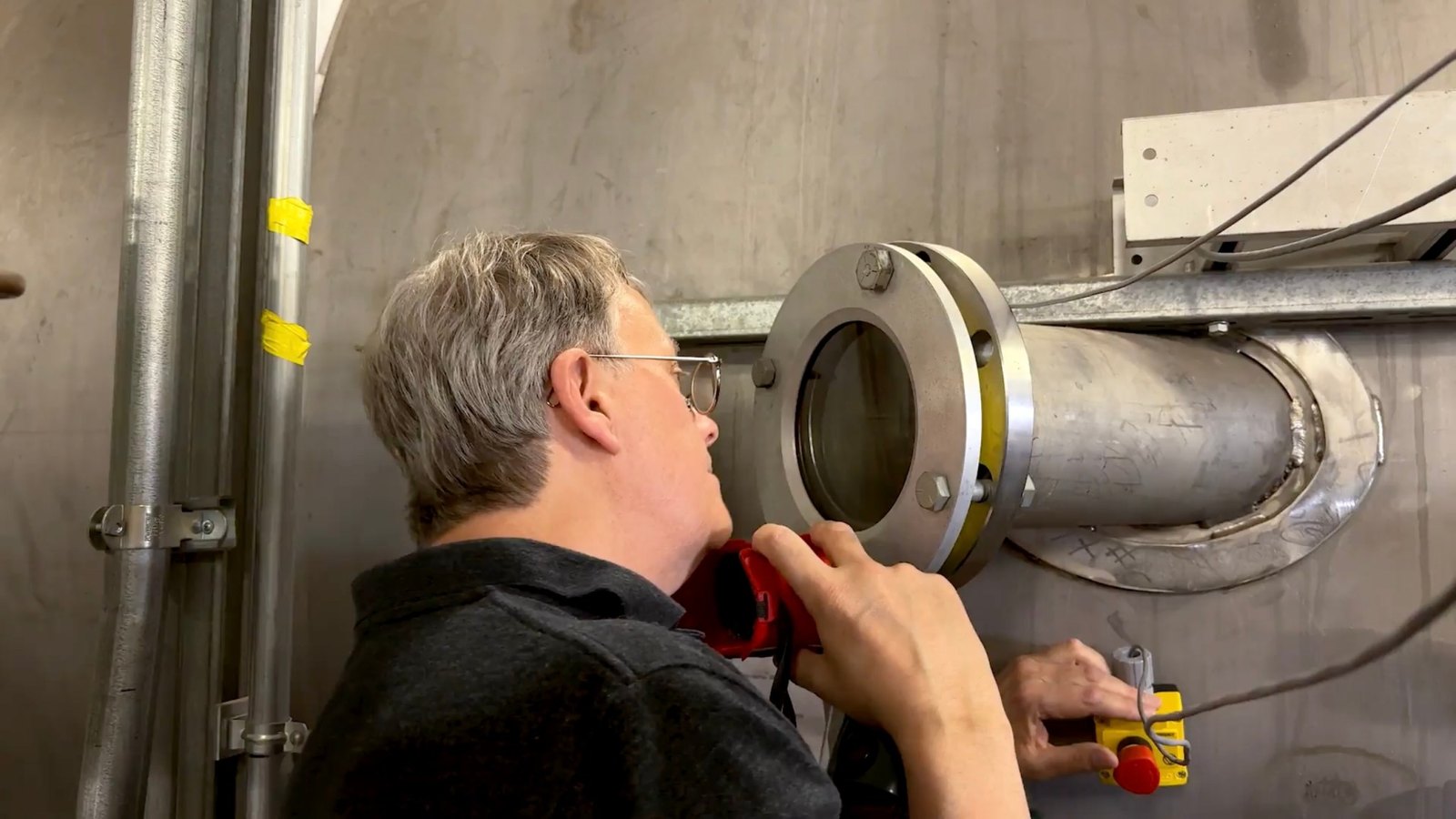
Image context: the cover stays inside a vacuum-test laboratory rather than drifting toward a Mars-travel fantasy. That matters editorially because the article is about hardware behavior under power, heat, and chamber constraints.
Facts on the File
| Item | What is known | Confidence note |
|---|---|---|
| Immediate event | JPL tested a lithium-fed magnetoplasmadynamic, or MPD, thruster in February and NASA published the result on April 28, 2026.[1] | High for event timing and agency description. |
| Peak test power | NASA says the prototype reached up to 120 kilowatts during five ignitions.[1] | High for reported test result; independent replication is not yet the issue. |
| Test setting | The work occurred in JPL's Electric Propulsion Lab, inside the condensable metal propellant vacuum facility, a 26-foot water-cooled chamber built for metal-vapor thruster testing.[1] | High for facility details. |
| Current comparison | NASA compares the result with Psyche's solar electric propulsion, whose Hall thrusters are already operating in deep space but at much lower power.[1][3] | High for Psyche as the flight baseline; the systems are not identical. |
| Target scale | NASA says the team aims for 500 kW to 1 MW per thruster; human Mars use could require 2 to 4 MW and long-duration operation.[1][4] | Medium-high; these are development and architecture targets, not flight commitments. |
| Strategic backdrop | NASA's Space Nuclear Propulsion work treats nuclear electric propulsion as one route to more efficient deep-space transport, especially where solar power becomes less practical.[2] | High for program framing; budgets and schedules can move. |
| Boundary condition | The National Academies and NASA technical literature both emphasize that megawatt-class nuclear electric propulsion still faces maturity, qualification, and integration risk.[4][5] | High for risk framing; exact timelines remain uncertain. |
What the Test Actually Changes
The core change is not that electric propulsion suddenly became new. It is already flying. Psyche's xenon Hall thrusters, for example, use solar electric power to accelerate charged atoms and provide gentle but persistent thrust on the way to the metal-rich asteroid Psyche.[3] NASA says that spacecraft will eventually reach about 124,000 mph relative to Earth, a reminder that low thrust can become high mission value when it works for long enough.[3]
The lithium MPD result attacks a different problem: power density. A magnetoplasmadynamic thruster uses high electric currents interacting with magnetic fields to accelerate plasma.[1] In this case, the propellant is lithium metal vapor rather than xenon gas. NASA's stated attraction is not only propellant efficiency; it is the possibility of operating at far higher power than today's flight electric-propulsion systems, especially when paired with a nuclear electric power source.[1][2]
That is why the 120 kW number matters. It is large enough to make the technology feel less like a paper architecture and more like an engineering program with test data. It is still small enough to expose the hard part: a Mars-class system is not one 120 kW thruster glowing inside a chamber. It is multiple high-power thrusters, power conversion hardware, power management and distribution, propellant feed systems, thermal control, radiators, fault handling, mission operations, and certification rules that all have to survive together.[2][4]
The heat problem is especially blunt. NASA says the central tungsten electrode reached more than 5,000 degrees Fahrenheit during the test, and the agency identifies component survival over many hours as a key challenge.[1] That turns the next phase from "can it fire?" into "can it fire predictably, repeatedly, and long enough to be trusted with a mission architecture?" In propulsion, a brilliant short test is valuable. A durable duty cycle is the product.
The Mars Claim Needs a Filter
The public hook is obvious: a thruster that could help send astronauts to Mars. The disciplined reading is narrower. NASA's Space Nuclear Propulsion Office describes nuclear electric propulsion as a system in which a fission reactor produces electricity, and that electricity powers plasma thrusters for efficient, sustained deep-space transport.[2] The lithium MPD test is one candidate piece of that system, not the system itself.
NASA's own technical record makes that distinction clear. A NASA Technical Reports Server paper on megawatt-class nuclear electric propulsion breaks the vehicle into critical technology elements: reactor, power conversion, power management and distribution, electric propulsion, and thermal management.[4] The thruster sits inside that chain. It does not solve the reactor, radiator, power electronics, launch safety, mission operations, or long-duration qualification problems by itself.
The National Academies' review gives the caution a second source. Its project framing defines nuclear electric propulsion as converting thermal energy to electricity to power plasma thrusters, with interest in systems at at least 1 megawatt-electric for future exploration missions.[5] That is the scale NASA is pointing toward, and it is also the reason the February firing should not be oversold. The test is a bridge from laboratory feasibility toward scale. It is not a bridge all the way to crewed Mars transportation.
There is a useful comparison in Psyche. Psyche's electric propulsion is real, in flight, and mission enabling, but it works with sunlight and xenon in a robotic mission profile.[3] A human Mars transport system would demand a different power source, different risk posture, higher total power, more redundancy, and a much harsher integration burden. The difference is not just bigger numbers. It is a different class of consequence.
24-Hour, 7-Day, and 30-Day Impact
In the next 24 hours, nothing changes for mission schedules. The test does not move a launch date, create a procurement decision, or make a crewed Mars vehicle ready. The practical short-term impact is interpretive: NASA has produced a credible public data point for a propulsion lane that has often lived in concept studies and roadmap language.[1][4]
Over the next 7 days, the useful follow-up is whether NASA or its partners disclose more about test duration, electrode wear, power-processing performance, lithium feed stability, and chamber contamination management. Those details would say more about engineering maturity than the headline wattage alone. If the only number repeated is 120 kW, the story remains promising but thin.
Over the next 30 days, watch the program context. NASA says the MPD work is funded by the Space Nuclear Propulsion project and involves JPL, Princeton University, and NASA Glenn.[1] Any budget line, contract notice, conference paper, or follow-on test plan that ties the thruster to full-power subsystem demonstrations would matter more than another Mars-facing slogan.
Scenarios
Base case: NASA uses the February test as the opening mark for a multi-year scale-up campaign. The next phase pushes toward hundreds of kilowatts, with the main evidence coming from longer firings, thermal durability, and power-processing stability rather than a single peak-power record.
Upside case: the CoMeT facility gives NASA a repeatable national testbed for metal-vapor propulsion, and the thruster scales toward the 500 kW to 1 MW range without unsolved electrode, feed, or thermal-control problems. In that world, MPD propulsion becomes a plausible building block for nuclear electric cargo or crew-precursor architectures.[1][2]
Downside case: the power milestone proves easier than the life test. If components erode quickly, lithium handling complicates operations, or power electronics and thermal rejection cannot scale cleanly, the program may still generate useful data without becoming the flight architecture NASA wants.
What Would Falsify the Optimistic Read
The clearest falsifier is not a missed Mars date. It is a failure to progress from peak power to endurance. If follow-on tests cannot sustain high-power operation for much longer durations, or if material wear makes the maintenance burden unrealistic, then the February result remains an impressive laboratory firing rather than a credible propulsion path.
The watchlist is therefore simple: longer-duration test results, movement toward 500 kW-plus operation, evidence that power-processing and thermal systems are advancing alongside the thruster, and program funding that keeps nuclear electric propulsion from becoming a stop-start technology file. The news is not that NASA has built the engine for Mars. The news is that the next hard questions are finally concrete enough to measure.
Sources
- NASA, "NASA Fires Up Powerful Lithium-Fed Thruster for Trips to Mars" (April 28, 2026; updated May 1, 2026).
- NASA Space Technology Mission Directorate, "Space Nuclear Propulsion" (program overview; accessed May 19, 2026).
- NASA, "NASA's Psyche Fires Up Its Sci-Fi-Worthy Thrusters" (May 22, 2024).
- NASA Technical Reports Server, "Strategy for Developing Technologies for Megawatt-class Nuclear Electric Propulsion Systems" (document ID 20210025180).
- National Academies, "Space Nuclear Propulsion for Human Mars Exploration" (project and publication page).
- Space.com, Keith Cooper, "NASA is making a powerful new ion engine to send astronauts to Mars - and it just passed its 1st test" (May 5, 2026).