As of 2026-06-02 10:03 UTC, NASA's Atmospheric Waves Experiment, or AWE, has moved from flight operations into the more important second act: data interpretation. NASA says ground controllers powered down the instrument on May 21, 2026, ending the mission's data-collection phase after a 30-month residence on the exterior of the International Space Station.[1]
The headline sounds tidy, but the consequence is messy in the useful way. AWE was built to track how storms, mountains, and lower-atmosphere winds send atmospheric gravity waves upward into the mesopause, where they can perturb the ionosphere and add a ground-weather component to space-weather risk.[1][2][6] The instrument is done collecting, but its archive is now the live object: more than 80 million nighttime infrared images, plus public visualization tools and staged data releases that researchers can keep mining after the hardware is removed.[1][7]
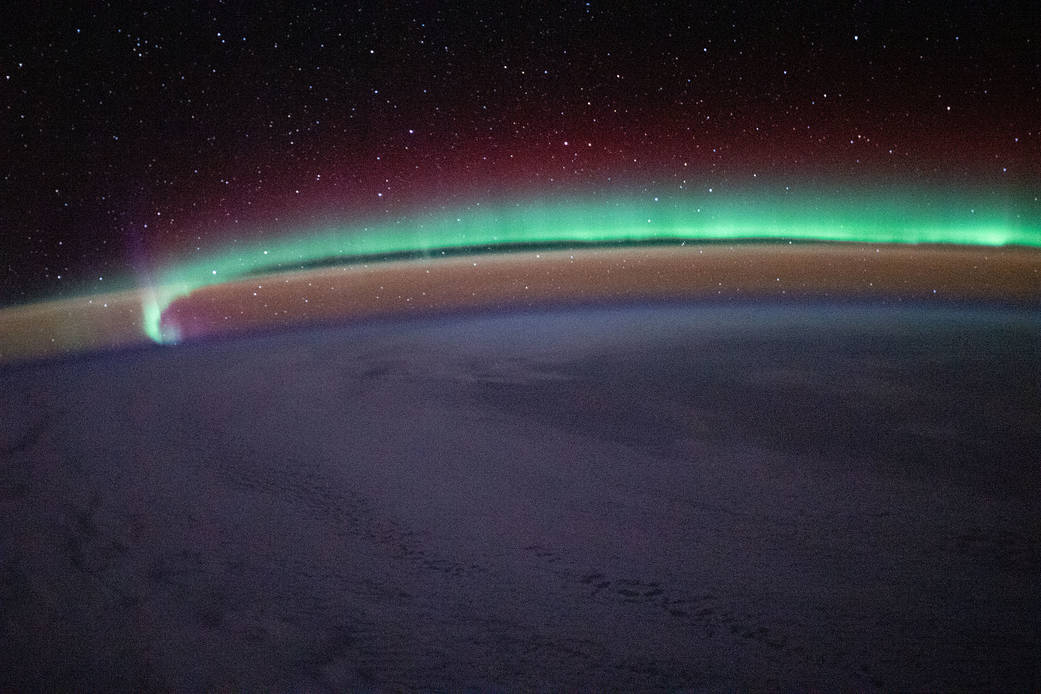
Fact File
| Item | What is known now | Confidence note |
|---|---|---|
| Mission status | NASA says AWE was powered down on May 21, 2026, ending scheduled on-orbit data collection.[1] | Strong; direct NASA mission report. |
| Platform | AWE was installed on the exterior of the International Space Station after its Nov. 9, 2023 launch and Nov. 18, 2023 installation.[2] | Strong; mission overview and partner account align. |
| Data scale | NASA reports four infrared images every second and more than 80 million nighttime images over 30 months.[1] | Strong for agency-reported mission count. |
| Public release | NASA's first public trove after 3,000 orbits contained more than 5 million individual images and derived temperature and intensity swaths.[3] | Strong for the March 2025 release; final archive processing is still ongoing. |
| Follow-on slot | AWE is being cleared for CLARREO Pathfinder, a station instrument designed for reflected-sunlight and Moon measurements five to 10 times more accurate than existing sensors.[1][5] | Strong for NASA's stated station-instrument handoff. |
What Changed
The immediate event is administrative: the instrument is off, Canadarm2 is expected to remove it, and the hardware will eventually ride in a SpaceX Dragon cargo trunk that burns up during reentry.[1] That matters because the International Space Station is not an attic for retired instruments. It is a constrained laboratory with exterior attachment points, power, data, robotic handling, and launch-logistics tradeoffs. Ending AWE makes room for CLARREO Pathfinder, whose job is different: high-accuracy calibration for Earth-reflected sunlight rather than infrared airglow wave tracking.[1][5]
The deeper change is scientific. AWE's news value is not that it "saw weather from space," which many Earth-observing missions already do. Its narrower contribution is that it watched a difficult layer near 54 miles, or 87 kilometers, where atmospheric gravity waves become visible through airglow variations.[2] That is high enough to matter for ionospheric variability, but still coupled to storms and terrain below. NASA's mission overview is explicit that these waves can affect GPS navigation, tracking, and communications systems through their influence on the upper atmosphere.[2]
The data volume changes the argument from anecdote to pattern. NASA's completion report cites AWE observations from the central U.S. tornado outbreak in May 2024 and Hurricane Helene's Florida landfall in September 2024.[1] The point is not that every storm creates the same upper-atmosphere signature. NASA says AWE saw different wave types from different storms, including a north Texas thunderstorm on May 26, 2024 that produced smaller, more irregular, asymmetric waves than other storms in the region earlier that month.[1] That is the kind of distinction forecasters and modelers need if "weather affects space weather" is to become more than a slogan.
Decision Impact
Next 24 hours: the practical question is not whether AWE will restart. It will not. The watch item is whether NASA and Utah State keep the public-facing data path clear as the instrument enters removal and disposal logistics.[1][4][7]
Next 7 days: researchers should watch for updated archive and visualization availability. Some AWE observations are already public through Utah State's globe and map tools, and NASA says all observations will ultimately become available for professional researchers and citizen scientists.[1][7]
Next 30 days: the handoff should be judged by continuity. AWE's output has to keep moving into papers, models, and operational learning while CLARREO Pathfinder takes the exterior-station slot for a different Earth-observation calibration mission.[1][5]
Why It Matters
Space weather is often framed as a solar problem: flares, coronal mass ejections, energetic particles, and geomagnetic storms. NASA's own space-weather material keeps that solar frame central, because charged-particle and magnetic disturbances can affect satellites, radio systems, astronauts, and power infrastructure.[6] AWE adds a useful complication. Some ionospheric variability starts below, from ordinary and extreme terrestrial weather pushing waves upward through the atmosphere.[1][2]
That complication is operationally important because navigation and timing systems fail in practical ways, not disciplinary categories. A satellite signal does not care whether a density disturbance began with the Sun or with a violent storm system. If AWE's archive helps modelers separate source types, wave sizes, seasons, and propagation pathways, it can improve the boundary conditions used to interpret disruptions in GPS, communications, tracking, and satellite-to-ground links.[2][3][6]
The strongest near-term value is likely in retrospective modeling rather than immediate public forecasting. NASA's March 2025 data release already made more than 5 million images available from the first 3,000 orbits, and USU's completion note says more than 50 science presentations had been delivered worldwide from initial releases, with many papers in process.[3][4] That is how a completed instrument remains active: not through more images, but through better comparisons among storms, seasons, models, and ionospheric outcomes.
Scenarios
Base case: AWE becomes a durable research archive. Data releases continue, the 30-month image set feeds case studies and global comparisons, and the mission's best return comes from improving models of how lower-atmosphere waves reach the upper atmosphere.[1][3][7]
Upside case: the archive becomes operationally useful faster than expected. Researchers connect storm-generated gravity-wave signatures to ionospheric disturbances in ways that improve warnings or diagnostics for navigation and communications users.[2][6]
Downside case: the data are rich but hard to operationalize. If processing bottlenecks, cloud and light contamination, model mismatch, or uneven community uptake slow the work, AWE remains scientifically valuable but less immediately useful for space-weather services.[3][4]
Action Checklist
- Treat the power-down as a handoff, not an ending: the public-data pipeline is now the mission's highest-leverage surface.[1][7]
- Separate evidence from ambition: AWE observed gravity waves tied to storms, but translating that into better forecasts requires modeling and validation against ionospheric effects.[1][2][6]
- Watch CLARREO Pathfinder as the station-resource signal: NASA is replacing one exterior Earth-observation instrument with another, showing how the ISS is being used as a rotating instrument platform.[1][5]
- Use the first data release as the near-term baseline: the final archive should be judged against the March 2025 release's images, temperature swaths, intensity swaths, and processing caveats.[3]
Sources
- NASA Science, "NASA's AWE Completes Mission to Study Earth's Effect on Space Weather" (May 21, 2026).
- NASA Science, "AWE: Atmospheric Waves Experiment" mission overview.
- NASA Science, "NASA Atmospheric Wave-Studying Mission Releases Data from First 3,000 Orbits" (Mar. 14, 2025).
- Atmospheric Waves Experiment, "NASA's Atmospheric Waves Experiment Completes On-Orbit Data Collection" (Utah State TODAY, May 21, 2026).
- NASA Science, "CLARREO Pathfinder" mission overview.
- NASA Science, "NASA Space Weather" focus-area page.
- Utah State University AWE, "Atmospheric Waves Experiment" public 3D data visualization.
- NASA, "The airglow and an aurora above the Earth's horizon" image article (Jan. 22, 2021; photograph iss064e024075).