As of 2026-06-01 21:33 UTC, the latest inflation story is no longer just about gasoline signs or one ugly CPI print. AP reports that the bond market is demanding more compensation to lend to the U.S. government, with the 10-year Treasury yield around the mid-4% range after the Iran-war oil shock, and that move is feeding into mortgage costs, consumer pressure, and midterm-year politics.[1]
The important distinction is timing. Energy is the spark, but long-term rates are the transmission line. Treasury's own daily yield table showed the 10-year note at 4.45% and the 30-year bond at 4.99% on May 29, the latest listed trading day before this brief.[2] Freddie Mac's weekly survey put the 30-year fixed mortgage average at 6.53% as of May 28, up from 6.51% the prior week.[3] That is how a global oil and inflation scare becomes a monthly-payment story.
Fact File
| Item | What is known now | Confidence note |
|---|---|---|
| Trigger | AP links the renewed bond-market pressure to the Iran-war energy spike, broader inflation anxiety, government-debt concerns, and heavy AI investment demand.[1] | Strong for reported market framing; attribution matters because motives in rates markets are never single-cause. |
| Treasury level | Treasury's daily table lists the 10-year at 4.45% and the 30-year at 4.99% on 2026-05-29.[2] | Strong for official daily data; June 1 final official table was not yet the cited baseline. |
| Mortgage channel | Freddie Mac lists the 30-year fixed-rate mortgage average at 6.53% as of 2026-05-28.[3] | Strong for weekly national average; individual borrowers face different rates. |
| Oil backdrop | EIA's spot-price page shows Brent at $102.75 and WTI at $97.63 on 2026-05-26, the latest displayed daily spot entries on that page.[4] | Strong for EIA spot series; AP's Monday market story describes a newer intraday/settlement move. |
| Inflation base | BLS reported April CPI up 0.6% month over month and 3.8% year over year; energy rose 3.8% in April and gasoline rose 5.4% on the month.[5] | Strong for official CPI release; May CPI is due June 10. |
What Changed
The market is treating inflation risk as more durable than a one-day oil headline. In a cleaner disinflation script, an energy shock can hurt consumers but still leave long yields contained if investors believe the Federal Reserve will eventually look through it. The present signal is less comfortable: the 10-year is high enough to tighten financial conditions while the 30-year is close to 5%, which makes the federal debt-service question and the household borrowing question move together.[1][2]
That is why the mortgage rate matters in this brief. A 30-year average at 6.53% is not a crisis by itself, but it blocks the affordability relief that many buyers were waiting for after earlier hopes of lower rates.[3] It also makes the political economy sharper. Higher yields do not need to crash stocks to be felt. They can freeze home purchases, raise refinancing hurdles, and force Washington to explain why federal borrowing costs are rising while voters are still sensitive to energy and shelter inflation.
The oil link is visible but not sufficient. EIA's delayed spot data still showed Brent above $100 in late May, while BLS's April CPI release had already shown energy doing heavy work in the monthly inflation increase.[4][5] The open question is whether markets are pricing a temporary war premium or a longer inflation-and-deficit premium. The first fades if oil normalizes and May inflation cools. The second is harder: it asks whether investors need higher yields because they see a larger, riskier supply of government debt against stickier nominal growth.
Decision Impact
Next 24 hours: watch whether the 10-year holds around the mid-4% area or backs away as oil headlines settle. A yield move without a fresh oil move would suggest the market is worrying about fiscal and inflation persistence, not just barrels.[1][2][4]
Next 7 days: watch mortgage-rate commentary and housing-sensitive stocks. The consumer impact becomes more concrete if Freddie Mac's next weekly survey extends the rise, because homebuyers react to quoted payments rather than abstract Treasury levels.[3]
Next 30 days: the May CPI release on June 10 is the cleanest scheduled test. If energy and core services both stay firm, the bond-market warning gains credibility. If May inflation cools and oil retreats, today's move looks more like a war-risk repricing than a regime change.[5]
Scenarios
Base case: yields stay elevated but orderly. Oil remains expensive enough to keep inflation anxiety alive, Treasury yields do not break sharply higher, and the affordability squeeze persists through mortgages and auto financing rather than through a sudden market accident.[1][3][4]
Upside case: oil prices retreat and the May CPI report weakens enough to let investors treat April's inflation pressure as a temporary energy burst. In that version, long yields can fall without requiring a growth scare, and mortgage-rate relief becomes possible later in June.[3][5]
Downside case: oil stays high, May CPI confirms broader price pressure, and the 30-year Treasury pushes decisively above 5%. That would make the story less about one geopolitical shock and more about the market charging Washington and households a higher long-term inflation premium.[1][2][5]
Action Checklist
- Separate household exposure from market narrative: the practical risk is not "bond volatility" in the abstract, but mortgages, auto loans, credit-card balances, and business borrowing that reset at higher rates.[1][3]
- Treat the next CPI print as an invalidation checkpoint: a cool May report would weaken the claim that the bond market is seeing a broader inflation problem.[5]
- Watch oil and yields together: if oil falls but yields stay high, the concern has shifted toward debt supply, term premium, or policy credibility.[2][4]
- Avoid reading one Treasury level as a complete forecast: rates markets combine inflation expectations, real growth views, fiscal supply, global capital flows, and risk appetite.[1][2]
Sources
- Associated Press, "Trump is facing a new inflation warning from the bond market, adding to his midterm challenges" (June 1, 2026).
- U.S. Department of the Treasury, "Daily Treasury Par Yield Curve Rates" (2026 table, including May 29, 2026).
- Freddie Mac, "Primary Mortgage Market Survey" (weekly mortgage averages as of May 28, 2026).
- U.S. Energy Information Administration, "Spot Prices for Crude Oil and Petroleum Products" (daily WTI and Brent spot series).
- U.S. Bureau of Labor Statistics, "Consumer Price Index Summary - 2026 M04 Results" (April CPI release).
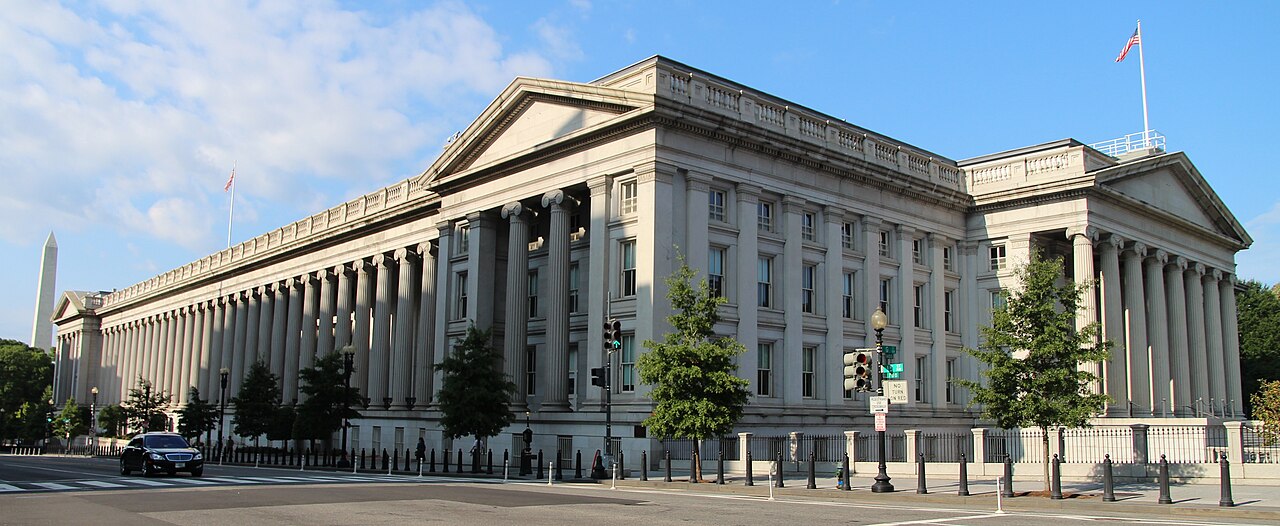
- Wikimedia Commons, "File:United States Treasury Building.JPG" (source page for the article photograph).