As of 2026-06-02 18:35 UTC, Ukraine's long-range strike campaign should be read less as a permissions debate and more as an industrial-capacity test. Reuters reported that President Volodymyr Zelenskyy said on Monday that Ukrainian forces can now hit Russian logistics across the occupied territories and that strikes have contributed to fuel shortages in Crimea and other Russian-held areas.[1] The battlefield claim is hard to verify independently in full, but the strategic direction is clear: Kyiv is trying to make Russian rear-area movement feel unsafe, repetitive, and expensive.
The timing matters because this is arriving after Germany and Ukraine used their April consultations in Berlin to formalize a deeper defense-production relationship. Associated Press reported from Berlin that the two countries were launching plans for joint production of advanced drones and other defense systems, with Zelenskyy arguing that Ukraine could produce much more military output if funding was available.[2] The German government's own account framed the consultations as a strategic-partnership reset, including intensified cooperation on weapons-system development.[3]
That combination changes the news. A strike campaign is not sustained by one spectacular hit. It is sustained by design iteration, financing, parts, operators, repair loops, intelligence, and enough production depth to keep pressure on logistics after Russia adapts. Ukraine is trying to turn that stack into a European-backed manufacturing lane.
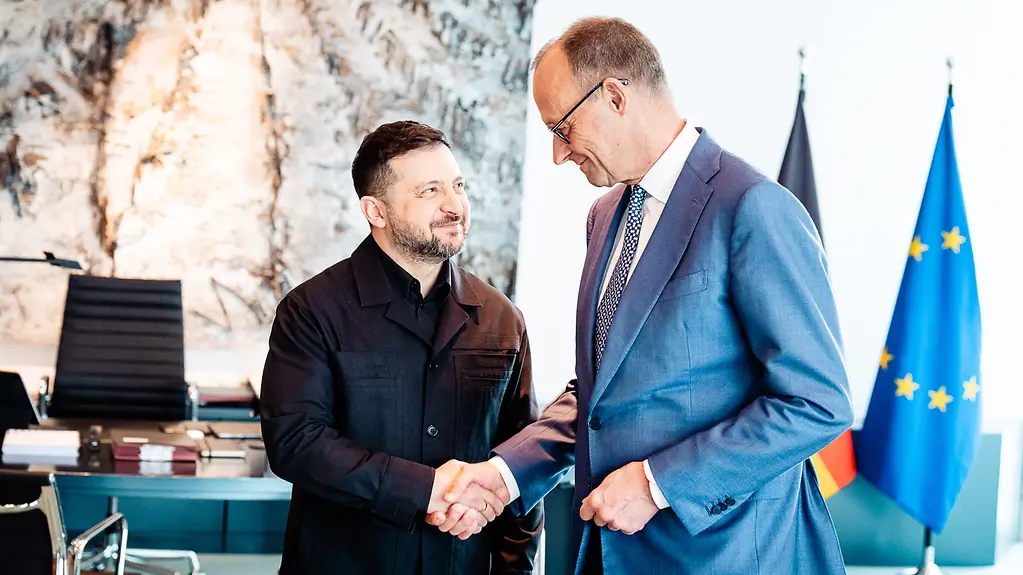
Fact File
| Item | What is known now | Confidence note |
|---|---|---|
| Latest claim | Reuters reported Zelenskyy's statement that Ukraine can strike Russian logistics across almost the full depth of occupied territory and has contributed to fuel shortages in Crimea and other occupied areas.[1] | Medium-high for the statement and reported effects; full battlefield impact remains difficult to verify independently. |
| Refinery campaign | The same Reuters report says Zelenskyy put January-to-May Ukrainian strikes on Russian oil refineries at 15.[1] | Medium; source is presidential claim reported by Reuters, not a complete independent battle-damage assessment. |
| Germany-Ukraine production lane | AP reported on April 14, 2026 that Berlin and Kyiv were starting plans for joint production of advanced drones and defense systems.[2] | High for the diplomatic event and announced intent. |
| Official German framing | Berlin described the April consultations as the first in more than 20 years and said Germany and Ukraine wanted to intensify cooperation in weapons-system development.[3] | High; direct German government source. |
| Drone and data lane | The German government's photo record says Merz and Zelenskyy inspected German-Ukrainian cooperation drones and that Germany and Ukraine would share digital battlefield data to develop weapons systems.[4] | High for the announced cooperation; later delivery evidence will matter more than ceremony. |
| Long-range procurement signal | The strategic-partnership declaration lists a contract for delivery of long-range strike drones, while Berlin's broader Ukraine support page says Germany has been linked to Ukraine through a strategic partnership since April 2026.[5][6] | High for the documentary signal; technical details and production rates remain limited. |
What Changed
The immediate change is that Ukraine is publicly describing occupied-territory logistics as a reachable target set, not only a frontline support chain. If Russian units cannot rely on fuel, road movement, depots, and repair traffic in Crimea, the south, and the east, the pressure is not only tactical. It changes how Russia has to stage reserves, route convoys, defend storage sites, and price the risk of ordinary military movement.[1]
The deeper change is that Ukraine is pairing this operational message with an industrial one. The April Berlin package was not only another aid announcement. AP's report described a move toward joint production, and the German government presented the consultations as a strategic partnership after a long pause in that format.[2][3] That is important because donated stocks and domestic production solve different problems. Donated systems can be decisive but finite. Joint production can be slower to start, but it creates a replenishment path and gives allies a way to fund Ukrainian designs without pretending that every useful weapon has to come from Western inventories.
The partnership is also turning battlefield feedback into an asset. The German government's photo record says the leaders inspected drones from German-Ukrainian cooperation and that the two countries would share digital battlefield data for the further development of weapons systems.[4] That is the practical bridge between front and factory: Ukraine can bring combat-shaped design requirements, while Germany can bring capital, industrial equipment, supply chains, and political cover.
Why Production Is the Strategic Surface
For most of the war, the outside debate has often centered on whether allies would send a specific Western system, allow a certain target set, or cross a particular escalation line. Those questions still matter. But they are no longer sufficient. If Ukraine's own drones and missiles are carrying more of the long-range burden, then the binding constraint shifts toward production rate, reliability, guidance components, explosives, air-defense penetration, and the ability to replace losses quickly.
That is why the German partnership matters even if the April documents did not name every manufacturer or reveal every system. Strategic ambiguity protects programs, but production cannot remain purely rhetorical. It needs purchase orders, trained workers, testing ranges, data-sharing rules, and repeatable lines. The German-Ukrainian declaration, Berlin's public account, and the government's photo record all emphasize strategic partnership, defense cooperation, data exchange, and long-range strike-drone delivery rather than only symbolic support.[3][4][5][6]
The strongest counterweight is execution risk. A memorandum does not equal delivered weapons. New production lines can be slowed by export controls, component bottlenecks, security concerns, intellectual-property disputes, workforce limits, and Russian attempts to target the supply chain. A long-range strike-drone contract can change the war only if it becomes dependable delivery, not just a documentable partnership milestone.[6]
The question, then, is not whether Ukraine can make impressive weapons. The question is whether Ukraine and its partners can choose the right subset, fund it at scale, and sustain output after Russia changes routes, improves electronic warfare, hardens depots, or disperses fuel.
Decision Impact
Next 24 hours: watch whether Russian and occupation authorities acknowledge further transport or fuel disruptions in Crimea and the occupied south. Ukrainian claims are politically useful; corroborating logistics symptoms are more valuable.[1]
Next 7 days: watch German and Ukrainian ministries for procurement details rather than slogans. The important signals would be signed orders, named production sites, training or data-sharing procedures, and any evidence that April's drone and weapons-system cooperation is moving into delivery schedules.[3][4][5][6]
Next 30 days: watch whether Ukraine's refinery and logistics campaign appears to repeat at tempo. One strike can be absorbed. A campaign that keeps forcing rerouting, rationing, depot dispersal, and air-defense reassignment begins to change the cost structure of occupation.[1]
Scenarios
Base case: Ukraine keeps using long-range drones and missiles to pressure logistics and fuel networks, while German-backed production ramps unevenly. The result is not a sudden battlefield collapse, but a more expensive rear area for Russia and a stronger Ukrainian ability to keep pressure on selected targets.[1][2][4][6]
Upside case: German financing and joint production turn Ukrainian designs into high-volume output faster than expected. If reliability improves at the same time, Ukraine can make logistics disruption routine rather than episodic, forcing Russia to spend more air-defense, repair, and transport capacity behind the front.[3][4][6]
Downside case: the industrial lane underdelivers. If component shortages, political caution, Russian adaptation, or slow contracting limit production, then Ukraine's long-range campaign remains dependent on bursts of availability rather than sustained pressure. In that case, the June claim about reach would still matter, but it would not become a durable operating rhythm.[1][5]
Bottom Line
Zelenskyy's latest logistics claim is important because it points to a campaign, not just a target. The more durable story is that Ukraine is trying to build the factory base behind that campaign with European money and infrastructure. If Germany's April production promises become real output, Ukraine's long-range strike capacity stops looking like a periodic headline and starts looking like an industrial system. If they do not, the strike campaign remains powerful but easier for Russia to absorb between waves.[1][2][3][4][6]
Sources
- Reuters via The Star, "Zelenskiy says Ukrainian military can hit Russian logistics throughout occupied areas" (June 2, 2026).
- Associated Press via Los Angeles Times, "Ukraine agrees to defense deal with Germany to help in fight against Russia" (April 14, 2026).
- Federal Government of Germany, "German-Ukrainian government consultations" (April 14, 2026).
- Federal Government of Germany, "Die Deutsch-Ukrainischen Regierungskonsultationen in Bildern" (April 14, 2026 photo record; German).
- Federal Government of Germany, "So unterstützt Deutschland die Ukraine" (April 24, 2026; German).
- Federal Government of Germany, Declaration on a strategic partnership between Germany and Ukraine (April 14, 2026 PDF).