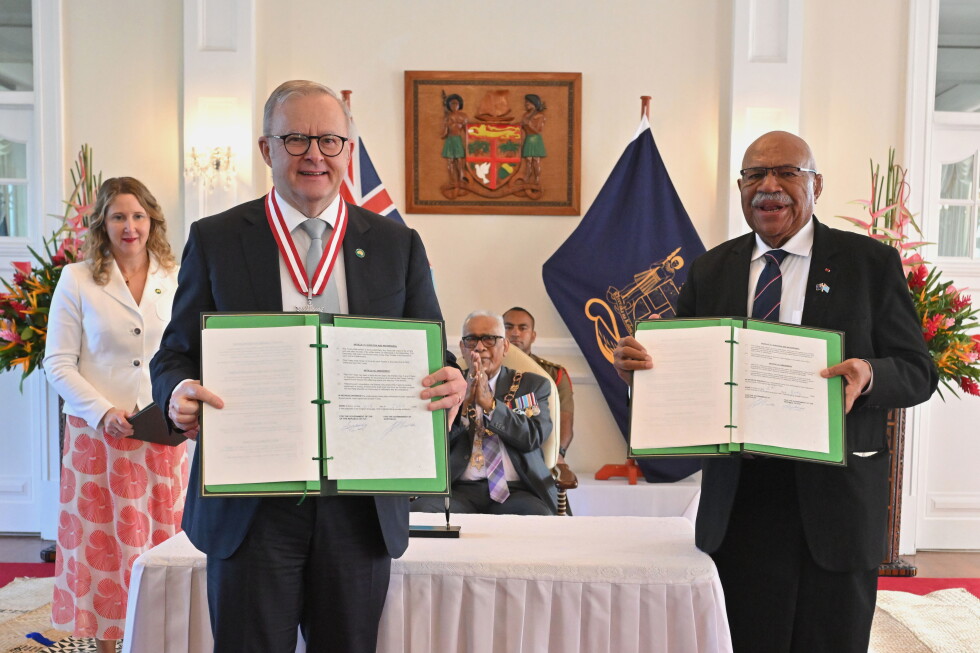
As of 2026-07-06 12:35 UTC, Australia and Fiji have turned the Pacific "Ocean of Peace" idea into a hard security instrument: the Ocean of Peace Alliance, signed in Suva by Prime Minister Anthony Albanese and Prime Minister Sitiveni Rabuka, includes a mutual-defense obligation between the two countries.[1][2]
That is the immediate news. The reason it matters now is the timing and the test. The same day, China test-launched a long-range ballistic missile from a nuclear-powered submarine in the South Pacific, carrying a dummy warhead, and regional governments criticized the lack of reassurance around the move.[1][4]
The strongest boundary is uncertainty. The public record clearly establishes the signing, the Australian government's description of a mutual-defense commitment, the companion Vuvale Union, and the reported Chinese missile test.[1][2][3][4] What is not yet fully visible is the implementing treaty text: when consultation is mandatory, what "aid" means in practice, how climate and transnational crime fit beside armed attack, and how Fiji preserves its "friends to all" diplomatic posture while becoming a formal treaty ally.
Image context: the cover uses real photojournalism from the signing ceremony at State House in Suva. It is relevant because the article is about alliance formation and Pacific diplomacy at the moment of signature, not an abstract great-power map or generated security illustration.[1]
Fact Line
| Timestamp / source | Key signal | Confidence note |
|---|---|---|
| AP, July 6 | Australia and Fiji signed the Ocean of Peace Alliance in Suva; AP describes it as Fiji's first mutual defense treaty and Australia's fourth alliance.[1] | High for the signing and public positioning; the precise legal mechanics await treaty text and implementation. |
| Australian public release, July 6 | The Australian release says the Ocean of Peace Alliance commits each country to come to the other's aid at times of greatest need, while the Vuvale Union deepens security, economic, and people links.[2] | High for official Australian characterization as republished from the originating organization; it is still one government's public summary. |
| Guardian, July 6 | The Guardian reported treaty language that the countries will act to meet the common danger if either is attacked, and noted the Vuvale Union's climate and visa-access dimensions.[3] | Useful for treaty-language detail and diplomatic boundary; full implementation still depends on text, ratification, and programs. |
| AP missile report, July 6 | China test-launched a long-range ballistic missile from a nuclear-powered submarine in the South Pacific, with a dummy warhead, and said it was routine training not directed at a country.[4] | High for the reported launch and statements; intent remains interpretive. |
| Fiji MFA, 2025 and 2024 | Fiji's Ocean of Peace concept sought a Pacific zone where strategic competition is managed, coercion is avoided, and regional sovereignty is protected through Pacific-led norms.[5][6] | High for the diplomatic concept; today's treaty changes the concept's operational weight. |
| UN Treaty Series | The South Pacific Nuclear Free Zone Treaty, concluded at Rarotonga in 1985, is the legal memory behind much of the region's nuclear-free language.[7] | High for treaty text; today's missile report involves a dummy warhead, so the treaty is context rather than a simple violation claim. |
What Changed
The announcement is larger than another defense cooperation memorandum. Australia already trains, funds, and operates with Pacific partners. Fiji already participates in regional security work. What changed on July 6 is that the relationship moved into alliance architecture.[1][2]
The Ocean of Peace Alliance creates a mutual-defense obligation, according to both AP's report and the Australian government's release.[1][2] That makes Fiji Australia's newest treaty ally after the long-standing 1951 alliance framework with the United States and New Zealand and the recent bilateral alliance with Papua New Guinea. It also gives Fiji its first alliance of this kind.[1][3]
The companion Vuvale Union matters because it prevents the defense pact from standing alone as a military headline. The Australian release says the Vuvale Union covers the breadth of the relationship: security, economies, and people.[2] AP reported it includes more than A$1 billion over a decade, while The Guardian reported treaty language that would have the two countries act to meet the common danger if either is attacked.[1][3]
That design is politically important in the Pacific. Fiji's Ocean of Peace language has never been only about soldiers and ships. In Rabuka's 2024 statement, the concept was framed as a way to manage strategic competition, avoid coercion, respect sovereignty, and keep the Pacific's own priorities at the center of outside engagement.[6] The 2025 endorsement in Honiara described the Blue Pacific as a zone of peace and cooperation, not a venue to be pulled into rivalry.[5]
The new alliance therefore has to do two jobs at once. It must reassure Canberra and Suva that each can rely on the other in a crisis. It must also reassure other Pacific governments that "Ocean of Peace" has not quietly become a label for bloc politics.
The Missile Test Became The First Stress Point
China's same-day missile test turned that assurance problem into a live file. AP reported that China's navy launched a long-range ballistic missile from a nuclear-powered submarine in the South Pacific at 12:01 p.m., carrying a dummy warhead, and that Beijing described the launch as routine annual training and not directed at any country.[4]
Australia did not treat it as background noise. AP reported that Foreign Minister Penny Wong said Australia regarded the planned test as destabilizing in the context of China's rapid military buildup and insufficient transparency. New Zealand also objected, with AP reporting that Wellington was informed only hours before the launch and noted that the missile was fired into the South Pacific Nuclear Free Zone.[4]
This is where precision matters. A missile with a dummy warhead is not the same thing as a nuclear test, and the Rarotonga treaty source should not be overused as if every military launch in the region automatically breaches it.[7] The point is political and strategic: in a region whose peace language is built partly from nuclear-free-zone memory, a submarine-launched ballistic missile test raises exactly the transparency and reassurance questions Fiji says the Ocean of Peace is meant to manage.[4][6][7]
Rabuka tried to preserve that diplomatic space. AP reported that he did not expect severe pushback from China and did not see the agreements as threatening either Fiji's or Australia's relationship with Beijing.[1] The Guardian also quoted the blunt Pacific balancing line: another country's enemies are not necessarily Fiji's enemies.[3]
Decision Impact
Next 24 hours: the key document is not another ceremony photo. It is the public explanation of the mutual-defense trigger. If full treaty and ratification documents are released, watch whether they use armed-attack language, broader crisis language, consultation clauses, or deliberately flexible "aid" wording.[1][2][3]
Next 7 days: regional reaction matters more than outside applause. The strongest validation would come from Pacific governments treating the pact as compatible with the Ocean of Peace Declaration rather than as a bilateral shortcut around Forum consensus.[5][6]
Next 30 days: delivery moves from symbolism to systems. The Vuvale Union's A$1 billion-plus decade-long commitment should start showing up in program lanes: skills, ports, policing, maritime domain awareness, health cooperation, and climate resilience. If those visible civilian and regional-security tracks lag, the alliance will look narrower and more military than its sponsors claim.[2][3]
Scenarios
Base case: Australia and Fiji publish or summarize enough treaty detail to show that the mutual-defense obligation is serious but bounded. The Vuvale Union gives the pact a broader development and resilience base, while other Pacific leaders reserve judgment until they see implementation.[1][2][3][5]
Assurance upside: the alliance becomes a practical Ocean of Peace instrument. Fiji uses the treaty to pull Australian support toward Pacific-defined priorities: climate security, transnational crime, maritime enforcement, health, skills, and infrastructure. In that branch, the pact strengthens regional agency rather than just importing big-power competition.[2][3][5][6]
Downside case: the missile test becomes the template for the next phase. China conducts more high-profile military signaling, Australia answers with more explicit alliance language, and Pacific governments begin to see "Ocean of Peace" as a contested phrase rather than a shared regional norm.[4][5][6]
Action Checklist
- For Australian officials: release the clearest possible treaty explanation: trigger, consultation process, aid forms, parliamentary oversight, and how the Vuvale Union money will be governed.
- For Fiji officials: keep explaining how the alliance preserves sovereignty, nonalignment habits, and Fiji's relationships with China and other partners while still making the Australian commitment credible.[3][6]
- For other Pacific governments: test the pact against Forum principles: does it strengthen regional capacity and transparency, or does it create a bilateral security lane that others have to react to later?[5][6]
- For analysts: separate two questions. The alliance is a real institutional shift. The Chinese missile test is a same-day stress signal, but intent cannot be proven from timing alone.[1][4]
- Invalidation condition: this report's base read fails if the treaty text shows a much narrower commitment than today's public descriptions, or if early regional reaction frames the pact as incompatible with the Ocean of Peace Declaration.[2][5][6]
The clean read is that July 6 did not settle the Pacific security order. It raised the standard for everyone operating in it. Australia and Fiji now have to prove that a mutual-defense treaty can serve Pacific-defined peace rather than crowd it out. China, after a rare submarine-launched missile test in the same ocean, has to prove that "routine" military activity can coexist with the transparency and restraint the region keeps asking for.[1][4][6][7]
Sources
- Rod McGuirk, Associated Press, "Australia and Fiji seal a new mutual defense pact in a push to counter China in the Pacific" (July 6, 2026) - current signing report, alliance positioning, same-day China context, and source page for the AP/AAP photograph used in this article.
- Mirage News, "Australia, Fiji Ink Historic Vuvale Union, Peace Pact" (July 6, 2026) - accessible republication of the Australian public release on the two treaties, mutual-defense language, and Vuvale Union scope.
- Daniel Hurst, The Guardian, "Australia and Fiji sign surprise defence alliance amid push to limit China's influence in the Pacific" (July 6, 2026) - treaty-language detail, attack/consultation framing, visa and climate context, and Rabuka's China boundary.
- Huizhong Wu and Charlotte Graham-McLay, Associated Press, "China test-launches a ballistic missile in the South Pacific and raises regional concerns" (July 6, 2026) - missile-test report, dummy-warhead detail, Chinese explanation, and Australian/New Zealand/Japanese concerns.
- Fiji Ministry of Foreign Affairs and External Trade, "Ocean of Peace declaration endorsed at Pacific Leaders meeting in Honiara" (September 11, 2025) - endorsement history and Fiji's description of the Blue Pacific as a zone of peace and cooperation.
- Fiji Ministry of Foreign Affairs and External Trade, "Oceans of Peace" (ministerial statement dated August 5, 2024) - Rabuka's explanation of the Ocean of Peace concept, strategic-competition management, anti-coercion language, and Rarotonga treaty memory.
- United Nations Treaty Series, "South Pacific Nuclear Free Zone Treaty" (concluded at Rarotonga, August 6, 1985) - treaty text and nuclear-free-zone context for the region's security language.