As of 2026-07-07 05:34 UTC, Hamas says it has dissolved the government body that has run Gaza and is preparing to transfer civilian authority to the National Committee for the Administration of Gaza, a technocratic committee tied to the U.S.-brokered ceasefire architecture and United Nations Security Council Resolution 2803.[1][5]
The announcement matters because it moves the Gaza transition from diplomatic design to operational proof. A resignation statement is not the same as control changing hands. The real test is whether the NCAG can enter Gaza, direct ministries, manage services, and operate under one legal-security framework while Hamas retains armed capacity and Israel still controls large parts of the territory.[2][3][4][6]
The uncertainty boundary is large. AP, Al Jazeera, ABC, The Guardian, and Asharq Al-Awsat all report a handover signal, but the same record shows unresolved constraints: Hamas has not unilaterally disarmed, technical staff are expected to remain in place, the NCAG has been operating outside Gaza, and Israel has treated the move skeptically.[1][2][3][4][6]
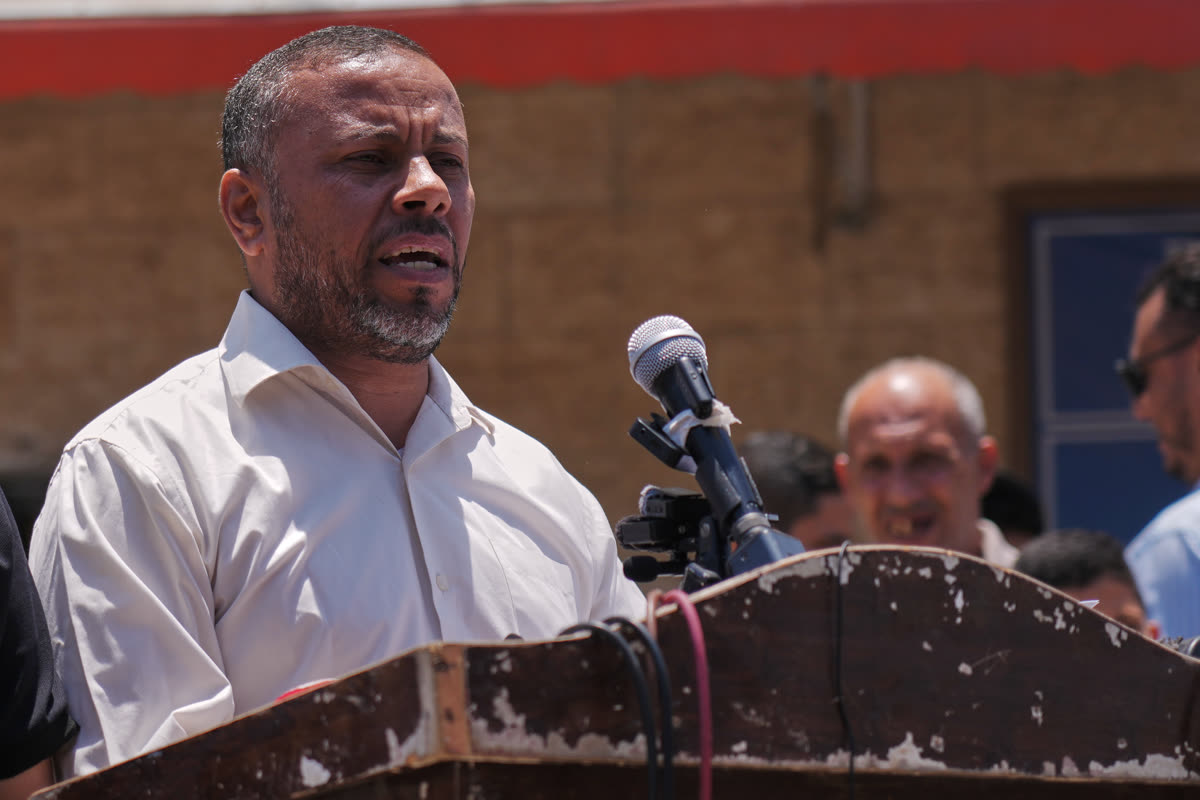
Image context: this post uses one real news photograph from the announcement setting at Al-Aqsa Hospital in Deir al-Balah. It is not a generated visual, chart, map, or symbolic Gaza placeholder; it documents the administrative handover claim at the moment it was presented publicly.[1]
Fact Line
| Timestamp / source | Key signal | Confidence note |
|---|---|---|
| AP, July 6-7 | Hamas said it dissolved its Gaza government and is preparing to transfer power to a UN-backed technical committee under the ceasefire plan.[1] | High for the public announcement; lower for whether power has actually moved. |
| Al Jazeera, July 6 | Gaza's Government Media Office said Mohammed al-Farra resigned and the Government Emergency Committee was dissolved to facilitate administrative transition.[2] | High for the text of the Hamas-side statement; the practical effect remains untested. |
| ABC, July 6 | Hamas officials said some technical and professional personnel would remain to prevent an administrative vacuum.[3] | Important caveat: continuity may preserve services, but it can also blur who commands the bureaucracy. |
| NCAG official site | NCAG describes itself as a transitional, technocratic, apolitical Palestinian committee established in January 2026 under UNSC Resolution 2803, responsible for public services and civil administration.[5] | High for the committee's formal mandate and self-description; not proof of on-ground authority. |
| The Guardian and Asharq Al-Awsat, July 6 | Reporting says Hamas has not made a unilateral disarmament promise, the NCAG has been blocked from entering Gaza, and the Board of Peace's test is actions rather than words.[4][6] | Medium-high; the central issue is implementation, not the statement itself. |
What Changed
The visible change is that Hamas has moved from conditional language about postwar governance to a formal public claim that its emergency governing body is dissolved. AP framed the step as part of the U.S.-brokered ceasefire deal, and Al Jazeera reported that Hamas presented it as a way to remove pretexts for continued conflict and clear space for the NCAG.[1][2]
That does not make this a clean resignation from power. It is closer to a control test. The difference matters. A government can resign on paper while payrolls, police, local coercion, border access, aid permissions, ministry files, and neighborhood-level enforcement remain fragmented. Gaza's immediate problem is not only who holds the title of administrator; it is whether orders from a new civilian authority can travel through a damaged, armed, partly occupied territory and produce real changes.
NCAG's own description sets a clear civilian mandate: public services, civil administration, reconstruction, recovery, and transition under the Board of Peace and Security Council Resolution 2803.[5] That mandate is broad enough to matter but narrow enough to expose the hard edge. Civil administration cannot stabilize Gaza if it cannot enter, staff, budget, protect aid routes, coordinate municipal work, and establish a credible relationship with the forces that actually control streets.
The Handover Has Three Bottlenecks
The first bottleneck is entry. ABC reported that the NCAG has been operating from Cairo, while Hamas has accused Israel of blocking its access to Gaza.[3] The Guardian similarly reported that the committee's members have been prevented from entering Gaza since being assembled in January.[4] If that remains true, Hamas's announcement becomes pressure politics rather than administrative transfer. A committee outside Gaza can accept responsibility, issue statements, and meet envoys. It cannot run water, crossings, police stations, schools, hospitals, or rubble clearance from a distance.
The second bottleneck is chain of command. ABC reported that Hamas officials said technical and professional personnel would remain to avoid a service vacuum.[3] In a normal transition, keeping civil servants in place can be prudent. In Gaza, it is also the place where ambiguity lives. Who appoints directors? Who signs procurement? Who controls fuel, salaries, relief lists, local police, detention, and permits? If the answer is "the same people, with a different label," Israel and the Board of Peace will call the handover cosmetic. If the answer is "new NCAG authority, using existing staff under clear rules," the move becomes more substantial.
The third bottleneck is weapons and security. The Guardian reported that Hamas's statement made no unilateral disarmament promise, while Asharq Al-Awsat reported that Hamas would still oversee security and policing in areas left under its control.[4][6] That is the crux. A civilian handover can begin before total disarmament, but it cannot be judged complete while armed authority sits outside the same command structure. The Board of Peace's stated principle, as reported by The Guardian, is one authority, one law, and one weapon.[4] That is less a slogan than an implementation test.
Decision Impact
Next 24 hours: watch for concrete access decisions. The strongest signal would be a dated arrangement allowing NCAG officials into Gaza with named responsibilities, security guarantees, and liaison channels with Israel, local ministries, and international aid actors.[3][4][5]
Next 7 days: watch ministry behavior. A real transition should produce visible administrative acts: appointment letters, budget authority, crossings or aid coordination, municipal service orders, health and education directives, and public instructions to civil servants. If the only movement is repeated statements, the announcement is still a bargaining move.[1][2][3]
Next 30 days: watch whether security and civil control converge. The handover becomes meaningful if NCAG can operate across more than a narrow enclave, if public workers answer to it, and if armed groups accept limits under a unified legal framework. It weakens if Israel blocks entry, Hamas keeps security authority separate, or reconstruction remains tied to isolated zones rather than Gaza-wide governance.[4][5][6]
Scenarios
Base case: Hamas's announcement restarts negotiations but does not immediately shift control. NCAG gets more diplomatic recognition and perhaps limited entry, while existing Gaza staff keep services moving. The main fight remains whether security, weapons, and Israeli-controlled territory can be folded into one transition framework.[2][3][4][6]
Implementation upside: Israel, mediators, the Board of Peace, and Hamas agree on a phased entry plan. NCAG enters Gaza, names service leads, takes over civil files, and uses existing staff under written authority. Disarmament remains staged, but police and armed movement begin moving toward one accountable chain of command.[3][4][5]
Downside case: the resignation is treated as tactical theater. Israel refuses entry or limits the committee to a small controlled zone, Hamas keeps real security and ministry leverage, and the Board of Peace concludes that actions have not matched the promise. In that branch, Gaza gets another governance shell while civilian conditions keep deteriorating.[4][6]
Action Checklist
- For mediators: publish the sequence that turns the announcement into control: entry, mandate, staff authority, budget custody, crossings, police liaison, and dispute resolution.
- For NCAG: state what it can do on day one inside Gaza and what it cannot do until security and access questions are settled.[5]
- For Israel: clarify whether it will permit Gaza-wide NCAG operation or only a limited-zone model; ambiguity will make the transition look blocked before it starts.[3][4]
- For Hamas: show the administrative handoff in documents, not only in speeches: ministry instructions, chain-of-command changes, and a timetable for security integration.[1][2][6]
- For aid agencies and governments: treat service continuity and independent authority as separate tests. Keeping staff in place may prevent collapse, but it does not prove the new committee governs.[3][5]
- Invalidation condition: this analysis fails if, within the next month, NCAG demonstrably enters Gaza, takes control of ministries and public services, and receives enforceable security authority faster than the current reports suggest.[3][4][5]
The practical conclusion is narrow. Hamas's announcement is significant because it acknowledges that Gaza's postwar administration cannot remain in the old form. But the announcement is not yet a handover. It becomes one only when a named civilian authority can enter the territory, command institutions, protect services, and bring weapons and policing under a single accountable structure. Until then, the story is less "Hamas resigns" than "who can actually govern Gaza now?"[1][4][5][6]
Sources
- Wafaa Shurafa and Samy Magdy, Associated Press, "Hamas dissolves its government in Gaza to transfer power to a UN-backed committee" (July 6-7, 2026) - current announcement, ceasefire context, unresolved disarmament issue, and source page for the AP photograph used as this article's image.
- Al Jazeera, "Hamas announces dissolution of Gaza governing body" (July 6, 2026) - Gaza Government Media Office statement, Hamas spokesperson framing, NCAG readiness comments, and transition significance.
- Matthew Doran, ABC News Australia, "Hamas to dissolve Gaza emergency government but some leaders will stay to 'prevent vacuum'" (July 6, 2026) - technical-staff caveat, Cairo-based NCAG context, stalled ceasefire negotiations, and Israeli skepticism.
- Julian Borger and Seham Tantesh, The Guardian, "Hamas offers to hand over authority in Gaza to US-backed administration" (July 6, 2026) - disarmament boundary, NCAG entry blockage, Board of Peace reaction, and analysts' interpretation.
- National Committee for the Administration of Gaza, official home page - NCAG mandate, January 2026 establishment under UNSC Resolution 2803, civilian-administration role, and leadership list.
- Asharq Al-Awsat, "Palestinian Technocratic Committee Says Ready to Govern Gaza" (July 7, 2026) - Ali Shaath readiness statement, Hamas handover signal, and caveat that ministries, staff, security, and policing remain central issues.