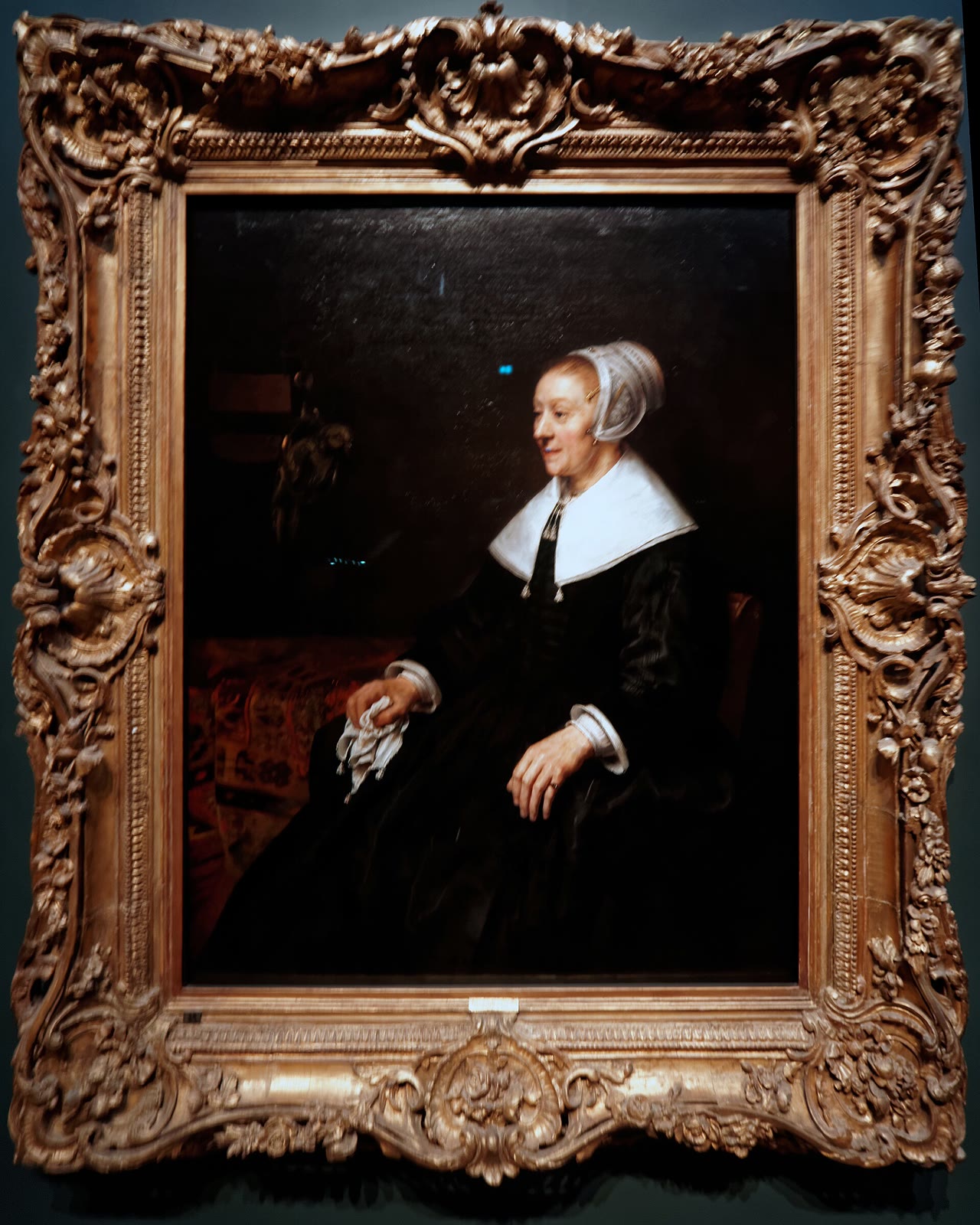
As of 2026-08-28 16:35 UTC, the UK government has deferred a licence to export Rembrandt's Portrait of Catrina Hooghsaet permanently from the country. The official headline calls the move a temporary ban. The operative fact is narrower: the owner has not lost the painting, a British museum has not acquired it, and the government has not announced an unconditional refusal to let it leave. It has opened a window for an eligible UK buyer to match a recommended price of £71,696,324.90, plus £754,698.15 in VAT.[1]
That window matters because this is the most valuable object the government says has ever received UK national-treasure status. It also matters because the same portrait went through an export deferral in 2015, then remained privately owned and has now returned to the system at a little more than twice the earlier £35 million matching price.[1][3][4]
The useful question is therefore not simply, “Has Britain saved the Rembrandt?” It has not. The useful question is: what must happen before this pause becomes a purchase, a refused licence, or an export?
What has happened—and what has not
| Point in the process | Verified position | Confidence boundary |
|---|---|---|
| Export decision | The decision on the permanent export licence is deferred. The first period runs through December 26, 2026.[1] | High. This is the minister's published decision. “Deferred” should not be reported as a completed acquisition. |
| Matching amount | The recommended price is £71,696,324.90, plus £754,698.15 VAT.[1] | High. These are the published figures. They do not say that any institution has this sum committed. |
| National-treasure test | The Reviewing Committee found that the portrait met all three Waverley criteria: connection to UK history and national life, outstanding aesthetic importance, and outstanding significance for scholarship.[1][2] | High on the finding. The label creates an export-control process; it does not transfer ownership. |
| Owner, buyer, and destination | The decision notice names neither the current owner, a prospective UK purchaser, nor the intended overseas destination.[1] | Unknown. Silence in the release is not evidence that no discussions exist. |
The final row is especially important. A fundraising campaign, consortium, or private buyer may emerge, but none was public in the decision notice as of the timestamp above. The announcement is an invitation to act, not evidence that the money has already been assembled.
“National treasure” starts a test
The Waverley criteria ask three different questions about an object: whether it is closely connected with UK history and national life, whether it is aesthetically outstanding, and whether it is exceptionally important to a field of study. Meeting any one can qualify an object as a national treasure; the criteria are not a ranking.[2]
In this case the committee said the portrait met all three.[1] That may sound surprising for a painting made in Amsterdam by a Dutch artist for a Dutch sitter. The history criterion can include an object made abroad that acquired importance through a British place, collection, person, or event.[2] The government's provenance probably places the portrait in Britain by 1752, then traces it through major private collections and long periods of public display. The scholarship case rests partly on the unusually rich record around Hooghsaet herself and on the painting's place among Rembrandt's late three-quarter-length portraits.[1][4]
The committee advises; the Secretary of State decides the licence. When the recommendation is accepted, the deferral does not confiscate the object. It temporarily holds the export decision while an eligible UK purchaser has an opportunity to make a matching offer under a prescribed process.[2]
The three clocks inside the “ban”
1. Expressions of interest: now through December 26
The first clock is for an “appropriate purchaser” to submit a serious expression of interest at the recommended price. For a public institution, Arts Council guidance expects a formal trustee letter setting out its own contribution, the amount still to be raised, and likely funding sources. A private UK purchaser can qualify too, but must undertake to provide reasonable public access and suitable conservation and security, normally through a named museum.[1][2]
This is not yet the full fundraising period. It is a credibility screen: identify the buyer, show a plausible route to the price, and accept the public-benefit conditions.
If no serious expression arrives, the export licence will normally be granted at the end of the first period, although the Secretary of State retains limited discretion to extend a case.[2] That is the clearest reason “temporary export bar” should not be shortened to “Britain blocks sale.” The pause is designed to find a matching buyer; without one, the ordinary endpoint is export.
2. The owner's decision: 15 business days
If one or more serious expressions arrive, the owner receives a 15-business-day consideration period. The prospective buyer must arrange an initial condition report, and the parties must enter the standard Option Agreement within that window. Under the current binding-offer system, refusing or failing to grant the option after a qualifying matching offer is treated as unwillingness to accept it, and the licence can be refused.[1][2]
That is where the mechanism becomes more than a request for goodwill. But it is still conditional: first there must be a serious buyer at the fair matching price.
3. Fundraising: nine months after an option is signed
For this exceptionally expensive portrait, the government has allowed a nine-month second deferral period, beginning only if an Option Agreement is signed.[1] The agreement gives the buyer a contractual right—but not an obligation—to buy. If the buyer raises the money and exercises the option, the sale completes and the export application is treated as withdrawn. If the buyer cannot raise the funds, the licence will normally be granted when the period ends.[2]
So the public timeline is not simply December 26. That date may end the case, or it may begin a 15-business-day bridge to a further nine months of fundraising.
The 2015 rehearsal did not settle ownership
This portrait has already demonstrated the difference between stopping an application and securing a work permanently.
In October 2015, the government announced an initial export deferral at a £35 million matching price, plus £660,000 VAT. The application was to export the painting to Asia. The Reviewing Committee's full annual record says the Art Fund expressed a serious intention to raise the purchase money; before the first deferral ended, the applicant withdrew the licence request, and the painting remained in the UK.[3][4]
That was a real outcome: the proposed export did not happen. But the same official record classed the case as a withdrawn application, not an acquisition by a UK institution.[4] The 2026 provenance now records a private sale in 2015 and another private sale through Christie's in 2025.[1] In other words, the earlier pause kept the portrait in the country at that moment without turning private possession into permanent public ownership.
The comparison also sharpens today's funding problem. The recommended price has risen from £35 million to almost £71.7 million before the separately stated VAT. That is not proof that the painting's underlying “value” doubled in some objective sense; both figures belong to particular export applications and market transactions. It is proof that the amount a matching purchaser must now assemble has slightly more than doubled.[1][3][4]
The person inside the procedure
The bureaucratic vocabulary can make the object sound interchangeable. It is not. Rembrandt painted Hooghsaet in 1657, when she was about 50. The large oil portrait shows her seated with both arms claiming the chair, a handkerchief in one hand and a pet parakeet nearby. Museum Wales reads the black dress and white cap in relation to her Mennonite community, while the silk, pearls, gold head irons, and exotic bird complicate any simple picture of austerity. She lived separately from her husband, and no paired portrait of him by Rembrandt is known.[1][6]
The painting also moves between tight finish and soft atmosphere. Museum Wales highlights the combination of fine detail, blurred passages, and dramatic light and shade.[6] That visual tension helps explain why the work can satisfy an aesthetic test and a scholarship test at once: it is both a forceful encounter with one sitter and evidence about portrait convention, religion, wealth, gender, collecting, and Rembrandt's late technique.[1][4][6]
What changes now
In the next 30 days: a credible lead purchaser would need to emerge, test the funding landscape, and decide whether it can stand behind a formal expression of interest. Public silence would not prove inactivity, but a named institution, board approval, or major lead pledge would materially improve the odds.
By December 26: the meaningful threshold is not a petition or a general declaration of support. It is a serious expression at the stated matching price, routed through the Reviewing Committee secretariat and backed by a plausible funding plan.[1][2]
After an option is signed: attention should move from the headline total to executable funding. A pledge, tax arrangement, public grant, philanthropic gift, or consortium share matters only to the extent that the buyer can exercise the option within nine months.
Recent system-wide results counsel against assuming either success or failure. In the committee's 2024–25 reporting year, 18 of 20 cases were deferred as national treasures; six objects were bought in the UK, nine were or could be exported, and three were still under deferral when the report closed.[5] Those counts are not a forecast for this exceptional case. They show that deferral is a decision funnel, not a guaranteed retention mechanism.
Three conditional outcomes
Base case — a credible campaign buys more time, not certainty. A museum or eligible private buyer submits a serious expression and signs an option, opening the nine-month fundraising period while a large gap remains. Trigger: official confirmation of an Option Agreement without confirmation that the full price is committed.
Upside case — a consortium converts the clock into public access. One buyer assembles the matching sum, exercises the option, and places the work in a stable public setting under the acquisition or access terms. Trigger: a completed matching purchase and withdrawal of the export application.
Downside case — the pause expires into an export licence. No serious expression appears by December 26, or a buyer signs an option but cannot fund it in the second period. Trigger: official notice that the licence has been or can be issued.[2]
A short accuracy checklist
- Call the current action an export-licence deferral or temporary export bar, not a completed national acquisition.
- Keep December 26, the 15-business-day consideration period, and the conditional nine-month fundraising period separate.
- Distinguish a serious expression of interest from cash committed, and cash committed from a completed purchase.
- Watch the Reviewing Committee and DCMS for a named purchaser, an Option Agreement, an exercised option, or an issued licence.
- Treat the 2015 withdrawal as evidence that a deferral can stop one export attempt—not as proof of permanent public ownership.
Invalidation condition: the “clock, not a veto” framing would need revision if the government announced that this licence could not be granted regardless of whether a matching buyer emerges, or if a binding acquisition had already completed. Neither condition appeared in the published record as of the article timestamp.[1][2]
For now, the portrait is neither saved nor lost. The state has attached a sequence of dates and conditions to its possible departure. Whether that sequence ends in a gallery, another private collection, or an export licence depends less on the word “treasure” than on who can turn £71.7 million into an executable offer.
Sources
- UK Department for Digital, Culture, Media and Sport, “Minister acts to help save Rembrandt masterpiece from leaving the UK” (August 27, 2026) — current decision, price, VAT, deadlines, Waverley findings, provenance, and object details.
- Arts Council England, UK Export Licensing for Cultural Goods: Procedures and Guidance for Exporters of Works of Art and Other Cultural Goods, Issue 1 (last updated November 1, 2023) — Waverley tests, serious-interest standard, split deferrals, binding Option Agreement, and licence outcomes; copy hosted by Germany's federal cultural-property protection portal.
- UK Department for Digital, Culture, Media and Sport, “£35 million Rembrandt painting at risk of leaving the UK” (October 16, 2015) — the portrait's first export deferral and earlier matching price.
- Reviewing Committee on the Export of Works of Art and Objects of Cultural Interest, Export of Objects of Cultural Interest 2015–16 — official case record for the earlier application, Art Fund interest, withdrawal, and retention outcome.
- UK Department for Culture, Media and Sport and Arts Council England, “Annual report on the Export of Objects of Cultural Interest 2024 to 25” (July 21, 2025) — most recent published case-outcome baseline used here.
- Museum Wales, “Rembrandt: Portrait of Catrina Hooghsaet” — museum account of the sitter, composition, technique, British display history, and 2013 Cardiff loan.
- Txllxt TxllxT, “Portrait of Catrina Hooghsaet at the Rijksmuseum's Late Rembrandt exhibition” (photographed April 16, 2015), Wikimedia Commons — provenance page for the documentary cover photograph.