As of 2026-09-27 03:34 UTC.
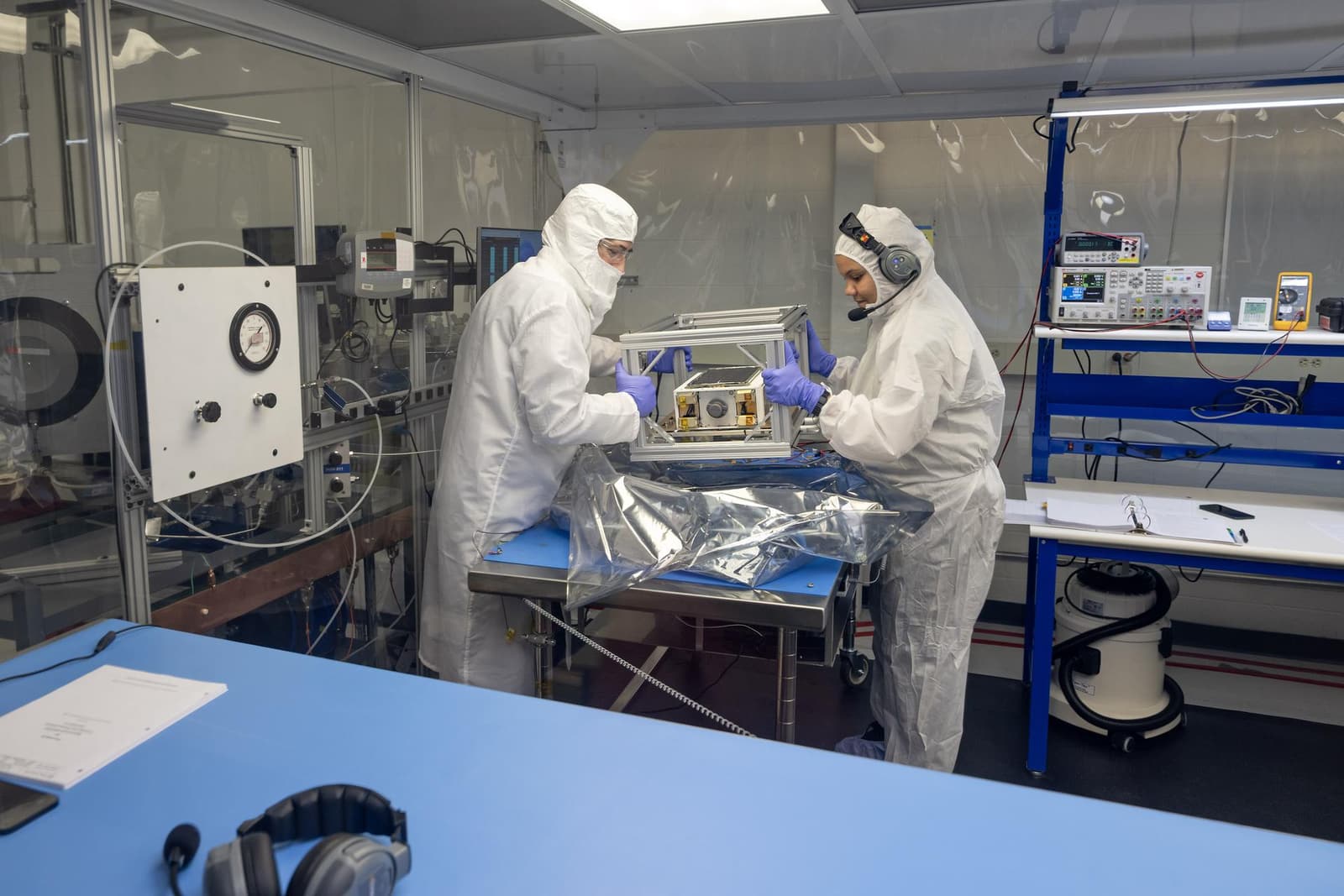
NASA announced on September 25 that its ASCENT Propulsion Dual Mode CubeSat had completed environmental and physical testing at Marshall Space Flight Center in Alabama. The agency lists launch aboard a Falcon 9 from Vandenberg, California, no earlier than October 1; final checkouts, solar-array integration and shipment remain.[1]
The experiment puts a practical question inside a small spacecraft: can one supply of liquid serve both a strong, brief push and a much gentler, economical one? The mission's published architecture pairs a chemical thruster with four electric electrospray thrusters in a six-unit CubeSat. Carrying both capabilities separately imposes a difficult mass, volume and power burden on spacecraft this small.[2]
Two ways to use the same liquid
The common ingredient is ASCENT, also known as AF-M315E. Developed as a less toxic alternative to hydrazine, it is an ionic liquid mixture that also lends itself to electrospray propulsion. Electric fields extract charged particles from the liquid and accelerate them out of tiny emitters. Chemical propulsion produces stronger bursts; electrospray trades immediate force for economical use of propellant over longer maneuvers.[3]
That difference gives operators a choice about how to spend their supply. A common tank makes the remaining liquid available to either kind of maneuver, instead of dividing it between separate stores at launch.[3]
This is a specific development in small-spacecraft propulsion, with substantial institutional work behind it. The 2024 mission architecture assigns Georgia Tech the host spacecraft's design, integration and operations, NASA Marshall overall project oversight, and MIT the electrospray thrusters.[2] The spacecraft surrounding the experiment must supply the power, commands and communications that let engineers learn from it.
The laboratory result has a boundary
MIT's June account describes experiments on a magnetically levitated test stand inside a vacuum chamber. Researchers fired ASCENT-fed electrospray thrusters and measured the resulting motion. The arrangement let them investigate very small forces without treating an ordinary supporting surface as part of the propulsion result.[3]
The research paper by Amelia Bruno, Matthew Corrado and Paulo Lozano reports no observed failure or significant degradation across multiple tested thruster units for firing times up to 167 hours. It also records a disagreement between direct and indirect measurements of propellant mass flow, suggesting additional mechanisms of mass loss.[4]
Both findings matter. Sustained firing supports the case for using the liquid in these thrusters. Uncertainty about where mass goes affects how confidently engineers can translate a measured push into a prediction of propellant consumption. The authors present measurements that can advance development; their laboratory result is not a demonstration of the complete spacecraft repeatedly switching modes in orbit.[4]
NASA's latest report adds three checks on the flight hardware:[1]
| Ground test | What NASA says it examined | Evidence boundary |
|---|---|---|
| Helium leak test in vacuum | Integrity of the seals | Does not demonstrate orbital refilling |
| Thermal-vacuum testing | Operation under vacuum and temperature extremes | A simulated environment |
| Spin test | Mass properties and centre of gravity | Supports attitude-control preparation |
These are agency-reported results. The table distinguishes the purpose of each test from the broader flight demonstration still to come.
Success includes getting the liquid to the thruster
A shared main tank does not eliminate the need to manage delivery. The mission architecture includes a pressure-reduction system between that tank and the electrospray reservoirs.[2] The team's 2025 engineering paper sets concrete success criteria: the minimum demonstration includes a chemical maneuver, an electric maneuver and filling an electrospray reservoir in orbit. Full success adds prolonged electric operation, refilling and repeated maneuvers in both modes.[5]
The delivery equipment therefore deserves attention alongside the engines: the electric side must receive its replenishment during flight.
For small-satellite developers, the immediate implication is a clearer opportunity to obtain flight evidence. It is too early to treat the system as an established choice for a new mission. All five sources below come from the participating institutions or researchers; they document the work without supplying an independent assessment of readiness.
The base scenario is launch preparation followed by spacecraft checkout and initial maneuvers. The upside trigger is reported success in both propulsion modes plus reservoir filling, followed by repeated operation. The downside trigger is a delay or a delivery, power or propulsion fault that prevents those tests. These are conditional reporting scenarios, not assigned probabilities.
The useful follow-up is specific:
- Next 24 hours: check for a revised launch notice; an earliest launch date is still a target.
- Next seven days: look for confirmation of deployment and spacecraft contact, keeping those milestones distinct from successful propulsion tests.
- Next 30 days: follow checkout and maneuver reports. Revise the assessment if a fault prevents testing either mode or replenishing an electrospray reservoir; extend the timetable if launch moves.
Sources
- Joel Wallace, NASA, “NASA Tests Dual Mode Propulsion CubeSat Ahead of Launch,” September 25, 2026 — ground tests, current launch target, remaining preparations and Charles Beason's hardware photographs.
- Kevin Tong and colleagues, “Mission Architecture for the Green Propulsion Dual Mode Mission,” 2024 Small Satellite Conference, NASA Technical Reports Server — spacecraft configuration and institutional responsibilities; its historical launch estimates are not used here.
- Jennifer Chu, MIT News, “New propulsion system could make tiny satellites both fast and fuel-efficient,” June 1, 2026 — propellant properties, propulsion tradeoffs and laboratory setup; its November launch forecast predates NASA's September update.
- Amelia R. Bruno, Matthew N. Corrado and Paulo C. Lozano, “Performance Characterization of Electrospray Thrusters with Energetic Ionic Liquid Monopropellant,” Journal of Propulsion and Power, May 31, 2026, author manuscript record at MIT — measured performance, firing duration and mass-flow discrepancy.
- John W. Dankanich and colleagues, “Green Propulsion Dual Mode (GPDM) Path to Flight,” International Electric Propulsion Conference, September 2025, p. 3 — minimum and full flight-success criteria.