As of 2026-09-28 07:34 UTC.
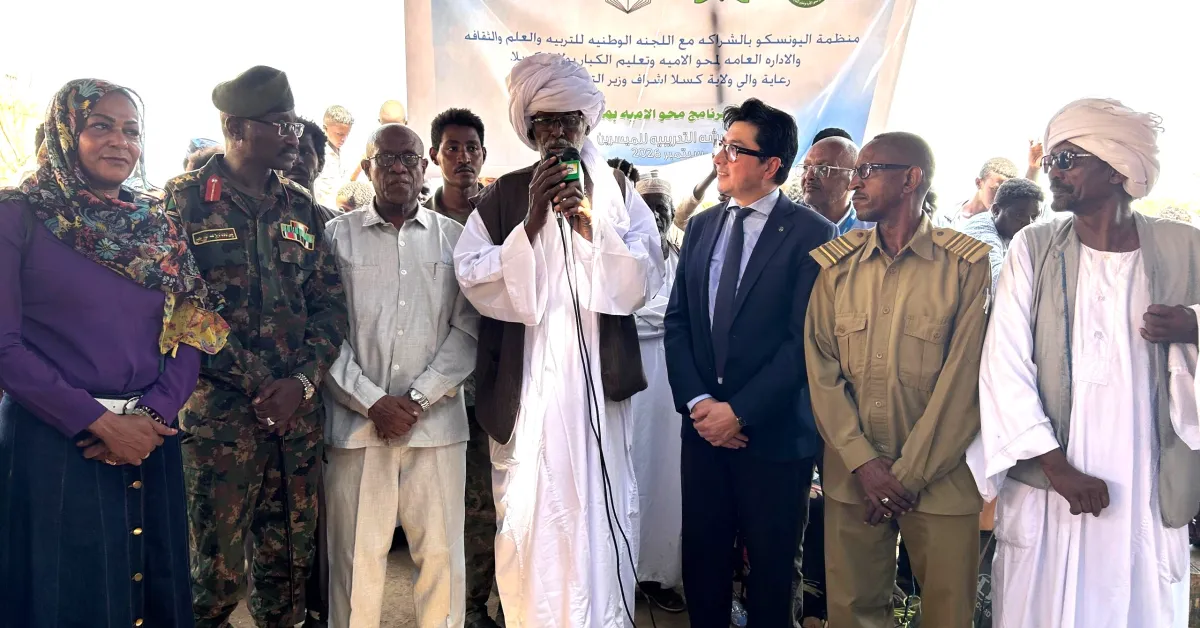
UNESCO has announced a literacy and adult-education programme in Aroma, in Sudan's Kassala State, extending education recovery to people who missed earlier opportunities to learn. Its September 27 account describes a launch backed by state education authorities, the Sudanese National Commission and community leaders.[1]
The announcement does not give an enrolment target, budget, teaching timetable or measured learning results. It establishes a programme launch; its eventual reach remains unreported.[1]
Recovery at more than one age
A separate UNICEF account from June shows the pressures on education elsewhere in Kassala. In New Halfa, community worker Mohammed, himself displaced from Khartoum, helps residents identify priorities for public services. At a primary school, the agency reported overcrowding, missing desks and children studying outside. His committee's work spans education, water and health, with members trained in planning, record-keeping and service monitoring.[2]
That account concerns a different project and locality. It does, however, make the practical meaning of community involvement visible: someone must identify what is missing, discuss it with residents and follow the work after a meeting ends. Those are useful questions to bring to Aroma's next update.
In neighbouring Gedaref State, UNICEF reported a more tangible sequence at Alban Jadeed Mixed Primary School. A school grant received in 2025 supported repairs, benches, learning materials and teacher incentives, following priorities set by a school improvement committee. By the agency's June 2026 account, enrolment had risen from roughly 600 to more than 900. The principal also reported that the share of children with benches had increased from about one fifth to over four fifths.[3]
These are implementer-reported changes at a children's school, not an evaluation of Aroma's adult programme. They illustrate the distinction between opening access and sustaining a usable place to learn. A seat, teaching materials and a teacher able to keep returning are part of the educational offer.
The evidence available at this cutoff has three different meanings:
| Record | What it establishes | Limit |
|---|---|---|
| UNESCO, September 27 | Aroma programme launch and institutional backing | No published delivery totals [1] |
| UNICEF, June 8 | Reported improvements at Alban Jadeed | Another programme, serving children [3] |
| UNESCO adult-education recommendation, 2015 | Principles for accessible, sustained learning | Guidance, not local results [5] |
The lesson must fit the learner's day
Sudan has an older adult-learning experience worth revisiting. The UNESCO Institute for Lifelong Learning's case study of GOAL's REFLECT Literacy and Livelihood Programme describes an initiative begun in 2005, including work in Kassala. Women developed learning activities around concerns such as household costs, water and community needs. Numeracy could be practised through calculating school fees; reading and writing were connected to decisions learners already faced.[4]
The same case study records obstacles. Family responsibilities restricted attendance. Suitable facilitators were hard to recruit, and teaching materials could be poorly matched to the languages learners understood. Its lessons include letting women help choose meeting times and places, and adapting instruction to local languages.[4]
This is a historical reference, despite the database page's 2024 update label. Its old participation figures cannot describe Sudan today, and the account does not establish that Aroma uses REFLECT. Its value here is narrower: an invitation to enrol is only the beginning of making a class accessible.
UNESCO's 2015 Recommendation on Adult Learning and Education offers a corresponding standard. It calls for sustained participation, safe learning spaces, culturally and linguistically appropriate teaching, and assessment of learning outcomes. It also treats adults affected by displacement and conflict as groups needing particular attention.[5]
For this programme, that suggests three distinct questions: who can join, who can keep attending, and what they become able to do. A registration total answers only the first. This is an assessment framework, not a claim about results already achieved in Aroma.
What would turn the launch into evidence of progress
The immediate audience for follow-up is local education authorities, programme partners and organisations considering support. The launch report and the contextual field accounts come from the implementing agencies; no independent assessment of Aroma's delivery is established by these sources.
The base scenario is that partners move from the announced launch to documented teaching arrangements. An upside trigger would be evidence of regular classes, continued attendance and assessed learning. A downside trigger would be cancelled sessions, facilitator shortages or reports that intended learners cannot attend. These are conditional possibilities, with no probabilities assigned.
A short reporting checklist keeps the next steps concrete:
- Next 24 hours: look for local registration information, including eligibility and a named contact. Do not infer those details from launch photographs.
- Next seven days: seek the teaching locations, languages, session times and arrangements for facilitators and materials.
- Next 30 days: seek attendance information and the plan for assessing learning; avoid expecting a completed literacy outcome within a month.
Revise the assessment if partners publish evidence that classes are already operating. If delivery is delayed or suspended, revise the timetable and the claim of progress accordingly. The next meaningful story will be about adults returning to learn after the launch gathering has dispersed.
Sources
- UNESCO, “UNESCO and Partners Launch Literacy Programme to Expand Learning Opportunities in Aroma, Kassala,” September 27, 2026 — announcement and launch photographs.
- UNICEF Sudan, “A day in a life of Mohammed, a community worker,” June 14, 2026 — community participation and school pressures in New Halfa.
- UNICEF Sudan, “Restoring school and learning in Sudan,” June 8, 2026 — school grants, enrolment and classroom improvements at Alban Jadeed in Gedaref.
- UNESCO Institute for Lifelong Learning, “REFLECT Literacy and Livelihood Programme, Sudan,” database page updated May 23, 2024 — historical case beginning in 2005; not a current operating census.
- UNESCO, “Recommendation on Adult Learning and Education,” adopted November 13, 2015 — participation, inclusion and quality, especially paragraphs 23–28.