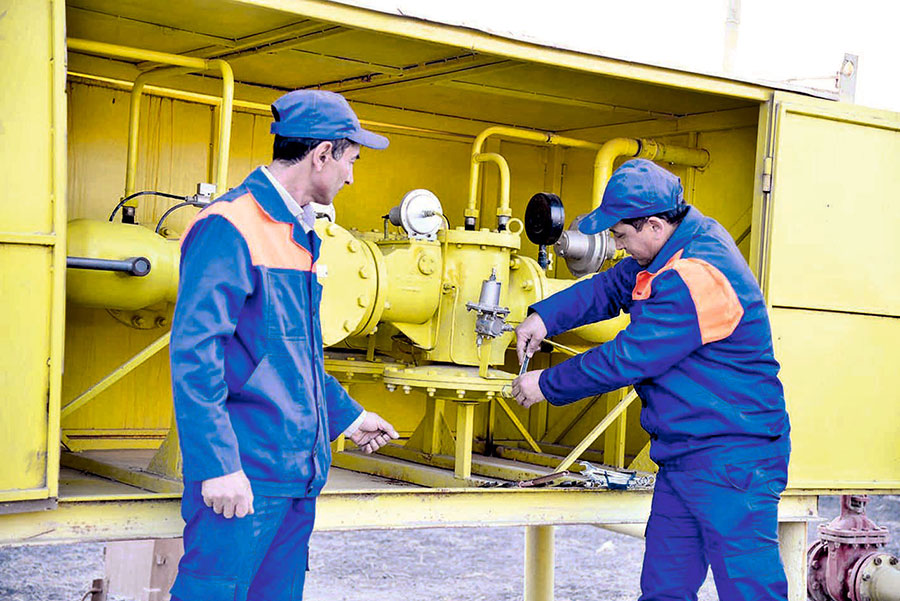
As of 2026-09-01 08:41 UTC, the UN Environment Programme's public mitigation register listed eight methane-emission cases in Turkmenistan where its Methane Alert and Response System, or MARS, had helped catalyse and verify action. The entries run from two Yelguyi cases in November 2024 to a corroded pipeline in Lebap Province repaired in March 2026.[1][3]
That is real progress. It is also much smaller than the unresolved file. The latest reporting, based on UNEP data, describes 192 MARS alerts in the preceding year and reports a response rate of about 20%.[3] UNEP's underlying metric is more exact than that shorthand: it counts distinct notified emission sources, once each, even when several plume alerts came from the same source.[2][9]
My view is that the eight repairs point to the right unit of climate accountability: a public receipt that follows one detected source from alert, through field response and physical work, to independent verification. National promises and aggregate percentages still matter. The receipt is what proves that somebody found the equipment, accepted responsibility and stopped a plume.
This is an evidence-backed opinion based on public UN, IEA, government and news records. No operator, official or community member was interviewed anew. The cited sources establish documented cases and reported response rates; they do not provide a complete inventory of Turkmenistan's methane emissions or every operator's internal work order.
A promise cannot close a valve
MARS is designed to bridge a familiar climate-policy failure. Detection alone produces a plume on a screen. UNEP combines observations from more than 30 satellite instruments with expert review and artificial-intelligence models, then sends a notification to a government or company that can act on it.[1][2]
The physical ending is deliberately less glamorous. According to the current account, Turkmenistan's eight fixes involved corroded pipes, faulty wells and failing flares.[3] Those are maintenance problems, not speculative future technologies. Someone has to locate the source, make the site safe, replace or repair equipment, report what happened and leave enough evidence for the emission to be checked again.
This is why a source-level receipt is more useful than another pledge. It joins remote observation to accountable work. It also preserves the distinction between three different achievements: seeing a plume, answering an alert and ending the emission. Public debate often compresses those into one success statistic. They are not the same.
What the eight cases establish—and what they do not
The UNEP list gives each mitigation case a stable source identifier. That modest design choice matters. It makes it possible to say that TKMS080 and TKMS081 at Yelguyi were cases in November 2024, while TKMS406 in Lebap Province was recorded in March 2026.[1] An observer can follow named events instead of trying to infer performance from a national slogan.
The sequence also shows persistence. The cases are spread across roughly 16 months and several locations, rather than being one demonstration repair repeated in publicity. Guardian reporting says UNEP described the work as a breakthrough in documented mitigation, while warning that eight cases had not yet changed the overall magnitude of Turkmenistan's emissions.[3] Both parts belong in the headline judgment.
The government record supplies a second evidence stream. In April 2025, Turkmenistan said international research had identified methane and associated-gas sources, that repair and preventive work had begun, and that equipment acquisition and facility upgrades were planned. It also reported an 11% national reduction by the end of 2024.[6] That account is evidence of official engagement, but its aggregate percentage should not be spliced into the MARS case series. The page does not publish the inventory method, uncertainty range or a bridge from its baseline to the later satellite alerts.
Eight verified fixes therefore prove a functioning alert-to-action pathway. They do not prove that total national methane emissions are falling, that all eight sources will remain closed, or that the largest unresolved sources are being addressed first.
A response is not a repair
UNEP calculates a country response rate by dividing distinct emission sources for which it received substantive feedback by distinct sources notified through MARS over a rolling 12-month period. Each source counts once, regardless of how many plumes were reported there. The data are published with a two-month lag. Feedback can contain an investigation, field information or planned mitigation; confirmation of success needs both satellite observations and information from the ground.[2][9]
That definition prevents two bad readings of the current numbers.
First, the reported 20% response rate is not a 20% repair rate. Second, eight verified cases should not simply be divided by the reported 192-alert figure. The news account uses alert language, while UNEP's rate is source-based; the periods and publication lags also differ, and a response may still be moving through diagnosis, planning or verification.[2][3][9]
Satellites also have a boundary. UNEP says the top-50 product tracks the largest sources and can be affected by cloud, latitude, terrain and observation coverage. A source can disappear from a ranking because it was fixed, because it became intermittent or because it fell below the detection threshold. Absence from the image is not, by itself, proof of absence on the ground.[2]
These limitations strengthen the argument for receipts. A public case record can say what the satellite saw, what the operator found and what later observation confirmed without pretending that any one instrument supplies the whole truth.
What a useful public receipt would contain
The IEA and UNEP have already supplied the operational spine: assign the alert, notify the likely operator, receive a response, verify the result, and document the event.[4] Public reporting can mirror that process without publishing security-sensitive schematics or commercially delicate production data.
| Public field | Why it matters |
|---|---|
| Stable source ID and alert date | Prevents one event from being counted repeatedly and lets later updates attach to the same record. |
| Responsible authority and operator status | Shows who owns the next action, even if the operator's name must initially be withheld for a documented reason. |
| Field finding | Distinguishes a corroded pipe, failed flare, faulty well, planned vent or false attribution. |
| Action and status date | Separates acknowledged, investigated, repair planned, repaired and unable-to-verify cases. |
| Verification basis | Records whether ground information and later remote observation agree that the emission ended. |
The result would be a ledger of outcomes, not a league table built for embarrassment. Countries with limited field teams or difficult terrain should be able to record the support, finance or time they need. Silence, however, should remain visible as silence.
The counterargument: disclosure can make cooperation harder
There is a serious case for private engagement. Operators may respond faster when an initial alert is treated as technical assistance rather than an accusation. Exact coordinates can expose critical infrastructure. A false attribution can damage trust. Complex repairs may require shutdown planning, imported parts or safety review that cannot fit a public-relations deadline.
None of that requires a blank public record. A receipt can delay precise coordinates, publish an operator category rather than a name during verification, mark a source as disputed, and explain why a repair needs more time. The IEA framework itself treats its 30-, 60- and 90-day windows as ambitious guidance rather than rigid law.[4]
The stronger objection would be empirical: if source-level disclosure caused operators to stop cooperating and produced fewer verified repairs, the policy should change. The current record points the other way. UNEP's open system has documented action across four continents, while the global response rate remained only about 12% in 2025.[1][4] The scarce result is not detection. It is an accountable answer.
The human result is larger than the ledger
Methane is responsible for nearly one-third of warming to date and has roughly 80 times the warming power of carbon dioxide over 20 years. Because it breaks down much faster than carbon dioxide, cutting it can slow near-term warming while also reducing the ground-level ozone that harms health and crops.[7] Methane work complements deep carbon-dioxide cuts; it does not replace them.
The opportunity is unusually practical. The IEA estimates that about 70% of fossil-fuel methane emissions can be reduced with existing technology and that more than 35 million tonnes could have been avoided at no net cost under 2025 energy prices. Its 2026 tracker places Turkmenistan and Venezuela at the highest end of upstream oil-and-gas methane intensity, while explicitly labelling measured-data availability for Turkmenistan as limited.[5]
That pairing—high estimated intensity and limited measurement—is exactly where receipts add value. Each verified repair is a small piece of better climate performance, less wasted gas and a more credible national record. The scale arrives by repeating the chain, not by enlarging the promise.
Give the next monthly update a memory
In the next 24 hours, UNEP and Turkmen authorities should cross-link the eight mitigation IDs with the current country-response record and state the common cutoff date. This would not reveal sensitive operations; it would show readers which cases and source-level response totals belong together.
Over the next seven days, the current response-rate row should be broken into aggregate status buckets: awaiting acknowledgement, under investigation, mitigation planned, repaired, verified, disputed and closed without confirmation. If several plume alerts belong to one source, that relationship should be explicit.
Over the next 30 days, the monthly Eye on Methane update should preserve status history rather than overwrite it, while Turkmenistan should publish the method behind its national reduction claim. The two series need not match: one tracks large detected events, the other should estimate a national total. They do need a documented relationship.
The base case is slow accumulation: the source response rate edges upward and the mitigation register gains cases, but most notified sources still lack recorded feedback. The upside case begins when field findings arrive faster, verified fixes rise faster than new detections and emissions do not recur at repaired source IDs. The downside case appears if official reduction claims multiply while the verified list stalls, response categories stay hidden or repaired sources recur without explanation. Those are observable triggers, not forecasts.
Turkmenistan's eight repairs deserve attention because they are neither a modelled curve nor a future target. They are physical interventions attached to identifiable sources. The honest way to celebrate them is to demand more of the same—and to leave a receipt every time the invisible plume is gone.
Before the next update
- UNEP: preserve stable case IDs, publish status history and keep feedback, mitigation and verification as separate fields.
- Turkmen authorities and operators: acknowledge every notification, record the field finding, explain delays and publish enough of the repair outcome to permit independent checking.
- Gas buyers and lenders: ask for source-level closure evidence alongside national intensity claims; finance repairs that operators identify but cannot promptly fund.
- Newsrooms: do not translate a response rate into a repair rate or treat disappearance from one satellite view as verified closure.
- Update condition: revise this account if UNEP changes the eight-case register, the current source count, the response rate or its verification standard.
- Invalidation condition: abandon the proposed public-receipt model if comparable evidence shows that it materially reduces operator cooperation or delays repairs without improving verification, or if a less granular audit produces equally traceable outcomes at greater speed.
Sources
- UN Environment Programme, “MARS mitigation action” (updated August 31, 2026) — verification framework and the eight listed Turkmenistan mitigation cases with stable source IDs.
- UNEP International Methane Emissions Observatory, “Mapping the world's biggest methane sources and tracking country response” (August 2026 snapshot) — top-50 scope, rolling response-rate method, lag, response definition and satellite limitations.
- Damian Carrington, The Guardian, “‘Breakthrough’ as Turkmenistan starts fixing ‘mindboggling’ methane mega-leaks” (August 31, 2026) — current alert, response and repair counts; repair types; UNEP's interpretation and uncertainty boundary.
- International Energy Agency with UNEP, “Responding to Satellite Notifications from the Methane Alert and Response System” (May 4, 2026) — five-step government process, global response baseline and indicative 30/60/90-day timelines.
- International Energy Agency, Global Methane Tracker 2026: Key findings (May 2026) — Turkmenistan intensity context, data caveat, technical abatement potential and cost estimates.
- State News Agency of Turkmenistan, “Implementation of the Program for Reducing Methane Emissions into the Environment in Turkmenistan” (April 21, 2025) — government account of research, repairs, prevention work and the national reduction claim.
- United Nations Secretary-General, Call to Action on Methane: Three Sectors, Nine Actions by 2030 (June 2026) — warming, health and crop stakes and the proposed 80% MARS response target.
- State News Agency of Turkmenistan, “Specialists of ‘Daşoguznebitgazgurluşyk’ gasify new housing and utilities sector in the velayat” (August 20, 2024) — source page for the archival photograph of workers maintaining gas equipment.
- UNEP International Methane Emissions Observatory, “Data dictionary: MARS response rates data set” — distinct-source denominator, one-count-per-source rule and definition of substantive feedback.