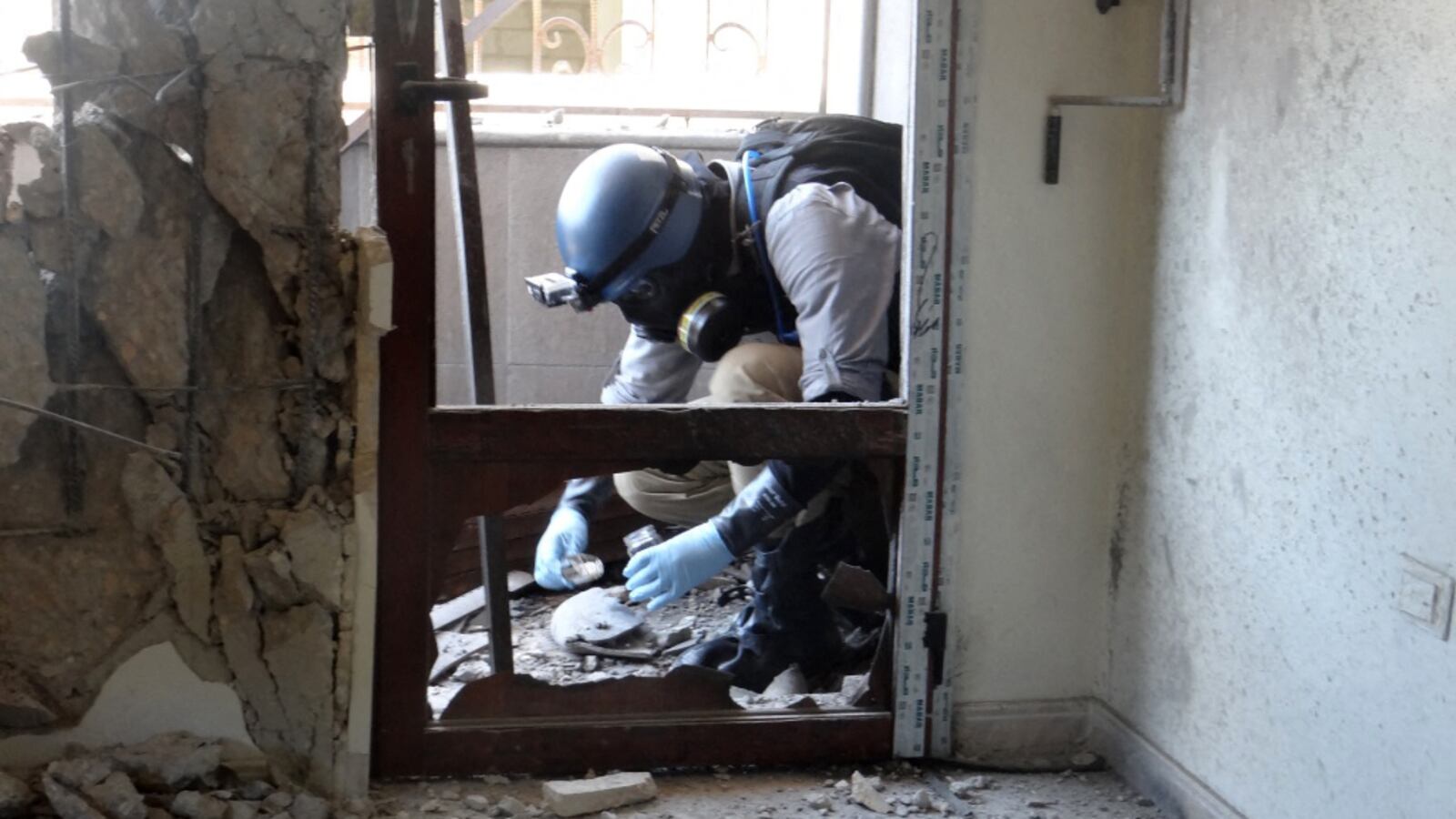
As of 2026-09-04 05:38 UTC, the Organisation for the Prohibition of Chemical Weapons had verified the irreversible destruction of 42 Syrian aerial bombs, the first verified destruction of chemical munitions in Syria since 2014. The result was disclosed at a September 3 UN Security Council briefing after an OPCW mission in August.[1][2]
The crucial detail is less intuitive than the headline: these were Category 3 chemical weapons, meaning unfilled munitions, devices or related equipment—not 42 bombs reported to contain nerve agent. Destroying them is a real disarmament result. It is not proof that Syria's inherited chemical-weapons inventory is complete or that separately discovered chemicals are gone.[2][3][6]
This Q&A follows the public record from discovery to declaration, destruction and verification. It is a reported synthesis of official documents and published reporting; no official, inspector, survivor or accused person was interviewed anew. The current UN briefing establishes the 42-item result, but an OPCW post-operation technical report was not publicly available at this cutoff.
Four documents, four boundaries
- September 3 — the UN briefing: OPCW inspectors verified the irreversible destruction of 42 aerial bombs during an August mission; this was Syria's first verified destruction of chemical munitions since 2014.[1][2] Confidence: high on the count and milestone. The public accounts do not yet disclose the destruction method or a serialised inventory.
- August 24 — the OPCW progress report: Syria had filed three June amendments declaring an additional production facility, a newly discovered chemical used to make nerve agents, empty chemical munitions and two storage facilities. An inspection and Category 3 destruction-verification mission had begun in August.[3] Confidence: high through August 23. The report predates public confirmation of the mission's result.
- August 24 — the declaration ledger: Seven of 26 issues opened since 2014 had been resolved; 19 remained, including potentially large quantities of undeclared or unverified chemical-warfare agents and munitions.[3] Confidence: high for the reporting period. This is an issue count, not a count of weapons or sites.
- May 27 — the field discovery: A nine-person OPCW team, supported by about 200 Syrian personnel, found dozens of previously undeclared munitions, chemicals under analysis, equipment and thousands of pages of records while prioritising sites from more than 100 potentially relevant locations.[5] Confidence: high on the initial discovery. Public sources do not establish that the 42 destroyed bombs equal the full May cache.
What exactly was destroyed?
Forty-two aerial bombs classified as Category 3 chemical weapons. OPCW's categories describe what an item is, not how alarming its category number sounds. Category 1 covers weapons based on Schedule 1 chemicals; Category 2 covers weapons based on other chemicals; Category 3 consists of unfilled munitions, devices and equipment designed for chemical-weapons use.[6]
That distinction prevents two errors. Calling the 42 bombs agent-filled would add a fact the current record does not support. Calling them ordinary empty shells would erase why the Chemical Weapons Convention treats purpose-built delivery hardware as a weapon even when its toxic fill is stored elsewhere or absent.[2][6]
The destruction therefore closes one defined inventory line. It removes 42 purpose-built delivery items and gives inspectors a count they can reconcile against Syria's amended declaration and storage records. It says nothing by itself about the quantity or fate of the newly declared nerve-agent-production chemical, other chemicals still under analysis, rockets found in May or matériel at other locations.[3][5]
Within the next 24 hours, the most useful addition would be an OPCW confirmation page tying the 42 aerial bombs to their approved category, facility plan, inventory and date—while withholding operational details that could create security risks.
Why is this a milestone rather than a routine disposal?
Because verification completed a chain that had been blocked for years. After the Assad government fell in December 2024, the new authorities allowed renewed site access. In May 2026, inspectors found undeclared elements. Syria amended its initial declaration in June. In July, the OPCW Executive Council approved facility agreements for storage sites at Al Qutayfah and Homs and an agreed plan to verify destruction of Category 3 weapons at Al Qutayfah. Inspectors deployed in August; the UN disclosed their 42-item finding in September.[2][3][4][5]
OPCW verification is not a ceremonial witness. Its general system joins an agreed destruction plan to inventory checks, on-site monitoring, records review and a formal confirmation that a declared quantity was destroyed without diversion.[6] The exact measures used for these 42 bombs should be described in the promised follow-up report, subject to legitimate security and confidentiality limits. Until then, “verified” is well supported; the public audit trail is not yet complete.
Does the discovery mean the 2014 operation was false?
No. It means its scope must be stated precisely.
The OPCW says all chemicals that Syria declared and removed from its territory in 2014 were destroyed.[3] The operative word is “declared.” The same August report says Syria's original declaration still cannot be considered accurate and complete. Those findings can coexist: inspectors eliminated the inventory presented to them, while later access and documents exposed elements the former government had withheld.
This is why “Syria's chemical weapons were destroyed” was always too broad. A more accurate sentence is: the internationally supervised mission destroyed Syria's then-declared stockpile, but questions about undeclared parts of the programme persisted and have now produced physical discoveries.[3][5]
How large is the unfinished file?
No public source supplies a defensible total. The best available boundary is a work queue, not an arsenal estimate.
In May, OPCW said it had considered more than 100 locations potentially relevant and prioritised a subset using 12 years of collected and corroborated information. The deployment recovered dozens of munitions, separately stored chemicals and thousands of document pages.[5] By August, 19 declaration issues remained. OPCW warned that those issues involve potentially large quantities of undeclared or unverified agents and chemical munitions.[3]
None of those denominators can be combined. A location may yield no weapon; one issue may span several facilities, chemicals or records; “dozens found” does not establish how many remain. Nor should the 42 destroyed bombs simply be subtracted from “more than 100 locations.” The next meaningful total must come from a reconciled declaration: what was produced, where it moved, what was used, what remains, and what inspectors have independently closed.
The base scenario is therefore verified batches paired with slow reconciliation. Its observable trigger would be further visits and a gradual decline in the 19-issue total.[1][3] Over the next 30 days, the September OPCW progress report should show whether the 42 items left the amended inventory, whether separately stored chemicals entered an approved destruction plan, whether delayed visits resumed and whether any open declaration issues closed.
Who is responsible for each handoff?
- Syria — declare, secure and destroy: protect relevant places and people, submit complete amendments and monthly reports, supply safe access and carry out destruction under the Convention.[3][5]
- The OPCW — verify and preserve: test the declaration against sites, samples, interviews and documents; verify storage and destruction; and keep work on past use and attribution evidentially distinct. Destruction verification, fact-finding and perpetrator identification are related mandates, not one interchangeable verdict.[3][5][6]
- The UN Security Council — scrutinise the record: use the reporting and compliance framework created by Resolution 2118, which also requires Syria not to use, develop, produce, acquire, stockpile or transfer chemical weapons.[7]
- States Parties — supply capacity: fund safe access, protective and inventory equipment, specialised expertise, training and protection against chain-of-custody breaks. The August report put available funding for Syria work in 2026–27 at €18.9 million.[3]
That division matters when something stalls. Syrian cooperation cannot substitute for OPCW confirmation; inspector access cannot substitute for a truthful national declaration; donor money cannot substitute for site security.
The upside scenario begins only if those handoffs converge: Syrian amendments connect production records, chemicals, munitions, storage sites and personnel; inspectors regain regular access; monthly reports arrive on time.[3][5] Those triggers would allow destruction to accelerate without breaking the evidentiary chain and make the declaration auditable as a whole.
Can weapons be destroyed without destroying evidence?
They must be. The August report says expedited on-site plans should account for inspector verification, personnel safety, environmental protection and preservation of evidence connected to chemical-weapons use. It also says the OPCW continues to preserve information for UN-backed investigative and prosecutorial mechanisms.[3]
Syria's UN envoy said authorities were preparing a first court hearing for people suspected of involvement in the former programme. No hearing date, charges or evidentiary record were public in the sources reviewed, so that remains an announced next step rather than a completed accountability result.[2][8]
Over the next seven days, watch for those court-hearing particulars and for an inspector account that keeps destruction evidence separate from evidence of past attacks. An announcement without a filed case or a verification report is not the same as either event occurring.[2][8]
Russia's representative challenged OPCW methodology and alleged politicisation at the September 3 Council meeting.[8] The narrowest current finding is less expansive than the attribution dispute: OPCW inspectors matched the inventories and confirmed the irreversible destruction of 42 items.[1][2] A detailed after-action report—item category, declared quantity, verification measures and reconciliation outcome—would make that physical result easier for every delegation and the public to audit without exposing dangerous site information.
The downside scenario has equally visible triggers: insecurity or strikes halt visits, sites or documents are lost, monthly reporting slips, or new finds repeatedly contradict amended declarations.[2][3] Individual disposals might continue under those conditions, but neither full elimination nor accountability could be demonstrated.
What changes for the people who should care?
For Syrian communities and survivors, removing delivery hardware reduces one future risk, while complete inventory and preserved evidence remain prerequisites for safety and justice. For neighbouring states, the material question is whether unsecured agents, munitions or expertise can move across borders. For OPCW members and donors, the test is whether access, specialist teams and funding keep pace with a programme dispersed across damaged and insecure sites.[3][5]
For newsrooms, the immediate action is linguistic: distinguish unfilled munitions from chemical agents, discovery from declaration, destruction from verified destruction, and a verified batch from a complete programme. Compressing those four distinctions would turn a concrete achievement into a misleading claim of closure.
This account should be updated when OPCW publishes its post-mission result, changes the 42-item count or category, updates the 19 open issues, or reports a plan for the separately declared chemicals. Its central assessment would be invalid if OPCW said the 42 items were not Category 3 munitions, were not irreversibly destroyed under its verification, or were already counted in a way that made the reported “first since 2014” milestone incorrect.
The value of the August operation is its narrowness. Inspectors can point to 42 declared objects and say that those objects can no longer serve their designed purpose. The next phase is harder: turn a programme built to be hidden into an inventory complete enough that every remaining object, chemical, facility and record can receive an equally precise ending.
Sources
- UN News, “Security Council LIVE: Addressing the legacy of Syria's chemical weapons” (September 3, 2026) — current meeting record and live briefing context for the verified-destruction milestone.
- Al Jazeera Staff and Reuters, “Syria begins destroying al-Assad-era chemical weapons materials” (September 3, 2026) — 42-item result, Category 3 description, first-since-2014 boundary, access concerns and announced court hearing.
- OPCW Director-General, Progress in the Elimination of the Syrian Chemical Weapons Programme, EC-113/DG.6 (August 24, 2026) — June declaration amendments, August missions, 19 unresolved issues, roles, security limits, evidence preservation and resources.
- Organisation for the Prohibition of Chemical Weapons, “Executive Council reinstates the rights and privileges of Syria under Chemical Weapons Convention” (July 9, 2026) — storage-facility agreements, Al Qutayfah verification plan and continuing obligations.
- Organisation for the Prohibition of Chemical Weapons, “Deployment of OPCW expert team to Syrian Arab Republic finds chemical weapons previously undeclared to the Organisation” (May 27, 2026) — discovery scope, personnel, potential locations, recovered matériel and next steps.
- Organisation for the Prohibition of Chemical Weapons, “Eliminating Chemical Weapons” — Category 3 definition and the standard declaration, monitoring and destruction-verification chain.
- United Nations Security Council, Resolution 2118 (September 27, 2013) — binding framework for eliminating Syria's chemical-weapons programme and reporting compliance.
- Adla Massoud, The National, “Syria begins destroying chemical weapon materials in break with Assad era” (September 3, 2026) — Council debate, accountability claim and source page for the archival AFP photograph.