As of 2026-07-28 11:36 UTC, the Ancient Buddhist Site of Sarnath is on UNESCO's World Heritage List. It is India's 45th listed property, recognition of the place where Buddhist tradition holds that the Buddha delivered his first sermon and met his first disciples.[1][5]
The celebration is deserved. But the most useful reading of the inscription is not that Sarnath has finally been “saved.” It is that the hardest management questions now sit in public view, largely outside the 8.05 hectares that were inscribed.
The World Heritage property itself covers 8.05 hectares in two separate components: 2.02 hectares at Chaukhandi Stupa and 6.03 hectares at the Archaeological Remains of Sarnath. Around and between them sits a 72.2-hectare buffer zone. The buffer is not itself part of the inscribed property; it is a complementary protection and management layer, and it should not be confused with the separate 100-metre and 200-metre statutory rings around nationally protected monuments.[1][2][8] That larger landscape—where devotion, tourism, urban development and everyday community life meet—is where the listing has to prove useful.
What the decision establishes—and what it does not
| Record | What is confirmed | What must not be inferred |
|---|---|---|
| Inscription | The Committee inscribed Sarnath under criteria (iii) and (vi), recognizing its testimony to an enduring spiritual tradition and its direct association with events in the Buddha's life.[1][2] | The inscription is not a claim that every part of modern Sarnath is inside the World Heritage property, or that every historical interpretation is settled. |
| Physical scope | The serial property contains Chaukhandi Stupa and the Archaeological Remains of Sarnath, linked by a common 72.2-hectare buffer zone.[1][2] | A buffer zone is not spare land. Development there can affect setting, views, archaeology, movement and the qualities for which the core was listed. |
| Existing protection | The June Committee working document and ICOMOS evaluation record national protection under India's Ancient Monuments and Archaeological Sites and Remains Act: a 100-metre prohibited area around protected monuments and a further 200-metre regulated area. The Archaeological Survey of India manages both components.[2][3] | UNESCO does not take ownership, issue local building permits or replace Indian law and institutions. Under Article 4 of the Convention, primary responsibility remains with the state.[4] |
| Known pressure | ICOMOS found the preserved structures credible but said the wider sacred geography had been compromised and warned that treating Sarnath mainly as an archaeological park could weaken its spiritual character over time.[2][3] | Inscription does not show that visitor pressure, interpretation, development control or the relationship between pilgrimage and recreation has already been resolved. |
| Follow-through | The ICOMOS evaluation and June draft decision set out six recommendations, including a carrying-capacity study, fuller monitoring, heritage-impact assessment and wider stakeholder involvement.[2][3] | The draft recommends that India consider these steps; it does not present them as completed, and it attaches no public reporting deadline to this set of recommendations. A final 48 COM 8B.17 decision page was not yet public at this article's “As of” time. |
That last boundary matters. A recommendation is neither a hidden sanction nor a ceremonial footnote. It is the clearest available list of what experts believe the new designation still needs.
The hard part lies outside 8.05 hectares
Sarnath's nomination took a long route. India placed the site on its tentative list in 1998, submitted the nomination considered in this cycle in January 2025, and hosted an ICOMOS technical mission in September 2025 before the Committee's July 25 decision in Busan.[3][6] This was not an improvised award.
Nor does conservation begin from zero. The archaeological components already sit under national monument law; the Archaeological Survey of India has excavated and conserved at Sarnath for generations; and the June working document identifies the Varanasi Master Plan 2031 as an additional planning layer.[2][6] ICOMOS assessed the site's state of conservation as good and the factors affecting the nominated property as under control.[3]
That positive baseline makes the remaining gaps more precise, not less important. ICOMOS said large visitor numbers were not currently a capacity problem, but crowds were often poorly managed at junctions and no carrying-capacity exercise had been completed. The existing Site Management Plan already proposes signage, pause points, daily headcounts and limits near key structures.[3] The issue is therefore not an unmanaged site suddenly rescued by UNESCO. It is whether existing plans will close documented gaps as recognition adds attention.
The published assessments are unusually plain about those gaps. The two protected components hold the known surviving structures of the former monastic complex, while the common buffer zone expresses their historical connection. Beyond those structures, the original forested sacred geography has been compromised and the wider setting disturbed.[2][3]
That is why the buffer zone should become the public measure of success. A crack in a stupa is visible. A road alignment, a building height, a crowd-flow plan, a new visitor facility or a shift from pilgrimage space to recreational park can alter the meaning of a place without touching ancient brick. ICOMOS and the June draft therefore recommend heritage-impact assessment before development within the property, the buffer zone and the immediate setting.[2][3]
The sensible response is not to oppose all change. Sarnath is not a sealed ruin, and Varanasi is not a museum city. The response is to make change explain itself before approval: What attribute of Outstanding Universal Value could be affected? What alternatives were studied? How will excavation risk, views, noise, ritual movement and community access be protected? Who was consulted? A designation earns trust when those answers become ordinary planning records rather than emergency defenses after a project is announced.
The difficult word is “spiritual”
The Committee inscribed Sarnath under criteria (iii) and (vi), not the full set of four criteria India originally proposed. The final property record emphasizes Sarnath's spiritual testimony and association with the Buddha's first sermon and earliest disciples.[1][2][5] Management therefore cannot protect the inscription by counting conserved bricks alone.
This does not require authorities to freeze one religious interpretation in place. UNESCO's own account notes historical discontinuity: Sarnath declined in the 12th century, was rediscovered in the 18th, and became a revived pilgrimage destination in the modern era.[1][2] The site's power lies in the encounter between material remains, remembered sacred geography and contemporary practice—not in pretending that institutional life continued unchanged for 2,500 years.
The recommendations follow that distinction. They call for a strategy balancing devotion, conservation, tourism and community needs, with relevant non-state religious stakeholders in an advisory role. They ask for interpretation that presents Sarnath as a spiritual rather than merely recreational destination, and for a carrying-capacity study that measures more than how many tickets can be sold.[2][3]
A serious capacity study should ask when paths become congested, where groups wait, whether worship can proceed without becoming spectacle, how quiet and sightlines change at peak times, what surfaces and structures endure, and how residents and workers move through the same space. The right number is not simply the maximum crowd that fits. It is the level and pattern of use at which archaeology, devotion and ordinary access can coexist.
The strongest counterargument is also a reason to act
World Heritage recognition can focus attention, strengthen international cooperation and support cultural diplomacy. India's Ministry of Culture explicitly presents Sarnath as a bridge to Buddhist-majority and Buddhist-heritage countries across Asia.[6] UNESCO can provide a framework for technical and financial assistance when a state requests it, and wider recognition can deepen public attachment to a site.[4]
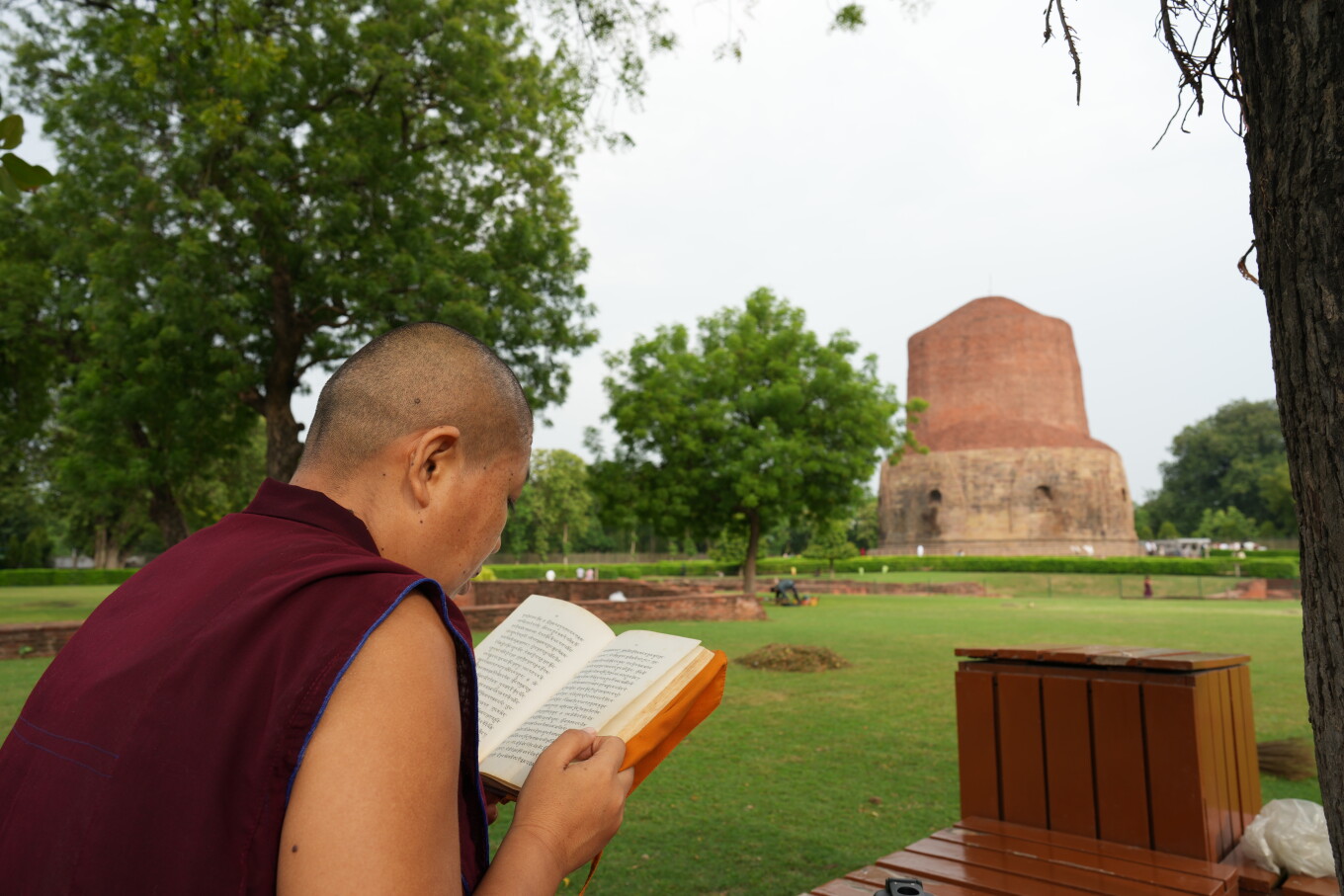
The current photographs also resist a purely bureaucratic reading. AP documented novice monks walking near Dhamek Stupa, worshippers reading and monks praying at Sarnath in the week before inscription.[7] Those scenes show a place already in use, not a dormant asset waiting for a global label.
Yet attention is not automatically protection. It can bring more visitors, new commercial pressure and demands for roads, lighting, parking, events and “beautification.” The Ministry's own statement pairs celebration with a commitment to manage tourism sustainably and prevent unplanned development in the buffer zone.[6] That promise should be treated as the beginning of the inscription story, not its closing quotation.
A short implementation clock
In the next 24 hours, official explainers and news coverage should publish the correct boundary: two component areas totaling 8.05 hectares, plus a 72.2-hectare buffer. They should also say plainly that UNESCO has not taken control of Sarnath. Accuracy now can prevent both triumphalist exaggeration and the false claim that an international body will run local land-use policy.[1][4]
In the next seven days, the Archaeological Survey of India, Uttar Pradesh and Varanasi authorities should publish a simple joint register for the six draft and advisory recommendations: lead agency, existing baseline, next milestone and consultation route. A public register would not require every study to be complete. It would show who owns each piece of follow-through.
In the next 30 days, authorities should disclose the scope and timetable for the carrying-capacity study, the heritage-impact-assessment procedure and the advisory role for religious and community stakeholders. They should also identify any proposed project inside the property, buffer zone or immediate setting that will be screened under that procedure. Where an adequate screen is not yet operational, approvals capable of affecting the site's listed values should wait.
Three paths are now visible.
The base path is recognition without a shared implementation clock. Existing conservation continues, visitor marketing accelerates, and the six recommendations remain scattered across agencies. The trigger is silence: no named leads, baselines or public milestones.
The upside path turns the listing into an accountability tool. Authorities publish the register, carry out impact review before—not after—project commitments, and make pilgrims, residents and religious institutions part of the management conversation. The trigger is documentary: accessible plans, assessments, consultation records and monitoring results.
The downside path treats the designation as a tourism brand first. New infrastructure and crowd growth arrive before capacity and archaeological questions are answered, while the surrounding landscape becomes less legible as sacred geography. The trigger is a project or visitor initiative advancing in the buffer zone or immediate setting without a published heritage-impact rationale.
These are scenarios, not forecasts. The current public record confirms the inscription and records the draft and advisory recommendations; it does not yet include a posted final 48 COM 8B.17 decision or establish which implementation path India will take.
The standard Sarnath should set
- Publish a readable boundary map and a live register of projects that may affect the property, buffer zone or immediate setting.
- Turn the six published draft and advisory recommendations into named workstreams with responsible agencies and milestones.
- Define carrying capacity through conservation, ritual use, visitor movement and community access—not ticket volume alone.
- Require heritage-impact assessment early enough to compare alternatives, and publish non-sensitive findings before approvals.
- Give Buddhist institutions, other religious stakeholders, residents, guides and local workers a documented advisory route.
- Report monitoring against the attributes that justified inscription, including setting and spiritual character as well as physical fabric.
The falsifier for this opinion is straightforward. If authorities can show that those systems are already operating across all six recommendations—with current baselines, responsible bodies and public evidence—then the implementation gap described here is too pessimistic and should be revised.
Until then, the proper response to Sarnath's inscription is celebration followed quickly by administration. The stones made the case for World Heritage. The way India manages the space around them will decide whether the title protects the place that gave it meaning.
Sources
- UNESCO World Heritage Centre, “Ancient Buddhist Site of Sarnath” — current property record for inscription year, criteria, serial status, component context, 8.05-hectare property and 72.2-hectare buffer zone.
- World Heritage Committee, Nominations to the World Heritage List, WHC/26/48.COM/8B, draft decision 48 COM 8B.17, pp. 33–36 and serial-property table — decision language, component areas, protection framework and six recommendations.
- ICOMOS, Evaluations of Nominations of Cultural and Mixed Properties, WHC/26/48.COM/INF.8B1, 2026, Sarnath evaluation — technical mission record, integrity and authenticity findings, management analysis and recommended follow-through.
- UNESCO World Heritage Centre, Convention Concerning the Protection of the World Cultural and Natural Heritage — Articles 4–7 and 13 establish primary state responsibility and the complementary international-cooperation and assistance framework.
- UNESCO, “Ancient Buddhist Site of Sarnath inscribed on UNESCO World Heritage List” (July 25, 2026) — official announcement, significance, two-component description and India's current site count.
- Government of India Press Information Bureau, Ministry of Culture, “‘Ancient Buddhist Site of Sarnath’ Inscribed in the UNESCO World Heritage List” (July 25, 2026) — nomination timeline, ASI role, government response, cultural-diplomacy case and buffer-zone commitment.
- Rajesh Kumar Singh, “The ancient Buddhist site of Sarnath that has been added to the World Heritage list, in photos.” Associated Press (July 25, 2026) — current photo essay and source page for the image of a worshipper reading before Dhamek Stupa.
- UNESCO World Heritage Centre, “What is a buffer zone in a World Heritage nominated property?” — distinction between an inscribed property and the complementary restrictions placed around it for protection and management.