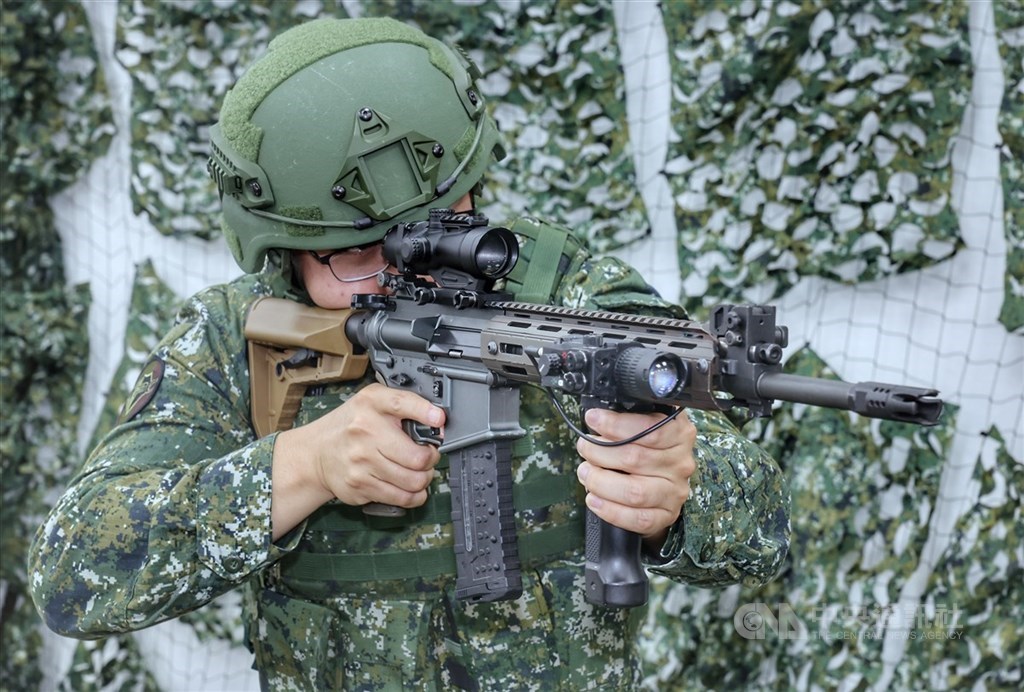
As of 2026-07-29 01:34 UTC, Taiwan has disclosed a new test inside its annual Han Kuang war games: the military plans to simulate moving production from the Armaments Bureau's 202nd Arsenal and from private defense contractors to rear-area sites after a notional attack. The live-force exercise is scheduled for August 5–14.[1][2]
The announcement matters because a factory can survive on paper and still fail as a supply system. Machines, tooling and personnel may reach another building while power, calibrated inspection equipment, approved materials, secure production data or transport links do not. The useful result will therefore not be that equipment moved. It will be whether an interrupted line can restart safely, produce an accepted item and feed it back into military maintenance or supply.
That result does not exist yet. Officials have described the exercise design, not its performance. Any claim that Taiwan has already proved a resilient wartime production network would run ahead of the evidence.
What is confirmed—and what is still missing
| Record | Confirmed fact | Confidence and boundary |
|---|---|---|
| Exercise schedule | Taiwan's Ministry of National Defense says Han Kuang 42's live-force phase will run continuously from August 5 through August 14.[1] | High. This is the official plan; dates and activities can still change. |
| Threat scenario | The exercise assumes that routine-looking Chinese military activity conceals preparation for a large landing operation, prompting rapid readiness, dispersal and mobilization measures.[1] | High on the scenario, not on probability. A drill premise is not a forecast that an attack is imminent. |
| Production relocation | Officials say the exercise will simulate relocating the 202nd Arsenal and private facilities responsible for “whole-system assembly” after attack, while continuing production from rear sites.[2] | High on stated intent. The public material does not name the private plants, products, alternate sites or target restart times. |
| Existing mobilization framework | Taiwan's mobilization agency says military-industry plans are meant to bring arsenals and civilian factories into expanded production and emergency repair, with annual exercises used to verify conversion.[4] | High on policy. A standing framework does not show that every designated plant can execute it under wartime disruption. |
| Legal basis | Taiwan's All-out Defense Mobilization Readiness Act authorizes a military-public-private production system, conversion contracts and participation by contracted defense factories in exercises.[5] | High on authority. The law establishes powers and duties; it does not supply a readiness score. |
The missing fields are the story. Neither the official briefing nor the first report provides a public measure for how long a line may remain down, what constitutes a successful restart, whether a complete production cycle will be attempted, or how output quality will be checked.[1][2] Some detail may properly remain classified. But without at least a bounded performance statement after the exercise, outside observers will be able to confirm movement—not resilience.
Why moving is easier than restarting
Industrial continuity is a chain, and the slowest missing link sets the pace. A machine tool without the right fixture is idle. A completed component without inspection is inventory, not usable supply. An assembly line without approved subcomponents can become an expensive waiting room.
Taiwan's published mobilization framework recognizes this systems problem. It covers not just factories but civilian transport, engineering equipment, emergency repair, dual-use parts standards and private-sector production capacity.[4] The mobilization law also requires the defense and economic authorities to survey production capacity and allows conversion arrangements with selected factories.[5] In other words, the August drill is not inventing public-private mobilization. It is supposed to test whether an existing administrative design can cross the gap into physical output.
There is recent precedent for calling civilian capacity into a Han Kuang scenario. A 2025 study by Japan's National Institute for Defense Studies records that Taiwan's July 2024 mobilization order authorized the military's weapons-production department to requisition civilian factories, alongside vehicles, heavy machinery and supplies.[3] The 2026 disclosure raises the public bar from requisitioning capacity to relocating it after a simulated strike and continuing production elsewhere.[2]
That distinction changes how the exercise should be judged. A convoy leaving a known site may be visually persuasive, but it proves only departure. The harder sequence is notification → personnel and tooling movement → utilities and data restoration → line setup → inspection → accepted output → delivery. A credible public after-action account need not reveal locations or sensitive production rates. It could still say whether the sequence was completed, which category of bottleneck dominated, and whether the exercise produced an item that passed the normal acceptance process.
There is another boundary. The 202nd Arsenal is only one disclosed node, and “whole-system assembly” is a narrow phrase.[2] Final assembly can stop when a small upstream supplier stops. The drill will say more about Taiwan's defense-industrial resilience if it tests a supplier chain and an emergency repair path, not simply a government arsenal and a large contractor at the end of the chain.
What changes over 24 hours, 7 days and 30 days
Next 24 hours: the announcement should be treated as a notice of test scope. Defense suppliers and relevant public agencies should verify their official points of contact, contractual responsibilities and continuity records through established channels. Editors should keep verbs in the future tense: Taiwan plans to test relocation; it has not yet demonstrated a restart.[1][2]
Next 7 days: Han Kuang begins on August 5. The first useful signals will be whether the relocation activity is integrated with the exercise's wider disruption scenario and whether officials describe a production or repair objective rather than a transport event.[1] Visible movement alone should not be scored as completion.
Next 30 days: after the exercise ends on August 14, the decision-grade evidence will be an official or independently reported after-action boundary: what process was tested, whether output restarted, what acceptance standard applied, and what class of problem remains. Exact sites, products and rates may stay undisclosed. A total absence of performance criteria would leave the central claim unverified.
Three possible outcomes
Base path — relocation works, production proof stays partial. The military and selected companies move people or equipment, establish alternate-site operations and identify coordination problems, but publish no evidence of a complete accepted production cycle. Trigger: officials confirm the relocation sequence and lessons learned while describing output only in general terms.
Upside path — the drill closes the loop. At least one line or repair cell restarts under the exercise conditions, completes a bounded task and passes its normal quality gate before the item re-enters the supply system. Trigger: a credible after-action account confirms restart, inspection and delivery without exposing sensitive locations or volumes.
Downside path — choreography outruns continuity. Movement occurs, but utilities, tooling, communications, inputs, safety controls or quality assurance prevent a timely restart. A second downside would be a drill so scripted that it never meaningfully tests those dependencies. Trigger: reported delays or safety failures, or an official account that documents movement while avoiding any production or repair outcome.
These paths are not predictions about a conflict. They are ways to judge a scheduled exercise against its own announced purpose.
A short action check
- Defense and industry managers: verify responsibilities through official mobilization arrangements, then record restart dependencies and exercise lessons without circulating sensitive operational detail.[4][5]
- Analysts: separate four different claims—authority exists, plans exist, relocation occurred, accepted output restarted. Evidence for one does not automatically prove the next.
- Editors: attach the August 5–14 dates and the “exercise scenario, not imminent-attack forecast” boundary to coverage.[1]
- Public officials: if security permits, report a bounded performance result after August 14—completion of the production or repair loop matters more than dramatic footage of equipment in transit.
- Invalidation condition: revise this brief if the production-relocation element is cancelled or materially redesigned, or if the exercise never attempts a restart or repair outcome. If officials later publish a defined success measure, use that measure instead of the provisional test proposed here.
Taiwan's announcement shifts attention to the right industrial question: not only whether weapons can be acquired or factories protected, but whether supply can continue after disruption. The August exercise will become evidence only when the line does more than move.
Sources
- Ministry of National Defense, Republic of China (Taiwan), “Reference materials for the Ministry of National Defense's fourth regular press conference of July 2026” (July 28, 2026) — official Han Kuang 42 schedule, scenario and exercise phases.
- Central News Agency / Focus Taiwan, “Taiwan to test relocation of weapons production in annual war games” (July 28, 2026) — disclosed facilities, rear-area production objective, exercise dates and source page for the archival cover photograph.
- Igarashi Takayuki, “Taiwan's Military Strategy and Preparations for Defense Operations,” National Institute for Defense Studies, East Asian Strategic Review 2025 — independent account of the 2024 mobilization order authorizing requisition of civilian factories, vehicles and supplies.
- All-out Defense Mobilization Agency, Republic of China (Taiwan), “The Executive Yuan Mobilization Committee” (updated July 28, 2026) — official framework for transport, supplies, civilian-factory conversion, emergency repair and dual-use standards.
- Ministry of National Defense Laws and Regulations Database, “All-out Defense Mobilization Readiness Act” — English legal text on public-private production preparation, conversion contracts and factory participation in exercises.