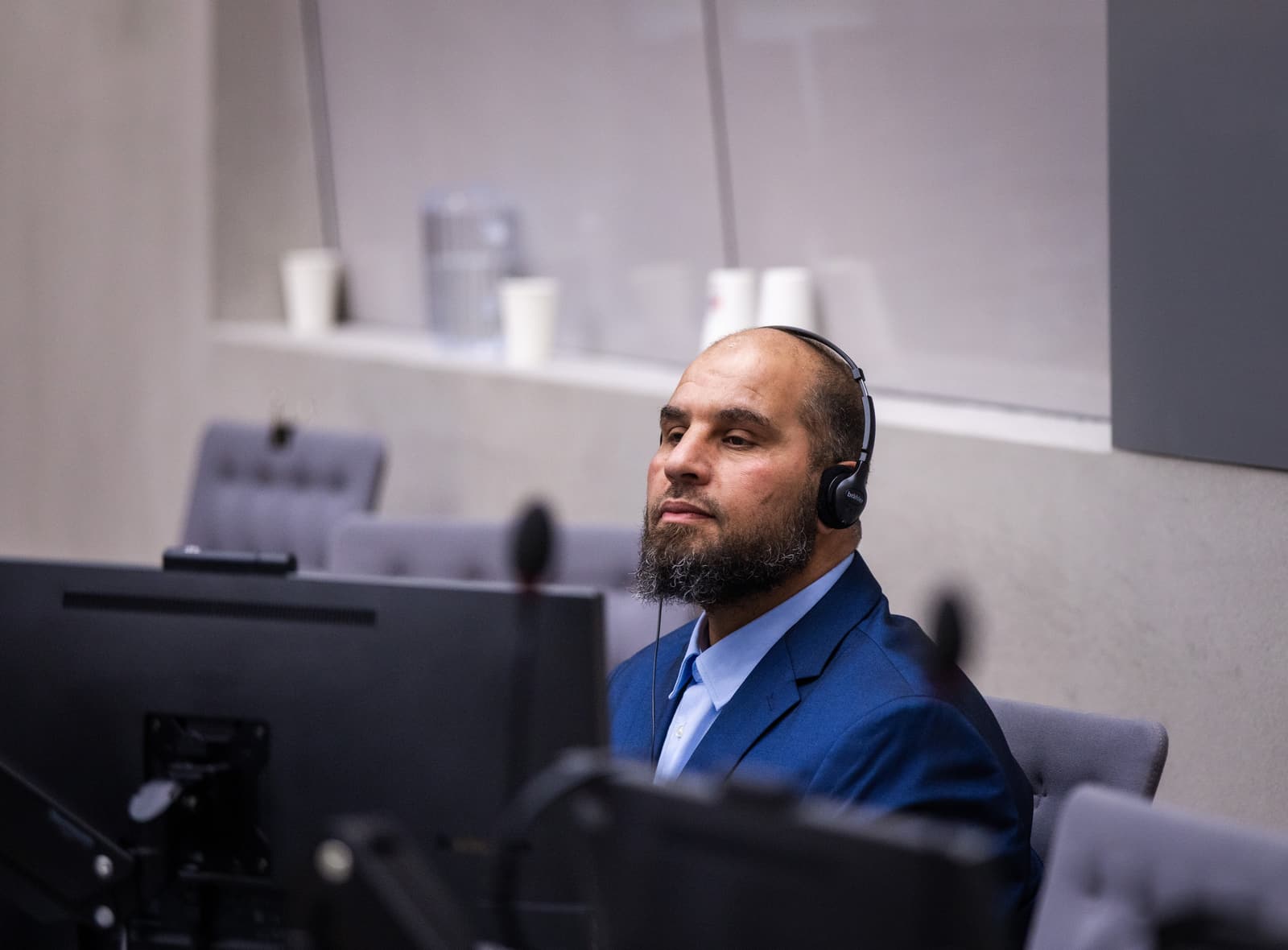
As of 2026-07-17 04:37 UTC, International Criminal Court judges have unanimously confirmed all 17 war-crime and crimes-against-humanity charges brought against Khaled Mohamed Ali El Hishri and committed him to trial. It will be the first ICC trial arising from the Court's Libya investigation, opened after the United Nations Security Council referred the situation in 2011.[1][6][7]
The milestone is larger than the biography of one alleged prison official. The confirmed charge sheet treats Libya's Mitiga Prison as an institutional system of detention and abuse. It expressly includes non-Libyan Africans among people allegedly enslaved and persecuted on national, racial and ethnic grounds. That matters because an earlier arrest-warrant decision had left migrant, refugee and asylum-seeking detainees at risk of falling outside parts of the case.[2][3]
My view is that the trial should be judged partly by whether it preserves that recognition: migrant survivors must remain visible in the evidence, outreach and participation process. That is not a request to relax the burden of proof. Confirmation is a pretrial finding of “substantial grounds to believe,” not a verdict, and El Hishri is entitled to the presumption of innocence and a fair trial.[2][7]
The Verified Record
| Date or record | What it establishes | Boundary that stays attached |
|---|---|---|
| July 16 confirmation decision | The three judges confirmed 17 counts covering imprisonment, torture, cruel treatment, outrages on dignity, other inhumane acts, rape, attempted rape and other sexual violence, murder and attempted murder, enslavement, and persecution.[1][2] | The finding sends the case to trial. It does not establish guilt beyond a reasonable doubt. |
| Evidence at the pretrial stage | The chamber says 63 people supplied witness statements, including 47 former detainees. It had authorized 64 victims to participate in the confirmation proceedings.[1][2] | Witnesses and participating victims are different legal categories, and neither total measures the full alleged victim population. |
| Migrant-specific findings | The decision confirms an enslavement count involving Libyan and non-Libyan detainees, including people from East, West, Central and Southern Africa, and a persecution count based on nationality, race or ethnicity.[2] | The decision uses the prosecution's defined term “Black Migrants.” It does not make every migrant a victim of every charged act, and victim and incident totals can change at trial. |
| July 15 jurisdiction decision | All three judges agreed the Court has jurisdiction. A majority relied on the 2011 Security Council referral; a concurring judge relied on Libya's 2025 acceptance of ICC jurisdiction through the end of 2027.[8] | Agreement on jurisdiction did not erase the judges' different legal routes to it; the ruling and any ensuing appeal remain separate from proof of the charges. |
| Next procedural step | The Presidency will assign the case to a Trial Chamber, which will set the next steps. No trial-opening date had been announced at the reporting cutoff.[1][7] | A transfer to trial is consequential, but it does not guarantee a quick timetable or a final judgment. |
The Case Changed Between Arrest And Confirmation
The most important development is easy to miss if the news is reduced to “all charges confirmed.” The scope of the alleged victim population was contested before the case reached this gate.
In May, the International Commission of Jurists examined the 2025 arrest warrant and identified a serious limitation. The pretrial chamber had linked war-crime protection closely to why a person was detained and had defined the civilian population attacked at Mitiga around perceived opponents of RADA, the Special Deterrence Force. Because many sub-Saharan African and foreign detainees were held over migration status rather than alleged allegiance in Libya's conflict, the reasoning could have excluded them from some war-crime and crimes-against-humanity allegations, participation, and eventual reparations.[3]
The arrest warrant was not the last word. Prosecutors revised the document containing the charges. They described the attacked civilian population more broadly and argued that Libya's non-international armed conflict gave RADA the authority, resources, strategic compound and institutional independence that made systematic abuse possible, regardless of the original reason for a detainee's arrest.[2][3]
The July 16 decision accepts the broader route at the confirmation standard. The chamber found that the conflict enabled RADA to consolidate control over Mitiga and Tripoli's security architecture. It concluded that international-humanitarian-law protection extended not only to people detained for conflict-related reasons but also to people arrested for other reasons because of the conflict's role in the prison system and the alleged conduct. Separately, it found substantial grounds for crimes against humanity directed against Mitiga detainees as a civilian population.[2]
That legal move does practical work. The decision says the prosecution alleged at least 176 detainees were enslaved and at least 173 were persecuted; the chamber confirmed those counts while warning that pretrial victim totals are provisional. Its analysis describes forced labour, control over movement and bodily autonomy, and compounding discrimination by race, nationality, ethnicity, gender, age and migration status. The confirmed persecution grounds include political, religious, national, racial, ethnic and gender grounds.[2]
This is why migrant inclusion is not a footnote to a “Libyan victims” case. It is part of the prosecution's theory of what the institution was and how power allegedly operated inside it.
A Trial Can Name A System Without Pretending To Try All Of It
There is independent evidence for treating Mitiga's migrant detention as more than incidental. A 2022 United Nations Panel of Experts report included an annex on the alleged enslavement of migrant detainees at Mitiga. It described testimony that migrants intercepted at sea were transferred from other detention sites into forced labour under Special Deterrence Force personnel. The July decision now places alleged racialized forced labour inside a count of enslavement and alleged targeting inside a count of persecution.[2][4]
The wider problem also extends beyond this defendant and beyond the charged period of May 2014 through June 2020. A February 2026 report by the UN Human Rights Office and the UN Support Mission in Libya documented a continuing countrywide pattern in which migrants, refugees and asylum seekers face arbitrary detention, torture, sexual violence, forced labour, extortion and trafficking. That report covered January 2024 through December 2025; it does not prove any allegation against El Hishri. It shows why the trial cannot responsibly be presented as a complete answer to Libya's migrant-abuse system.[5]
The distinction is essential. A criminal trial determines the responsibility of a named accused for charged conduct. It cannot substitute for closing arbitrary detention sites, changing migration law, protecting people intercepted at sea, or prosecuting every actor in a fragmented security network. Turning one case into a referendum on all Libyan detention would be unfair to the accused and disappointing to survivors.
But shrinking the story to one man's alleged acts would be the opposite error. Prosecutors charge El Hishri through direct, indirect and co-perpetration theories, as well as alternative forms of ordering, assisting or contributing to the alleged crimes. The institutional evidence is therefore part of how the case is built, not decorative background.[2]
What A Victim-Centred Trial Requires
First, the Registry and victims' representatives should make participation legible outside a Hague courtroom. Sixty-four people were authorized to participate at confirmation, while the Court's own decision refers to thousands allegedly detained. The gap does not show indifference: fear, trauma, death, displacement and security constraints can all prevent participation. It does show why safe referral routes, clear eligibility explanations and outreach through trusted Libyan and migrant-rights organizations matter.[2]
Second, language access must follow the affected population. Arabic interpretation protects the accused and many Libyan participants, but alleged victims came from multiple African regions and language communities. Public summaries, application guidance and secure contact information should reach those communities directly or through trusted intermediaries. “Open proceedings” have limited meaning if the people named in the charge sheet cannot understand how to follow or join them.
Third, states must treat cooperation as part of the evidence chain. Germany's arrest and surrender of El Hishri made this trial possible. Human Rights Watch contrasts that transfer with Italy's failure in 2025 to surrender another ICC suspect linked to Mitiga after arresting him.[6] The Court has no police force. Every unexecuted warrant turns accountability from a legal promise into a border-crossing lottery.
Finally, journalists and institutions should keep the two standards separate. The confirmation decision found enough concrete and tangible evidence to warrant a trial. The Trial Chamber must hear and test the case under a higher standard, including credibility challenges that a pretrial chamber cannot conclusively resolve on written statements alone.[2] Reporting the charges fully and preserving the presumption of innocence are compatible duties.
Decision Impact
Next 24 hours: coverage should use “charges confirmed” or “committed to trial,” not “convicted.” Reports should name enslavement and persecution alongside murder, torture and sexual violence, and should state that non-Libyan African detainees are part of the confirmed factual frame.[1][2]
Next 7 days: watch for the Trial Chamber assignment, any request for permission to appeal, and the first scheduling order. Victims' representatives and civil-society groups should publish plain-language guidance on what confirmation changes—and what it does not change—for people seeking participation.[1][3]
Next 30 days: the useful measure is whether the trial infrastructure becomes visible: a realistic calendar, disclosure and witness-protection arrangements, multilingual outreach, and a safe route for affected communities to ask about participation without exposing themselves. States should also report concrete action on outstanding cooperation requests rather than treating this one surrender as the end of the Libya file.[6]
Three Paths From Here
Base path — a narrow but real accountability case. The Trial Chamber preserves the confirmed scope, schedules proceedings, and tests the 17 counts over a long evidentiary record. Trigger: ordinary case-management orders appear, witness protections hold, and no authorized appeal materially narrows the charges.
Upside path — the case strengthens a wider accountability chain. Migrant and Libyan survivors can safely participate, outreach reaches displaced communities, states execute additional warrants, and national authorities preserve evidence for complementary cases. Trigger: transparent participation guidance, measurable state cooperation and additional lawful transfers to competent courts.
Downside path — recognition on paper, attrition in practice. Appeals or case-management decisions narrow the migrant-related theory, witnesses cannot participate safely, the timetable stalls, or states continue to ignore warrants. Trigger: material charges are removed, protection failures emerge, or long periods pass without a trial calendar and public explanation.
Action And Invalidation Check
- Keep alleged attached to the conduct and substantial grounds to believe attached to the confirmation decision.
- Track counts 13 and 16 in particular: enslavement and persecution on national, ethnic or racial grounds are the clearest migrant-specific legal anchors.[2]
- Ask the Registry how affected migrants outside Libya can obtain secure, multilingual participation guidance.
- Report participating-victim and witness totals accurately; do not treat either as the total number of alleged victims.
- Ask states what they are doing about outstanding ICC cooperation requests, not only whether they welcome the first trial.
- Keep the broader 2024–2025 UN findings separate from proof against this defendant; they establish context and continuing policy urgency, not guilt.[5]
- Revise this opinion if an authorized appeal or Trial Chamber ruling removes or materially narrows the migrant-related charges or contextual findings. Its assessment would also change if the Court publishes evidence that safe outreach and participation have reached the relevant displaced communities at meaningful scale.
The confirmation decision has done something the arrest-warrant stage had not: it has placed migrant detainees inside the legal account of Mitiga's alleged system. The trial's obligation is now double. It must keep those victims visible, and it must test every charge with the rigor owed to an accused who has not been convicted. Justice loses credibility when it chooses between recognition and due process. This case needs both.
Sources
- International Criminal Court, “ICC Pre-Trial Chamber I confirms all charges against Khaled Mohamed Ali El Hishri and commits him to trial” (July 16, 2026) — official result, next steps and witness counts.
- International Criminal Court, Decision on confirmation of the charges against Mr Khaled Mohamed Ali El Hishri, ICC-01/11-01/25-143 (July 16, 2026) — evidentiary standard, contextual reasoning, migrant-specific findings, modes of liability and confirmed counts.
- International Commission of Jurists, “Libya: Questions & Answers on the El Hishri case before the International Criminal Court” (May 15, 2026) — arrest-warrant limitations, migrant-victim participation concern and the prosecution's revised charge theory.
- United Nations Security Council, Final report of the Panel of Experts on Libya established pursuant to resolution 1973 (2011), S/2022/427 (May 27, 2022), Annex 21 — testimony and findings concerning forced labour by migrant detainees at Mitiga.
- UN Support Mission in Libya and UN Human Rights Office, “Migrants in Libya victims of ‘violent business model’ of systemic violations and abuses” (February 17, 2026) — findings covering January 2024 through December 2025 and the continuing policy context.
- Human Rights Watch, “ICC: Landmark First Hearing in Libya Atrocity Case” (May 13, 2026) — first-case significance, cooperation record, other warrants, Libya's justice-system limits and source page for the December 2025 ICC-CPI courtroom photograph.
- Associated Press, “ICC judges order a Libyan suspect to stand trial on murder, rape and torture charges” (July 16, 2026) — independent confirmation, defence position and trial-timing boundary.
- International Criminal Court, “ICC Pre-Trial Chamber I confirms Court's jurisdiction in El Hishri case” (July 15, 2026) — jurisdiction ruling and the judges' distinct legal rationales.