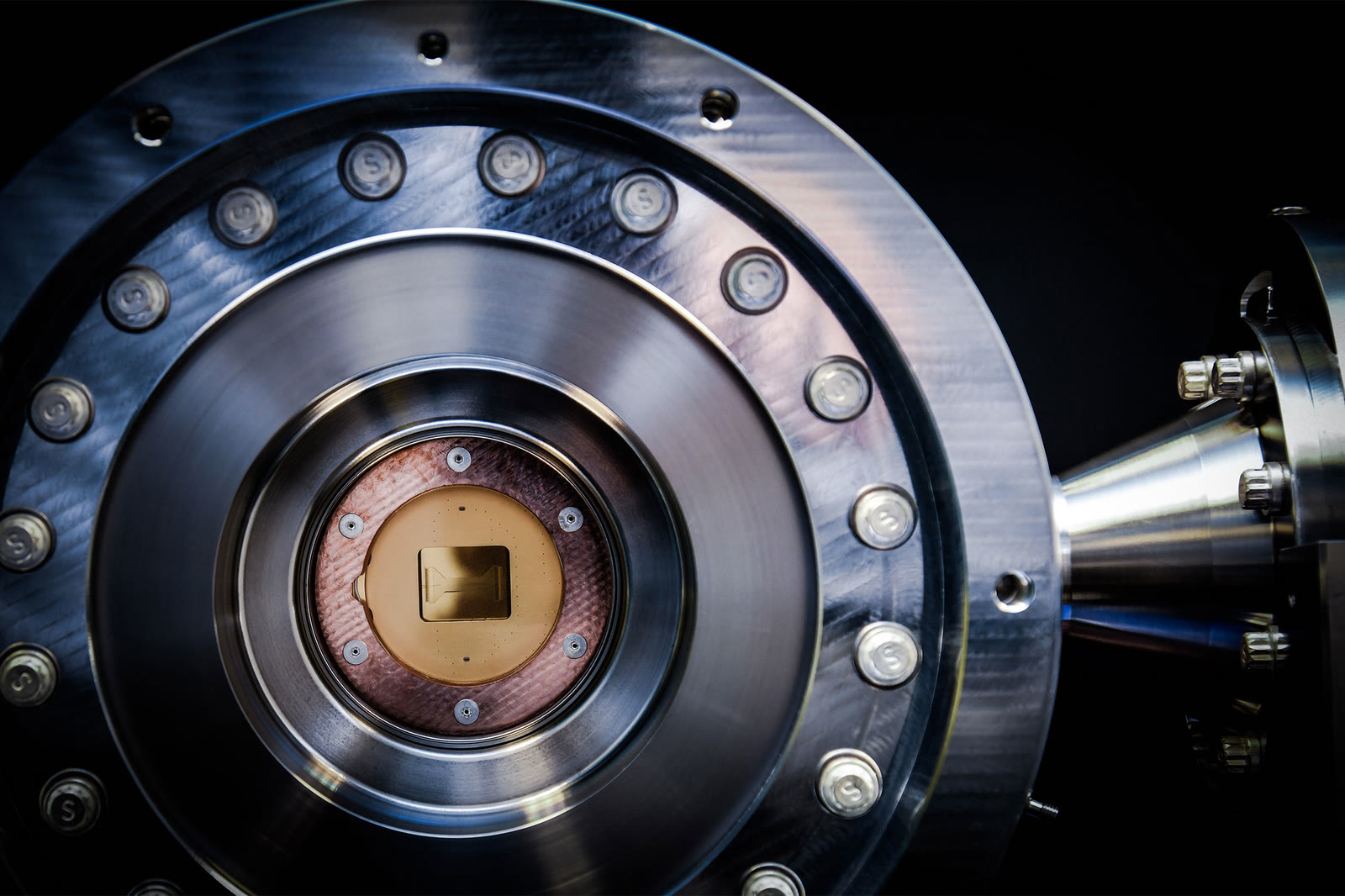
As of 2026-07-16 18:40 UTC, a paper published in Nature reports a new way to compute with engineered non-Abelian anyons on Quantinuum's H2 trapped-ion processor. The collaboration prepared a 54-qubit state, encoded information in the anyons' shared fusion space, and used both braiding and fusion to assemble a universal set of topological operations.[1]
“Universal” has a precise, narrow meaning here: the demonstrated ingredients are sufficient in principle to approximate any quantum operation in the scheme. It does not mean that the apparatus ran an arbitrary useful program fault-tolerantly, or that the experiment settled the cost of keeping logical errors below physical errors as a computation grows. The result is a proof of principle for a larger computational toolbox.
The immediate advance is therefore architectural. In a 2024 experiment on 27 qubits, researchers created and braided non-Abelian anyons in a different quantum-double model.[2] The new experiment moves to the smallest non-Abelian group, called S3, and adds fusion-based measurements that supply operations braiding alone cannot provide in this model.[1][3]
The Briefing File
| Signal | What the record establishes | Boundary to keep attached |
|---|---|---|
| Publication | Nature published “Universal gates from braiding and fusing anyons on quantum hardware” on July 15, 2026.[1] | Publication establishes that the work passed Nature's peer-review process, not that every claim is independently confirmed or that the machine is production-ready. |
| Physical run | The team prepared the ground state of the S3 quantum-double model on 54 physical qubits of Quantinuum's H2 processor.[1] | The anyons are collective excitations engineered in a quantum simulation; they are not newly discovered fundamental particles. |
| Computational step | Braiding plus fusion enabled logical operations, readout and topological preparation of a resource known as a magic state.[1] | A universal gate set is a sufficiency result. End-to-end active error correction, deterministic throughput and useful scale remain separate tests. |
| Precedent | The 2024 H2 experiment used 27 qubits to prepare a D4 topologically ordered state and manipulate its non-Abelian anyons.[2] | The new work extends that experimental line; it is not the first laboratory creation or braiding claim. |
| Audit trail | The authors released experimental data and numerical-simulation code through Zenodo.[5] | Open artifacts make scrutiny possible, but independent reproduction has not yet accumulated around a paper published one day ago. |
Why Fusion Changes the Computation
An anyon is a quasiparticle: an excitation whose useful identity belongs to the collective quantum state rather than to one isolated hardware qubit. With non-Abelian anyons, exchanging—or braiding—the excitations can change the encoded state in an order-dependent way. Because the information is represented globally, small local disturbances should have less direct access to it. That is the attraction of topological quantum computation.[1][2]
The main gate primitives here, however, use an “absolute” encoding tied to a fixed origin. The authors call that origin an Achilles' heel because a local charge measurement there can leak logical information. A separately demonstrated “relative” encoding is designed to remove this weakness, though it brings additional protocol overhead.[1]
But protection and universality are different questions. The simplest non-Abelian anyon models do not provide every operation through braiding alone. A beautifully protected but incomplete instruction set cannot run a general quantum algorithm.
Fusion supplies the missing kind of move. When two anyons are brought together, their combined topological charge can have more than one possible outcome. Measuring that outcome reveals information about their shared state without reducing the operation to an ordinary readout of one physical qubit. The 2025 S3 circuit paper showed how topological-charge measurements could complement braiding to form a universal circuit set; its interferometric construction aimed to avoid literal fusion.[3] The 2026 experiment realizes the needed charge-measurement primitives through braiding and fusion on hardware.[1]
The magic state is the key bridge. In quantum computing, “magic” names a specially prepared resource state that promotes an otherwise restricted operation set to a universal one. The experiment uses the completed primitive set to topologically prepare and certify a qutrit magic state. It does not teleport or consume that state in a gate-injection protocol.[1] Creating the state nevertheless illustrates the added non-Clifford computational power and addresses the known ceiling of braiding in the selected model.
Four Claims That Should Stay Separate
A universal gate set is not a universal-computer benchmark. The experiment demonstrates the necessary operation types on an encoded state. It does not report a long, application-scale algorithm protected throughout by active error correction. Some branches are heralded or post-selected, so their acceptance probability and the cost of retrying matter alongside the fidelity of accepted results.[1]
The paper reports a 26.52% charge-post-selection acceptance rate for the magic-state sample. In a separate relative-encoding benchmark, the selected outcomes had about 11.5% acceptance and total acceptance after heralding was about 6%.[1] These are protocol-specific figures, not one system-wide success rate.
Topological encoding is not zero-error hardware. H2 remains a physical trapped-ion processor. Its ions are moved through a racetrack-shaped quantum charge-coupled-device architecture so pairs can be brought into gate zones for operations.[4] State preparation, transport, gates and measurements can all introduce errors. Topology changes how information and errors are organized; it does not repeal the noise budget.
Fifty-four physical qubits are not fifty-four topological logical units. The physical qubits cooperate to realize the lattice and its global fusion space. Quoting the hardware count as though every qubit independently carried a protected logical variable would overstate the usable capacity.[1]
A simulated phase is still an experimental result. The non-Abelian topological order is engineered through gates on programmable hardware rather than obtained as a naturally stable material sitting in a refrigerator. That makes the system controllable and measurable, but it also means circuit depth and preparation fidelity are part of the resource bill. Calling the anyons “engineered” or “simulated” clarifies the platform without making the observed many-body behavior fictitious.[1][2]
What to Watch Next
The most informative follow-up is not another universality label. It is evidence that the topological layer improves as the experiment becomes harder.
First, look for repeated logical operations with a complete accounting of preparation, heralding, discarded runs and feed-forward. A useful comparison reports the success probability of the whole procedure, not only the fidelity after unsuccessful branches have been removed.
Second, look for scaling. More physical qubits should permit larger code distances or more encoded operations, and those additions should reduce the relevant logical error rate rather than merely make the circuit longer. The 2025 construction discusses routes toward local error correction, but a theoretical route and an experimental threshold demonstration are different milestones.[3]
Third, look for active decoding during a computation. The paper separately tests an adaptive ground-state-preparation circuit with mid-circuit measurement, feed-forward and conditional correction based on stabilizer outcomes; that is not active decoding of a universal computation.[1] This distinction is the cleanest defense against both dismissal and hype.
Finally, look for replication beyond one data set and one processor configuration. The released Zenodo package gives other researchers a concrete audit target.[5] Independent analysis can test how analysis choices and post-selection filters affect the reported logical behavior; unshared hardware-calibration details remain outside that audit.
Decision Horizon
Next 24 hours: editors, investors and research offices should describe the result as a hardware demonstration of a universal gate set using engineered anyons. Claims that a topological universal computer has arrived should be corrected. Claims that this is “only theory” should also be corrected: the gates, fusion measurements and magic-state procedure were run on H2.[1]
Next 7 days: technical readers should inspect the public data and code, with particular attention to which results are deterministic, which are conditioned on measurement outcomes, and how physical noise propagates into the encoded observables.[5] Hardware buyers should not infer a new commercial capability from the paper without a separately published performance specification.
Next 30 days: the field should converge on a resource-accounting template for follow-up experiments: physical qubits, encoded dimension, circuit depth, acceptance rate, logical fidelity, decoder assumptions and total shots. That would make a future scaling result comparable across topological models and processors instead of leaving “universal” to do too much rhetorical work.
Three Paths From Here
Base path — a stronger experimental toolkit. The paper becomes a reference implementation for combining non-Abelian braiding with fusion measurements. Other teams reproduce parts of the protocol, while useful fault-tolerant computation remains a longer program. Trigger: independent analyses agree with the published logical operations, but error suppression with increasing system size is not yet shown.
Upside path — topology begins to pay its engineering bill. Larger experiments add active decoding and repeated universal operations while logical errors fall as protection grows. Trigger: a transparent, end-to-end comparison shows that the encoded procedure outperforms an appropriate unencoded baseline after preparation and post-selection costs are included.
Downside path — overhead outruns protection. The state can be prepared and its gates verified at today's scale, but added qubits and deeper adaptive circuits make successful runs too rare or noisy. Trigger: acceptance or logical fidelity deteriorates with scale, or the apparent advantage depends on increasingly aggressive filtering of experimental shots.
Action Checklist
- Preserve the phrase universal gate set; do not shorten it to “universal computer.”
- State that the non-Abelian anyons are engineered collective excitations on a trapped-ion quantum processor.
- Separate the 54 physical-qubit lattice from the smaller encoded fusion space.
- Report heralding and post-selection costs beside accepted-run fidelity in every follow-up.
- Ask whether logical error falls as protection grows, not simply whether a larger state can be prepared.
- Treat open data as an invitation to reproduce the analysis, not as independent confirmation by itself.[5]
- Reassess commercial-readiness claims only when a complete, actively corrected workload and its resource cost are published.
The brief's central finding would need revision if the paper is corrected or retracted in a way that removes either the demonstrated fusion operations or the universality of the combined gate set. Its significance would be weakened—not erased—if independent reanalysis finds that conditioning costs or noise prevent the protocol from improving with scale. Until those tests arrive, the defensible conclusion is specific: fusion has expanded what engineered non-Abelian anyons can do on quantum hardware, while a fault-tolerant computer remains future work.
Sources
- Nature, “Universal gates from braiding and fusing anyons on quantum hardware” (15 July 2026) — 54-qubit S3 experiment, braiding and fusion protocol, logical operations, magic-state preparation and limitations.
- Nature, “Non-Abelian topological order and anyons on a trapped-ion processor” (14 February 2024) — 27-qubit D4 predecessor experiment and its preparation and braiding results.
- npj Quantum Information, “A universal circuit set using the S3 quantum double” (3 July 2025) — theoretical construction for measurement-assisted universal operations and prospective error-correction route.
- Quantinuum, “H2 Operation” — official description of the H2 trapped-ion QCCD architecture, transport system and gate zones.
- Zenodo, “Supporting Data and Code for ‘Topological Quantum Computation with S3 Quantum Double in Trapped Ions’” — public experimental data and numerical-simulation code associated with the 2026 paper.
- Harvard Gazette, “Harvard physicists make a new phase of matter” (20 February 2024) — institutional account of the predecessor experiment and source page for the archival H2 chamber photograph.