As of 2026-08-09 00:46 UTC, the United Nations was marking the International Day of the World’s Indigenous Peoples with a theme centered on one health workforce: “Honouring Indigenous Midwives: Safeguarding Life and Well-being.” At the same time, the World Health Organization was accepting comments on the third draft of its Global Plan of Action for the Health of Indigenous Peoples (2027–2040), with an August 24 deadline.[1][2]
Reading those two documents together exposes a small but consequential gap. The UN observance names Indigenous midwives repeatedly. WHO’s 16-page draft does not use the word “midwife” or “midwifery” once. It instead calls for culturally safe birth, Indigenous health workers, community health workers, traditional medicine providers, legal recognition, compensation and integration into multidisciplinary teams.[3]
That is a verified wording difference, not evidence that WHO intends to exclude Indigenous midwives. Much of their work plainly fits the draft’s broader categories. The problem is accountability: work that is celebrated by name in August can become difficult to count, fund or monitor when the policy vocabulary turns generic in September.
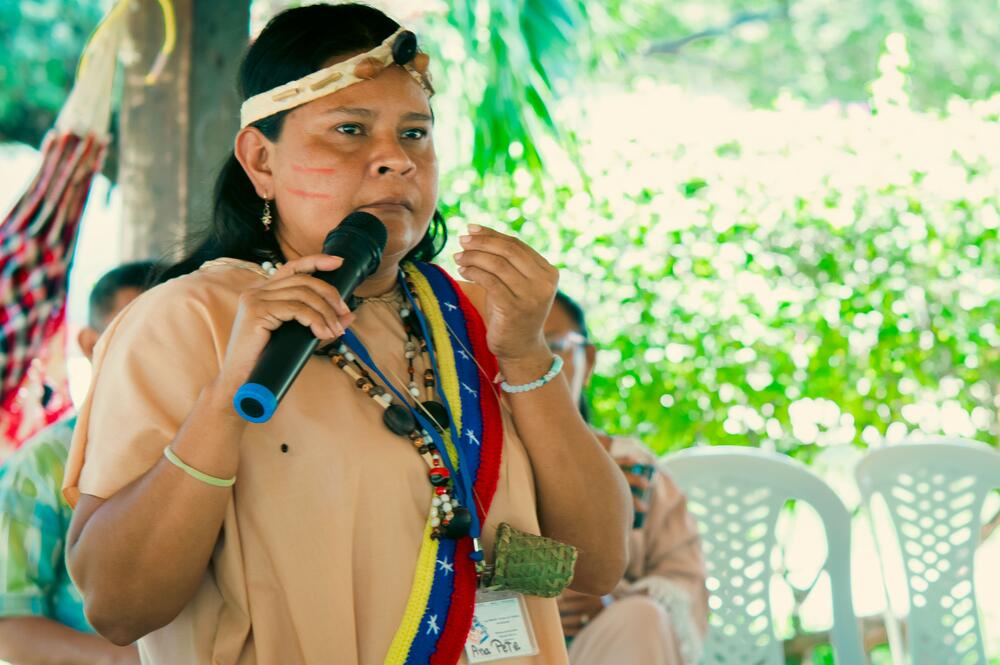
The distinction is visible in the cover photograph. Ana Edixa Pete, a Yukpa midwife from El Tukuko in Venezuela’s Sierra de Perijá, is speaking at a community gathering. UNFPA describes such exchanges as places where Indigenous midwives share knowledge with one another and press health personnel to respect traditional birth care.[11] “Traditional provider,” “community worker” and “midwife” can all describe part of Pete’s role. None captures the whole of it.
The paper trail
| Document and date | What it says | What remains unresolved |
|---|---|---|
| UN observance, August 9 | The 2026 theme presents Indigenous midwives as caregivers, knowledge holders and protectors of cultural continuity, while pointing to discrimination and weak recognition in formal health systems.[1] | The observance creates attention, not a budget, legal status, referral protocol or workforce measure. |
| WHO third draft, released at the end of July | The plan seeks Indigenous leadership, funded Indigenous services, culturally safe care, recognition of traditional providers and a larger Indigenous workforce. Comments are open through August 24.[2][3] | The draft does not identify Indigenous midwives as a workforce or implementation category. |
| WHO governing path, 2026–27 | WHO says a fourth draft is due to circulate in October or November, before Executive Board consideration in January 2027 and World Health Assembly consideration in May 2027.[2] | The text is not adopted policy. Its wording, indicators and resourcing can still change. |
| Colombian Pacific characterization, published July 29 | A community-linked survey identified 1,742 traditional midwives across 29 rural municipalities, including 624 Indigenous and 1,103 Afro-descendant practitioners.[7] | A count establishes visibility, not by itself fair pay, legal protection, training access or safe referral. |
How the wording check was done
The finding is reproducible. A case-insensitive text search of WHO’s official July PDF for the stem midwi returns no match. The relevant sections were then checked in context rather than treating the search result as the conclusion.[3]
The draft’s section 3.4 asks health systems to develop and retain Indigenous health workers and to recognize, compensate and integrate Indigenous community health workers and traditional medicine providers. Section 4.1 calls for non-stigmatization of traditional practices and respectful exchange with biomedical providers. Section 4.2 proposes integrated services backed by policy, law, quality assurance and funding. Section 5.5 supports women’s decision-making around culturally safe birth.[3]
Those provisions are substantive. They also explain why the absent noun should not be inflated into a claim of absent policy. A traditional Indigenous midwife may fit under “traditional medicine provider”; a licensed Indigenous midwife may fit under “Indigenous health worker”; another birth keeper may work under a community-specific title that should not be erased by either label. WHO is writing a global plan for many legal and cultural systems, under a stated 5,000-word ceiling.[3]
But umbrella language creates a second risk: everyone assumes somebody else is included. If national adaptation later reports only licensed clinical staff under “health worker,” traditional midwives may disappear. If it counts only informal birth attendants under “traditional provider,” licensed Indigenous midwives and community-led professional programmes may disappear instead.
The surrounding issue was already in the record
The missing word is not missing from the wider paper trail. WHO’s summary of seven Indigenous Peoples’ hearings, held from March 18 to 31 with 97 participants, records calls for traditional health providers to be recognized within maternal-health services. Participants also asked for Indigenous-led indicators, stronger accountability and sustainable finance; they raised terminology concerns—especially the word “stakeholders”—and asked for more explicit treatment of racial discrimination.[2][9]
The summary does not attribute each point to a named participant, and it does not say that every traditional maternal-health provider is a midwife. It does show that the draft’s umbrella categories sit on top of concrete concerns about recognition, funding, measurement and maternal care.
A February 2026 study transmitted to the UN Permanent Forum on Indigenous Issues is more direct. Its section on traditional medicine and midwifery describes Indigenous midwifery as part of intergenerational health governance and argues that related UN documents need to account for ancestral Indigenous community midwives, not only professional midwives.[10] The document was available months before WHO released its July draft.
That sequence does not reveal why WHO chose broader terms. It does make the naming question foreseeable rather than hypothetical: an Indigenous-focused UN study raised it, Indigenous participants raised the systems around it, and the current draft still leaves readers to infer where midwives fit.
A midwife is not merely a location in the system
The National Council of Indigenous Midwives in Canada offers one useful—not universal—test of what generic labels miss. Its competency framework spans prenatal, labour, postpartum and newborn care, but also culturally safe practice, rites of passage, communication, community wellness and development of the profession.[4] The point is not that a Canadian framework should be exported worldwide. It is that Indigenous midwifery combines clinical, cultural and governance responsibilities that a single employment category may not preserve.
The research record supports careful integration rather than romanticization. A 2025 mixed-methods systematic review included 35 studies of Indigenous women’s experiences and maternal or infant outcomes. It found more positive experiences where care was culturally safe and accessible, along with signals such as earlier prenatal care, more visits, less preterm birth or neonatal intensive-care admission, and more breastfeeding at discharge. Mortality, low birthweight and childbirth-complication outcomes were broadly equivalent to standard care in the included evidence.[5]
That review does not prove one Indigenous midwifery model will produce the same result everywhere. The studies crossed different countries, systems and definitions, and the authors identified a limited evidence base. WHO’s broader position paper likewise treats midwifery as a model of care that depends on continuity, interdisciplinary collaboration, competent practitioners, referral capacity and a functioning health system—not as an isolated substitute for emergency obstetrics.[6]
This boundary matters. Recognition without safety pathways can leave a midwife carrying clinical risk without transport, supplies or a receiving facility. Regulation without Indigenous authority can criminalize knowledge or demand credentials that communities had no role in designing. Integration without pay can turn “respect” into another unpaid obligation.
Colombia shows what becoming visible requires
The new Colombian Pacific dataset makes the accountability problem concrete. More than 3,700 surveys, conducted with community participation, identified 1,742 traditional midwives and another 1,977 knowledge holders who support the practice. Of the midwives counted, 89% were women; 826 were older than 60; 40% could not read or write; and 11% spoke only their own language. The project used 60 enumerators, 20 community facilitators and six language translators chosen through the participating ethnic authorities.[7]
Those figures should not be generalized beyond the 29 participating rural municipalities. Their value is methodological. The project did not begin with a hospital payroll and call it the workforce. It asked communities who practised, who carried related knowledge, what languages they used and what conditions shaped the work.
That approach also reveals why a global indicator labelled merely “number of health workers” would be inadequate. A useful midwifery measure needs distinctions: Indigenous identity, community recognition, legal or professional status where relevant, age and succession, language, compensation, referral access, place of practice and control of the resulting data. WHO’s draft supports Indigenous data sovereignty and Indigenous-led indicators.[3] Whether later monitoring actually names this workforce is still open.
The referral is where recognition becomes real
Xot’s Guatemala case supplies a quieter operational test. UNFPA’s account describes a midwife making monthly home visits, maintaining contact during pandemic restrictions and working within a national recognition policy. When her client’s baby was overdue, Xot recommended going to Roosevelt Hospital; the child was born there.[8]
That sequence refuses a false choice between ancestral practice and biomedical care. The midwife’s local relationship helped sustain prenatal care. Her referral moved the patient toward hospital capacity when the situation changed. The policy question is whether the system makes that handoff early, respectful and reversible: Can the midwife refer directly? Will the facility receive her information? Can she accompany the patient? Is she protected and paid for the work before and after transfer? Does the family retain language, ceremony and decision-making wherever clinically possible?
WHO’s draft contains the architecture for such a bridge—referral pathways, integrated services, cultural safety, workforce compensation and Indigenous leadership.[3] Naming Indigenous midwives would not build the bridge by itself. It would make it easier to see whether they are allowed onto it.
The redline to watch
The observance lands during an open part of WHO’s drafting calendar. Public comments are due August 24, consultation with permanent missions follows in September, and a fourth draft is scheduled for October or November.[1][2] That sequence turns the day’s ceremonial recognition into a document test.
The simplest repair would be an explicit reference to Indigenous midwives in the workforce or culturally safe-birth provisions, written broadly enough to preserve different community names and routes into practice. But inserting the noun would be cosmetic if later implementation cannot connect it to pay, supplies, Indigenous-chosen education, legal protection and a place in multidisciplinary teams.
WHO could instead retain global umbrella terms and publish a transparent mapping or annex. To be auditable, it would need to show which category includes Indigenous midwives, who decides whether a practitioner is recognized, how community and facility referrals work in both directions, and which indicators cover compensation and succession. It would also need to keep Indigenous Peoples in control of data about their workforce and outcomes.
When the fourth draft appears, the useful comparison will not be rhetorical prominence alone. It will be the revised language, indicator framework, financing provisions and any implementation mapping read together. A clear reference or an auditable mapping would narrow or erase the gap identified here. Continued silence across both text and measures would not prove exclusion from every national programme, but it would leave responsibility diffuse and comparisons unreliable.
The investigation’s boundary is narrow. It compares the official observance text with the third WHO draft available at the stated cutoff. It does not establish the intent of the drafters, audit every national midwifery law or treat all Indigenous birth workers as interchangeable. Revise the finding if WHO replaces the July PDF, publishes an authoritative mapping that names midwives, or incorporates a clear reference in the fourth draft. Until then, the record contains an unusual split: Indigenous midwives are the headline of the day and an inference inside the plan.
Sources
- United Nations Department of Economic and Social Affairs, “Honouring Indigenous midwives: Advancing rights, ensuring cultural continuity and promoting intergenerational well-being” (July 2026) — official 2026 observance theme and rationale.
- World Health Organization, “Global Plan of Action for Health of Indigenous Peoples” — consultation deadline, drafting chronology and 2026–27 governing-body timetable.
- World Health Organization, Third draft: Global Plan of Action for the Health of Indigenous Peoples (2027–2040) (July 2026) — official text reviewed for terminology, workforce, traditional-practice, birth, funding and data provisions.
- National Council of Indigenous Midwives, “Indigenous Midwifery Knowledge and Skills: A Framework of Competencies” — Indigenous-led account of the profession’s clinical, cultural and community scope.
- Deborah McNeil et al., “Indigenous maternal and infant outcomes and women’s experiences of midwifery care: A mixed-methods systematic review,” Birth 52 (2025) — review of 35 studies and evidence boundaries.
- World Health Organization, Transitioning to midwifery models of care: global position paper (October 15, 2024) — system conditions, continuity, collaboration and implementation context.
- UNFPA Colombia, “Characterization in the Colombian Pacific reveals the realities of 1,742 Indigenous and Afro-Colombian traditional midwives” (July 29, 2026, Spanish) — workforce count, community-led survey design and demographic findings.
- United Nations Guatemala, “El don de acompañar partos” (July 7, 2021, Spanish) — Rosa Lidia Xot Gómez’s home-visit and referral account and programme context.
- World Health Organization, Summary report: High-level synthesis of key considerations from Indigenous Peoples hearings (March 2026) — official record of calls on governance, accountability, finance, maternal-health recognition for traditional providers, terminology and racial discrimination.
- Geoffrey Roth, Restoring Indigenous health by connecting systems through the Indigenous determinants of health: local to global evidence, UN Permanent Forum on Indigenous Issues, E/C.19/2026/5 (February 5, 2026) — study section on Indigenous midwifery and explicit recognition in UN documents.
- UNFPA Latin America and the Caribbean, “Midwives of Latin America and the Caribbean: Saving lives on the front lines” (May 1, 2025) — Ana Edixa Pete’s profile, knowledge-exchange context and provenance for the UNFPA Venezuela cover photograph.