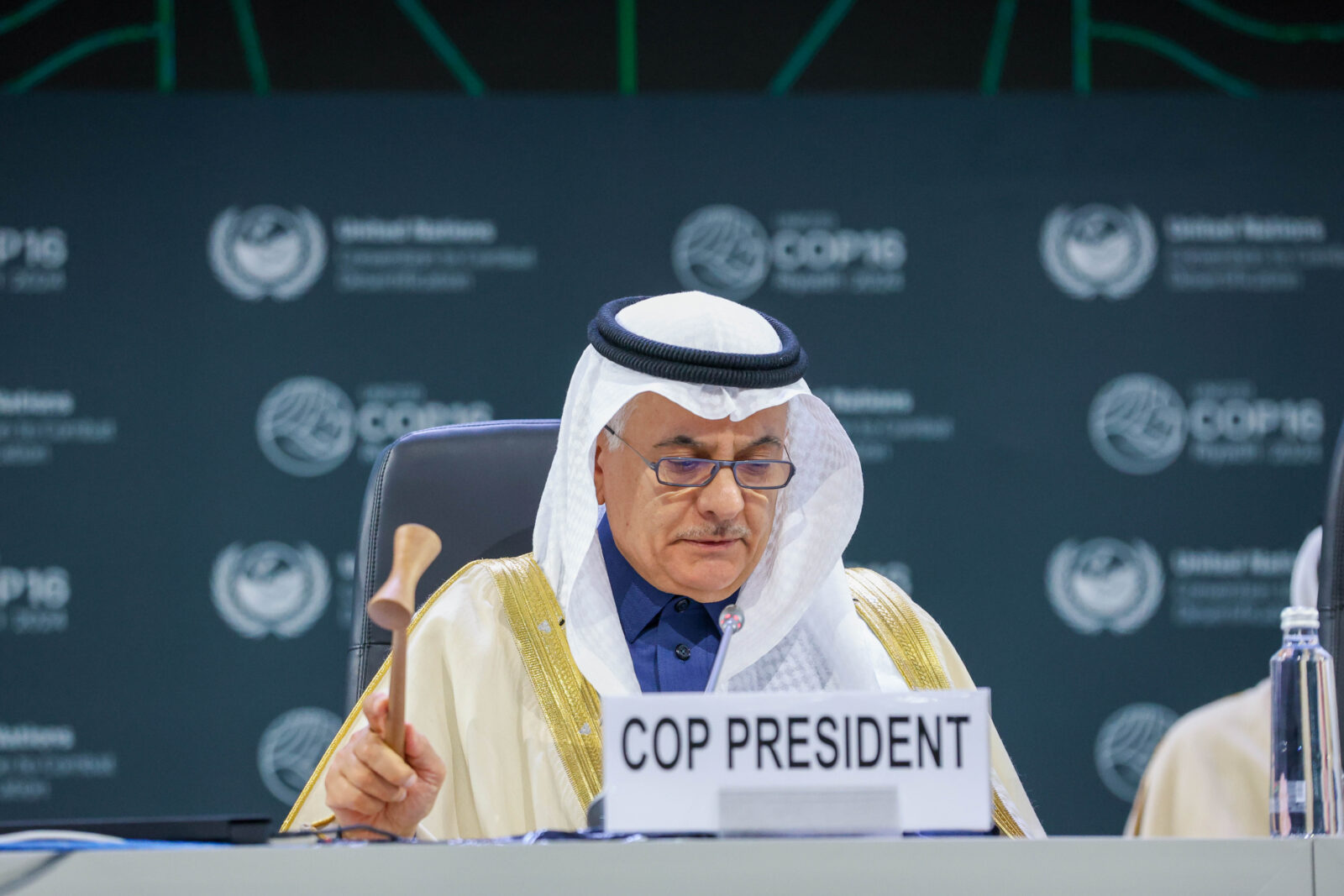
As of 2026-08-17 12:36 UTC, the scheduled opening day of the United Nations desertification convention's COP17 was under way in Ulaanbaatar. The two-week meeting brings together the UNCCD's 197 Parties, with drought resilience among the subjects carried into the formal negotiations.[1][4]
But the public pre-session draft does not contain a settled drought pact. Its central paragraph still asks delegates to choose among a “[global framework] [protocol] [XX]” and between a “[legally binding] [non legally binding]” instrument. It proposes another negotiating process aimed at adoption at COP18, rather than an instrument ready to take effect in Mongolia.[2]
That distinction is the story at the start of this summit. COP16 ended in Riyadh in December 2024 without agreement on the legal character of a global drought regime. Twenty months and three rounds of informal dialogue later, the same choice remains visible in square brackets.[3][5] This is an investigation of the published text, not a claim that COP17 has already failed: negotiations have only begun, and a new revision could change the record at any time.
What the public record establishes
| Record | What it shows | Confidence boundary |
|---|---|---|
| Opening day, August 17 | The official journal scheduled an opening ceremony, the first COP meeting and initial committee sessions in Ulaanbaatar.[1] | High on the schedule; limited on outcomes. The journal is a programme, not a live record of decisions taken. |
| Draft decision, document ICCD/COP(17)/12 | Paragraph 2 retains alternatives for the instrument's name and legal status, while aiming for adoption at COP18.[2] | High on the published wording; provisional by definition. This is pre-session text and can be replaced. |
| Inherited timetable | The reproduced annex calls for a first working-group meeting in the first half of 2025 and later asks for a report to COP17.[2] | High on what the document says; not a future schedule. The document expressly identifies the annex as text inherited from COP16. |
| National planning | The secretariat reports close to 75 national drought plans finalized, with 37 authorized by countries and published.[3] | High for the secretariat's July 2026 tally. It does not establish comparable implementation or spending in every country. |
| Finance initiatives | The Riyadh Global Drought Resilience Partnership was still being operationalized; a separate proposed investment facility targeted initial capitalization of $300–400 million and was anticipated for launch at COP17.[3] | Medium and time-sensitive. A target, launch or facility design is not the same as signed capital, deployed money or measured resilience. |
The unresolved paragraph carries three different disputes
The brackets are not a typographical loose end. They sit inside the operative sentence that would create the next negotiating body and define what it is supposed to deliver.[2]
First is legal character. A protocol can create binding duties for countries that join it, while a non-binding framework generally coordinates voluntary action. “Binding” alone would not guarantee finance or compliance, however; those depend on the obligations, reporting rules, review process, funding provisions, ratification and domestic implementation that the eventual text contains.
Second is accountability. The draft's possible content includes national drought plans, national reporting and periodic assessment, but several references to the future instrument remain placeholders. A title can be settled while its measurement system stays weak. The real accountability test is whether the final mandate identifies who must report what, against which baseline, on what timetable and with what review.[2]
Third is resources. Current opening-day reporting attributes the push for a legally binding instrument at COP16 to countries in the Global South, particularly African states; reporting from the close of that meeting identifies legal status—and protocol versus framework—as the divide that consensus did not bridge.[5][7][8] For drought-exposed countries, form and finance are connected: a planning duty without predictable technical and financial support can become another reporting obligation that poorer administrations are expected to carry.
The stale dates reveal what this document is—and is not
The draft contains a conspicuous time problem. It instructs the proposed working group to hold its first meeting in the first half of 2025, even though COP17 is meeting in August 2026. Near the end, it asks the Executive Secretary to report progress to COP17, the very conference now considering the text.[2]
Read alone, those clauses look impossible. Read with the introductory section, they make sense: COP17 is being asked to resume consideration of the consolidated draft left in an annex at COP16, and the old annex has been reproduced as the negotiating base. The dates are inherited, not evidence that a 2025 meeting secretly occurred.
They are still diagnostically useful. The published draft cannot become an operational decision unchanged. A genuine procedural breakthrough must do more than remove the words “XX”: it must update the timetable, decide or deliberately defer legal character, specify the working group's mandate and provide a route from negotiation to adoption. The first verifiable sign of movement will therefore be a revised document—not an opening speech saying that drought matters.
Action outside a treaty is real, but unevenly legible
The lack of a global instrument does not mean nothing has happened since Riyadh. The UNCCD says almost 75 national plans have been finalized. It has convened three Tafa'ul dialogue meetings, expanded technical learning networks and advanced finance vehicles. The latest policy report says 37 national plans are both authorized and published, while the Riyadh partnership was still in an advanced establishment phase.[3]
Those facts point in opposite directions. Countries do not need to wait for a protocol to build early-warning systems, assess vulnerability or budget for preparedness. Yet the gap between plans described as finalized and plans publicly available makes cross-country scrutiny incomplete. Likewise, a $300–400 million capitalization target for the proposed Drought Resilience Investment Facility is a useful ambition, but it should not be reported as cash raised unless closing documents identify investors, commitments and conditions.[3]
The urgency is not confined to conference language. The OECD estimates that 40% of the world's land faces increasingly frequent and severe drought, that the economic cost of an average episode has been rising by 3% to 7.5% a year, and that losses in 2035 could be 35% to 110% higher than today.[6] These figures do not prove that one treaty design is best. They do show the cost of confusing a negotiating process with delivered resilience.
What changes in 24 hours, seven days and 30 days
In the next 24 hours, the important evidence is procedural. The official journal places drought before the Committee of the Whole and schedules a closed contact group on “Other Matters”; the next test is whether the drought text moves into that group and whether a revised document or conference-room paper appears.[1] Observers should save each version with its publication time. A bracket removed from one paragraph can reappear as vaguer language elsewhere.
In the next seven days, compare revisions on four points: legal status, scope, reporting and finance. Check whether the obsolete 2025 timetable is replaced with dated meetings and whether participation by civil society and affected communities survives the edit. Announcements about new funds should be logged separately from the negotiated decision, with target capitalization, committed capital and deployed capital kept in different columns.
In the next 30 days, the controlling record should be the decision adopted by the close of COP17 on August 28, plus any dated work programme that follows. A communiqué, presidency summary or launch event may explain political intent; none substitutes for the adopted text. If no final decision is adopted, the absence itself is the result to record.
Three paths from Ulaanbaatar
These are conditional paths, not assigned probabilities.
| Path | What it would mean | Observable trigger |
|---|---|---|
| Base: a procedural bridge to COP18 | Parties create a named working process, repair the dates and preserve a COP18 adoption target, but avoid deciding now whether the eventual instrument is binding. | Final text establishes the body and timetable while omitting or deferring legal character. |
| Accountability upside: a defined binding pathway | Parties choose a legally binding route and pair it with a mandate covering reporting, assessment, finance and support for implementation. | Adopted text removes the legal-status alternatives, states concrete negotiating elements and funds a dated work programme. |
| Downside: another deferral without machinery | The summit repeats broad support for proactive drought management but fails to establish a credible route to an instrument. | The final text drops the negotiating body or deadline, retains only voluntary invitations, or is not adopted. |
The invalidation test
This investigation's headline premise is time-stamped. It is invalidated as soon as an official revision replaces document ICCD/COP(17)/12 and resolves the quoted alternatives. At that point, the new text—not this article—becomes the source of truth. A final COP17 decision would supersede every pre-session draft.
Until then, the shortest useful checklist is:
- Record the document number, revision label and publication time before describing “the deal.”
- Read the operative paragraphs, not only the preamble or a speaker's summary.
- Separate a working-group mandate from an adopted international instrument.
- Separate capitalization targets, announced commitments, signed capital and money deployed.
- Check whether revised dates, reporting rules, review and implementation support make the text executable.
COP17 began with broad recognition across its public record that drought is systemic, costly and worsening.[2][3][6] Its public negotiating text does not show equivalent agreement on the legal machine meant to organize a response. The test in Ulaanbaatar is whether delegates can turn inherited brackets into a current, financed and measurable mandate.
Sources
- UNCCD, “Journal: Monday, 17 August 2026” — scheduled opening ceremony, first COP meeting and committee programme for COP17's opening day.
- UNCCD, Draft decisions for consideration at the seventeenth session of the Conference of the Parties, ICCD/COP(17)/12 (2026) — reproduced drought annex, bracketed legal-form choices, proposed mandate and inherited timetable.
- UNCCD, Policy advocacy on drought, ICCD/COP(17)/11 (July 7, 2026) — national-plan tally, Tafa'ul process, partnership status and proposed investment facility.
- UNCCD, “17th session of the Conference of the Parties” — conference dates, participation scope and official COP17 framing.
- Sibi Arasu, Associated Press, “UN talks fail to reach agreement on dealing with rising risk of global drought” (December 14, 2024) — reported account of COP16's unresolved legal-status dispute.
- OECD, Global Drought Outlook: Trends, Impacts and Policies to Adapt to a Drier World (2025) — drought exposure and economic-loss estimates.
- Stéphane Foucart, Le Monde, “COP17 to Combat Desertification: Geographer Jean-Daniel Cesaro on why pastoralism matters” (August 17, 2026) — opening-day context and the continuing binding-instrument dispute.
- CGIAR, “Global action for land and people: Outcomes of the negotiations of UNCCD COP16” (December 18, 2024) — COP16 outcome context and provenance for Anastasia Rodopoulou's closing-plenary photograph.