As of 2026-08-17 17:40 UTC, Intuitive Machines had announced an authorization to begin work on a multi-satellite communications program with an anticipated value above $600 million. The customer was undisclosed. The company said it would use its IM 1300 platform to design, manufacture, integrate and support multiple spacecraft, while keeping the rest of the program confidential.[1]
The announcement confirms substantial work. It does not add a fresh $600 million to the public record on August 17.
Four days earlier, an earnings release filed with the US Securities and Exchange Commission had already described a signed contract for three commercial geostationary satellites worth more than $600 million.[3] More importantly, the June 30 quarterly filing says the company had already placed the program's estimated total value in its $1.762 billion backlog, based on a $45 million authority to proceed.[2]
That distinction is the useful news. The program is more than a sales lead, but its headline value is not the same thing as cash received, work invoiced, revenue recognized or even the full value of firm orders counted under the accounting definition of remaining performance obligations.
Four records, four different boundaries
| Public record | What it establishes | What it does not establish |
|---|---|---|
| August 17 announcement | An undisclosed customer authorized work on multiple IM 1300 communications spacecraft; anticipated program value exceeds $600 million.[1] | Spacecraft count, orbital slots, payload, launch dates, payment milestones, cancellation terms or how much work was newly authorized on August 17. |
| August 13 earnings release | The company described a signed $600 million-plus contract for three commercial GEO satellites and reported quarter-end backlog of about $1.8 billion.[3] | That all three satellites were firm orders under the accounting measure for remaining performance obligations. |
| June 30 Form 10-Q | A $45 million authority to proceed supported recording the estimated total program value above $600 million in backlog; about $587 million associated with the program sat outside remaining performance obligations.[2] | That the amount outside remaining performance obligations was already billable, collected or scheduled for recognition on a program-specific timetable. |
| SEC filing feed at the cutoff | The latest listed company filings were the August 13 Form 10-Q and Form 8-K; no August 17 Form 8-K was visible by this article's cutoff.[7] | Whether a later filing, customer disclosure or contract amendment will add terms after the cutoff. |
The records are not mutually exclusive. A customer can make a binding commercial commitment, authorize an initial tranche of work and leave later administrative or contractual steps before the whole expected program appears as firm performance obligations. Intuitive Machines says that is the situation here.[2] The missing terms are still consequential, because they determine how quickly an impressive backlog number becomes production activity, invoices and recognized revenue.
Why $45 million and more than $600 million can coexist
Intuitive Machines defines backlog more broadly than the accounting measure called remaining performance obligations, or RPO. Its June filing says backlog includes the revenue it expects from legally binding contracts or other binding customer authorizations, less revenue already recognized. Following its January acquisition of Lanteris Space Systems, the company revised this policy to cover the combined business's wider range of commercial arrangements.[2]
Management says it includes the total expected revenue when the customer has made a substantive commitment, the work and pricing are substantially defined, performance is authorized, and remaining steps are not expected to change the program's overall economics materially.[2] On that basis, dismissing the award as “only $45 million” would ignore the company's stated binding commitment and defined scope.
The opposite reading—treating the entire headline value as a newly firm, immediately monetizable order—is also unsupported.
At June 30, Intuitive Machines reported $814.7 million in remaining fixed-price performance obligations, compared with $1.762 billion in backlog. It attributed approximately $587 million of the difference to this multi-satellite program.[2] In other words, most of the program's estimated value was inside the company's backlog metric but outside RPO at the reporting date.
That is not an accusation that the backlog is fictitious. It is the company's disclosed measurement boundary. Backlog is a management estimate of future revenue under commitments it judges substantive; RPO is the remaining transaction price attached to firm orders under the revenue-accounting framework. The two measures answer different questions.
The filing gives recognition ranges for the entire backlog—roughly 25% to 30% expected during the rest of 2026, 35% to 40% during 2027 and the balance later.[2] Those percentages should not be applied mechanically to the satellite program. Intuitive Machines has not published a program-specific delivery or revenue schedule.
The hardware heritage is clearer than the order mechanics
The IM 1300 is not a paper spacecraft. Intuitive Machines says the platform's lineage begins in 1989 and that more than 95 of the large geostationary spacecraft are on orbit. The platform came into the group through Lanteris, formerly Maxar Space Systems, and is designed for high-capacity communications missions with configurable payload power, antennas and stationkeeping systems.[4]
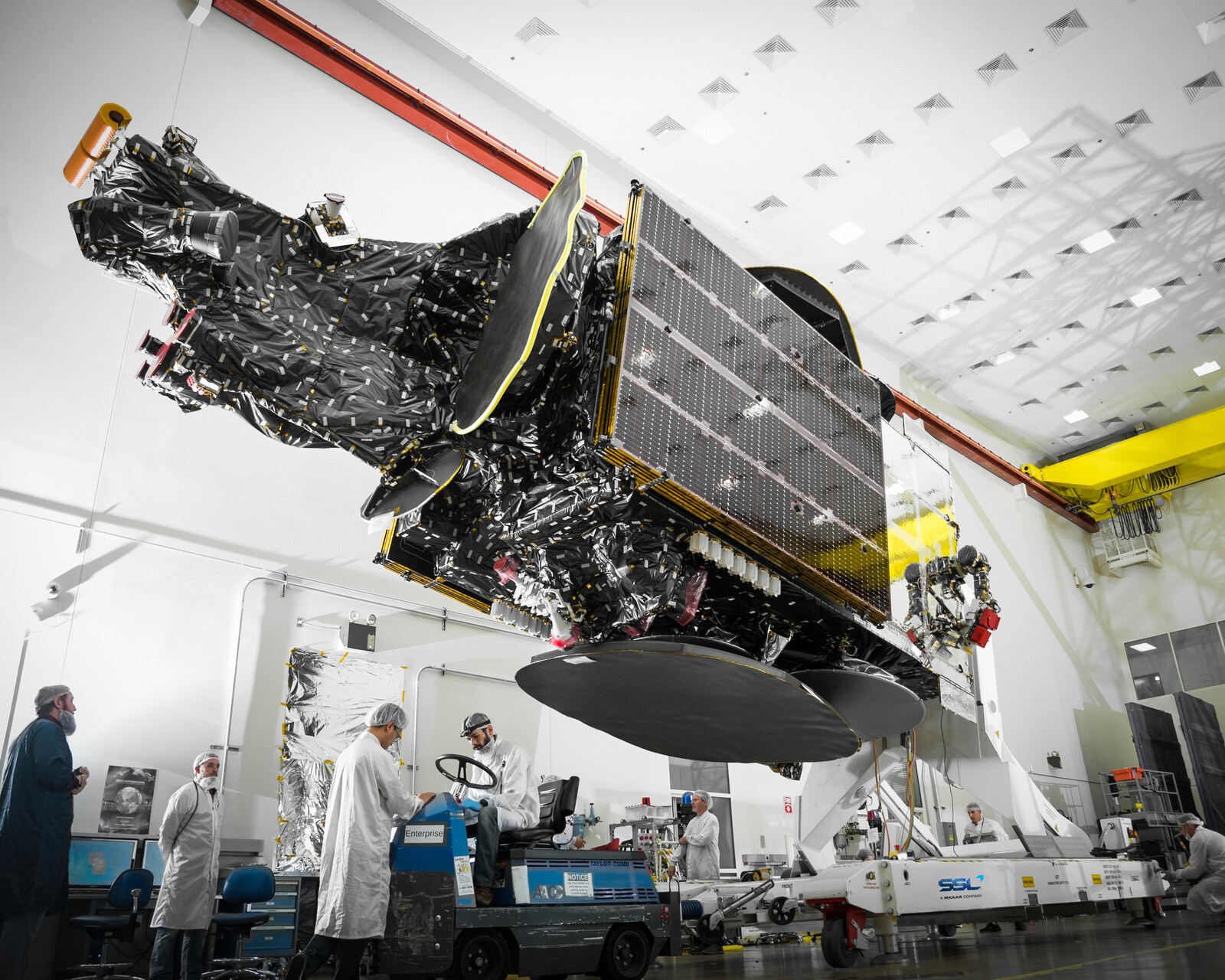
The cover photograph shows that heritage in physical form. Telstar 18 VANTAGE was built by SSL, then part of Maxar, and photographed during factory processing before its September 2018 launch.[5] Telesat's SEC filing identifies it as an SSL 1300 spacecraft operating at 138 degrees east.[6] The image is evidence of a real manufacturing line and flight-proven platform—not evidence of what the confidential customer ordered in 2026.
That boundary matters. The August 17 release does not identify the new spacecraft's payloads, power class, manufacturing stage or intended orbital locations. It would be irresponsible to reverse-engineer the customer from an older satellite photograph, the platform's past missions or online speculation. The right inference is narrower: Intuitive Machines acquired mature GEO manufacturing capability, and the customer selected that capability for a three-spacecraft communications program.[1][3][4]
Execution is now the harder question. Three large GEO spacecraft require long-lead components, payload integration, environmental testing, launch coordination and milestone acceptance. The 10-Q also warns that backlog can move with order volume, fulfillment speed, inventory availability, development work and manufacturing lead time.[2] A proven bus reduces platform novelty; it does not remove program, supplier or schedule risk.
What changes over 24 hours, seven days and 30 days
In the next 24 hours, reports and market commentary should label the number correctly. This is a public confirmation of a program already reflected in June 30 backlog, not evidence that backlog rose by another $600 million on August 17. Any claim about a new incremental booking needs a dated reconciliation from the company or a later SEC filing.
In the next seven days, the useful documents would be a Form 8-K, contract exhibit, updated investor presentation or customer statement that answers at least one open question: the newly authorized amount, milestone schedule, delivery window, program status or relationship between the $45 million initial authorization and the remaining estimated value. Confidential customer identity may stay protected; contract mechanics can still become clearer.
In the next 30 days, watch whether the company reports a larger authorization, a movement from backlog into RPO, material inventory commitments or a revised recognition schedule. None of those is guaranteed to appear monthly. Their absence would not cancel the program, but it would leave the same visibility gap in place.
Three conditional paths
| Path | What it would mean | Observable trigger |
|---|---|---|
| Base: staged authorization | The customer releases work in tranches while the company begins design and procurement under the existing authority. | A larger funded or firm order appears over time, with program backlog progressively moving into RPO and then revenue. |
| Upside: faster commitment and production clarity | The customer firms the remaining scope earlier and the company discloses a credible delivery cadence. | A filed order or company reconciliation moves most of the roughly $587 million program gap into RPO without reducing total economics. |
| Downside: scope or schedule erosion | Later steps take longer, the program is resized, or manufacturing constraints delay conversion. | A backlog adjustment, reduced estimated value, extended timetable or repeated lack of additional authorization in later filings. |
These are monitoring paths, not probability forecasts. The base path should not be mistaken for a prediction simply because it sits in the middle.
The invalidation test
This analysis should be revised if Intuitive Machines shows that the August 17 authorization is incremental to the program already recorded at June 30, rather than a public announcement of that same commitment. It should also be updated if a later filing moves the full value into remaining performance obligations, identifies materially different economics or reveals that the releases refer to separate programs.
Until then, the shortest useful checklist is:
- Keep $45 million authorized, more than $600 million estimated program value, about $587 million outside RPO and $1.762 billion total backlog in separate columns.[2]
- Do not add the August 17 headline value to June 30 backlog a second time.
- Do not treat backlog as cash, invoices or recognized revenue.
- Do not infer the customer or mission from earlier 1300-series spacecraft.
- Use the next filed reconciliation—not price action or anonymous speculation—to judge whether visibility improved.
The August 17 release matters because it ties Intuitive Machines' newly acquired GEO manufacturing heritage to a large commercial program. The SEC record matters more for interpreting the number. It shows a serious customer commitment and an initial authorization, while preserving a large gap between expected program value and accounting-defined firm performance obligations. Both halves belong in the headline.
Sources
- Intuitive Machines, “Intuitive Machines Selected for Multi-Satellite Communications Infrastructure Program” (August 17, 2026) — authorization, anticipated value, confidentiality boundary and IM 1300 scope.
- Intuitive Machines, Form 10-Q for the quarter ended June 30, 2026 (filed August 13, 2026) — backlog policy, $45 million authority to proceed, estimated program value, RPO reconciliation and recognition boundary.
- Intuitive Machines, second-quarter 2026 earnings release, Exhibit 99.1 to Form 8-K (August 13, 2026) — three commercial GEO satellites, quarter-end backlog and company outlook.
- Intuitive Machines, “IM-1300 Series Satellite” — platform lineage, on-orbit heritage and high-capacity communications capabilities.
- Maxar Technologies, “Advanced High Throughput Satellite Built by Maxar's SSL for Telesat Successfully Begins On-Orbit Operations” (September 10, 2018) — Telstar 18 VANTAGE context and cover-photograph provenance.
- Telesat, Form 20-F for 2021 — identification of Telstar 18 VANTAGE as an SSL 1300 spacecraft and its orbital position.
- US Securities and Exchange Commission, Intuitive Machines filing history — filing-status check at the article cutoff.